Let’s imagine how a day in Ancient Egypt could be spent, from the morning in which we get up and have breakfast with bread and beer, passing through the pastimes of daily life, such as banquets and entertainment, until the evening in which Nut, the goddess of the night, swallows the Sun. When we talk about Ancient Egypt we are referring to the civilization that developed along the Nile river, between the river delta on the Mediterranean Sea up to the border with present-day Sudan.
The beginnings of civilization are around 3900 BC, with the so-called predynastic period, and then evolved until the most recent period of ancient civilization, which ends with the Roman Byzantine period about 600 years after the birth of Christ. An evolution that saw Ancient Egypt flourish and transform, crossing the eras of the Old and New Kingdoms.
Dwellings in Ancient Egypt
The sun rises, and ancient Egypt awakens. Depending on your social class, you can live in a multi-storey house – in which, for example, officials, rich workers and traders, and personalities close to the pharaonic classes, such as scribes live – or in a single-storey house, which is usually reserved for workers of a more humble class.
In general, the homes of both the people and the aristocratic classes in the Egyptian period were not richly furnished: from the iconographic and written documents that have come down to us – the hieroglyphics, fortunately, have been deciphered thanks to the Rosetta Stone! – we know that the furnishings and furnishings are simple and essential in nature.
The majority of houses probably have a kitchen area with utensils, terracotta and metal pots, baskets and other objects dedicated to both storing and cooking food. Then there is an area that could be similar to our living room, with seats and small furnishings, and then what could be the sleeping area, with separate bedrooms for men and then for women and children.
Having breakfast, dressing and putting on make-up at the time of the Pyramids
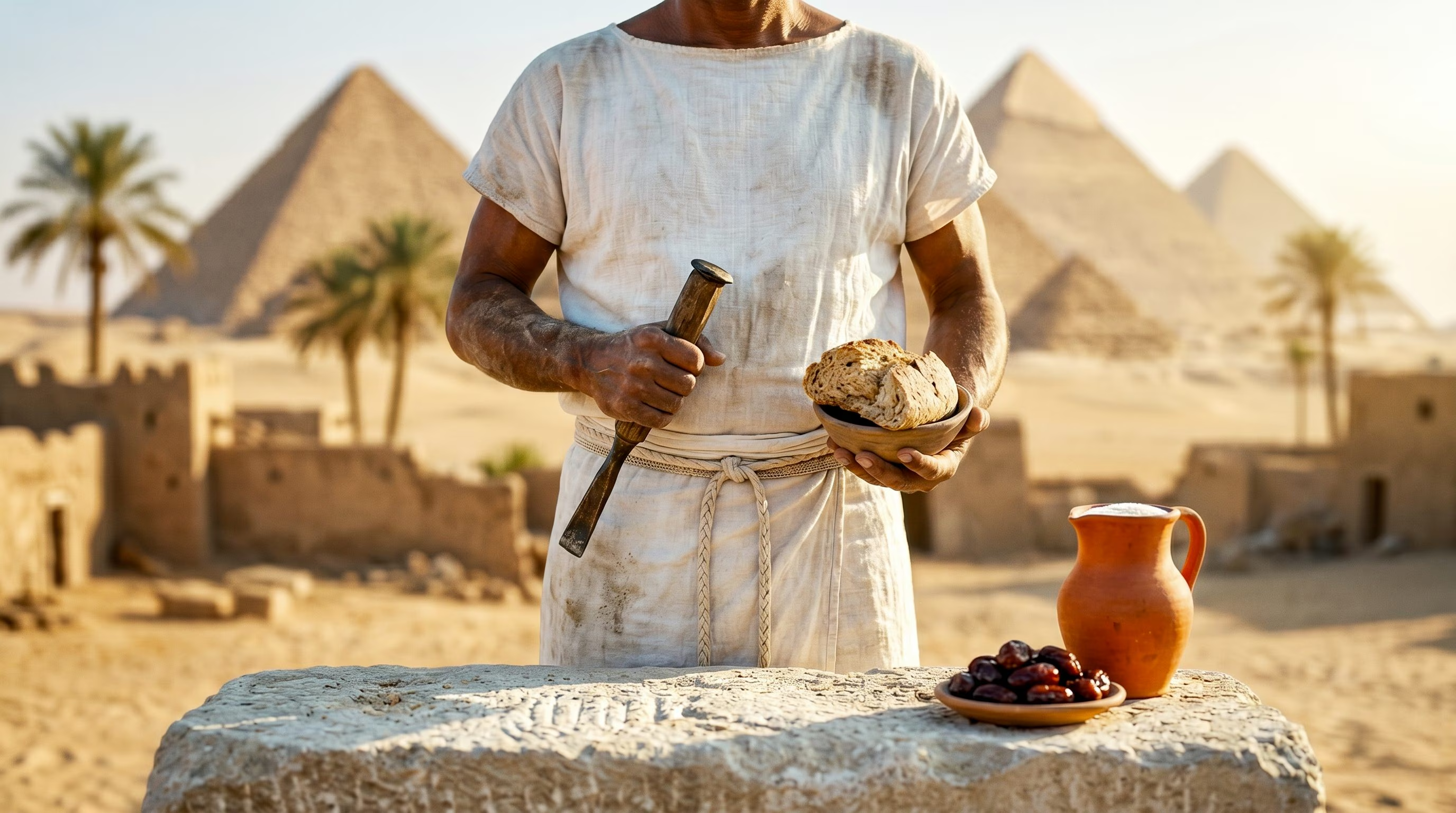
Everyone, therefore, begins the day in the type of home and area of the city that suits their role in society and their work, and is ready to have breakfast. As? With a meal that could be based on bread, perhaps stuffed with fruit: we know that the ancient inhabitants of Egypt consumed bread and cereals both thanks to the documentation received and based on the study of the teeth and the type of chewing.
Furthermore, a project developed by the Egyptian Museum of Turin tells of how the Egyptians prepared desserts with fruit, raisins, honey, figs, dates and carobs, used as a sweetener. Another food consumed in the early hours of the day by the Egyptians is beer, made from barley, which together with grape and date wine accompany the dishes.
It’s time to get dressed: what we know about “fashion” in this historical period is that great importance is given by the wealthy classes to jewels but much less, in all social classes, to the dress itself. Generally clothes are similar for both genders and their goal is to cover, but remain fresh and light. Men in particular wear the chendjita sort of loincloth, with a scarf wrapped around the hips and cinched at the waist by a belt, which in the period around 1400 BC was integrated with a light tunic or shirt. The female dress is made of very fine muslin, which remains almost unchanged throughout the Egyptian period. Great importance is then given to make-up and cosmetics, which have a cultural and religious value rather than a purely aesthetic one.
Going to work in 3000 BC
Society is full of roles: farmers, hunters, fishermen, traders, artisans, goldsmiths, potters, but also architects, embalmers, doctors, astronomers, great scholars. And then obviously the scribes, the officials, the religious community, and all the entourage that gravitates around the king, the Pharaoh, and his women and children. Ancient Egypt is a world rich in knowledge and skills, and the variety of professions is very varied throughout the period of the dynasty. It is very important to consider that social classes, in ancient Egypt, are not organized by conditions of birth, but according to the career path undertaken and therefore the service performed in society.
The Egyptian workers, depending on their work, could reside in the large cities – Memphis, Luxor, Aswan, Alexandria, Thebes, Abydos just to name a few -, but also in something that may resemble what later became the “workers’ villages”, or sites near the city where workers, laborers and designers resided for the period necessary to carry out the work. Evidence of this type comes to us from the village of Deir-el-Medina, near Luxor, where artisans and workers lived around 1500 BC: the archaeologist who found the first traces of this area was Ernesto Schiaparelli, an Egyptologist who also directed the Egyptian Museum in Turin. A precious document that emerged from the village of Deir-el-Medina is also a papyrus where there is talk of a sort of workers’ strike, due to the suspension of food rations due to the economic and political difficulties of that period.
Another interesting element to consider is that in ancient Egypt there is no currency, but work is paid with donations, exchanges and supplies: the first coins appear in fact from 400 BC. C.
In ancient Egypt people also went to school (but only after 2000 BC)
The education of young people is considered very important: the school, founded to train the scribes, the intellectual class of the country, was born around 2000 BC and, today, we can consider that literacy in ancient Egypt was very widespread. We have testimony of a text – The satire of professionspapyrus preserved in part to British Museum of London – in which a father accompanies his son to school and, while walking, comments ironically on the different jobs he sees them doing. In the end he concludes that the scribe is the profession considered absolutely the best: by studying and undertaking a career of profound culture one can, in fact, reach the heart of the royal palace, and live and work in the presence of the Pharaoh.
In the morning, therefore, the students go to school, bringing with them some bread for a snack, and learn classical and hieratic hieroglyphic writing, in cursive version, read texts and anthologies, and prepare themselves comprehensively on broad-spectrum historical, scientific and cultural themes and aspects.
Egyptian games and celebrations
In their free time, Egyptians are very happy to dedicate themselves to fun, games and the arts. During aristocratic banquets there is musical entertainment and dancing, but all social classes have their own entertainment: board games (including seneta kind of checkers, which is still played today) tug-of-war, running, swimming, athletics, but also wrestling and juggling tournaments. There are also traces of children’s games, such as dolls and mechanical games with moving parts. An activity widely practiced by children is the game of astragalus (concave sticks to be thrown in the air) which contrasts with that of dice, reserved only for adults.
The holidays were frequent: for example that of Heb-Sed in which the thirtieth year of a King’s age is celebrated, or the festival of Opet, in which Amon, the ram god of Thebes, is worshiped, to which are added astronomical holidays, including the New Year itself, which corresponds to the rising of a star taken as a reference.
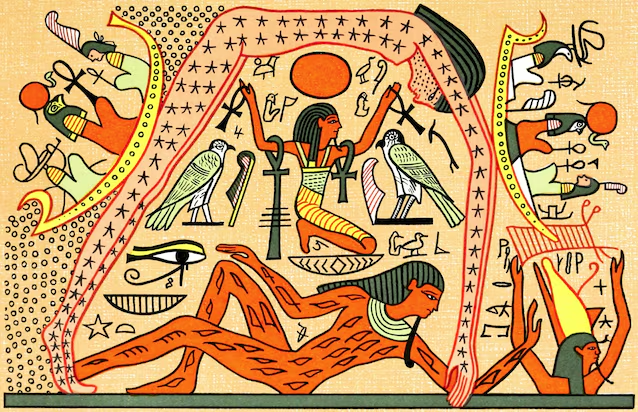
How could a day in ancient Egypt end? Returning to one’s home, the royal palace, or the harem of the pharaoh’s wives, or one’s humble home as a slave and waiting for Nut, the goddess of the night, to swallow the Sun every sunset and then generate it again at dawn.