The Venice Biennale is one of the most prestigious and oldest cultural institutions in the world, founded in 1895 to promote contemporary art. Today it is active in the world of art, architecture, music, dance, cinema and theater with events (i.e. exhibitions, shows, films, installations) including the Mostra Internazionale d’Arte Cinematografica, the oldest cinematographic event in the world, founded in 1932.
In addition to it and the exhibitions dedicated to art and architecture, the Biennale also organizes international music, dance and theater festivals, each of which awards, among other awards, the prestigious Golden Lion. At the 2026 Art Biennale, however, they will not be awarded with the usual methods: due to the resignation of the entire jury a few days before the inauguration, which came after the controversy over the participation of Russia and Israel, they will in fact be awarded through the visitors’ vote, in November.
The Biennial dedicated to figurative art
Among the biennial Venetian exhibitions, the most famous is the one dedicated to the visual arts, technically called the International Art Exhibition of Venice, established in 1895 in the presence of Umberto I and Margherita of Savoy with a section of Italian and foreign artists chosen by a jury and specially invited (but also leaving room for uninvited artists).
Over the years, the works of many of the artists who made the history of twentieth-century art have been presented here, from Klimt to Rodin, from Klee to Dalí via Pollock and Warhol. Each participating country, today, independently chooses which and how many artists to bring and with whose curatorship.
The exhibition spaces: the pavilions
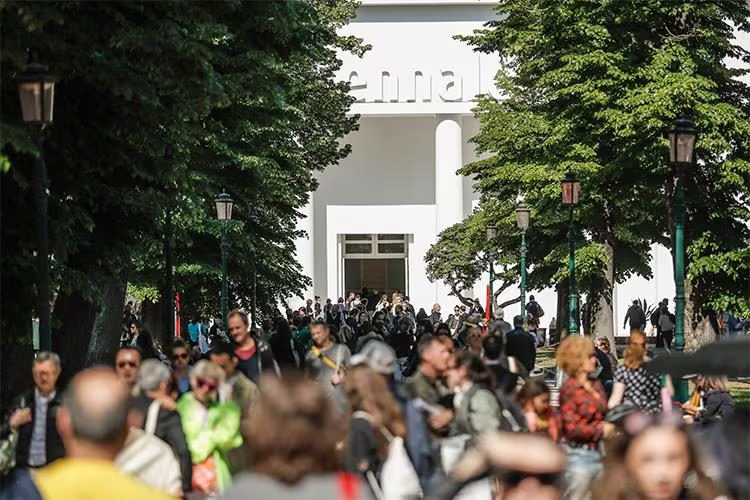
To host the event, an exhibition building was specially built in the Napoleonic Gardens of the Castello district, now known as the Biennale Gardens: it is the current Central Pavilion, built in 1894, restored and modified several times throughout its history. The main exhibition is held here, curated by a curator chosen by the Board of Directors of the Biennale Foundation.
Since the beginning of the twentieth century, smaller pavilions have sprung up around this space where the exhibitions of the states interested in participating could be hosted. The first to be built were those of Belgium (1907), Germany (1908), Great Britain (1910), Hungary (1912) and France (1914). The Gardens now host 29 pavilions from foreign countries, some designed and built by famous architects, such as the Dutch pavilion, designed by Gerrit Thomas Rietveld, or the Finnish one, designed by Alvar Aalto.
Since 1980, the Arsenale has also become an exhibition venue for the Biennale, a vast production center from the pre-industrial era, where ships for the Serenissima fleet were built. Here stands among others the large Italian Pavilion, which occupies part of the “Tese delle Vergini”, for a surface area of approximately 1,800 square metres. During the exhibition it hosts one or more Italian artists. Inside the main body of the Arsenal, in addition to part of the main exhibition, the pavilions of several other countries are hosted: from Argentina to the People’s Republic of China, from Luxembourg to Mexico and New Zealand.
How the awards work: Golden Lion and Silver Lion
For each Biennial there is a jury, with its president, who assigns the various prizes. The following prizes are awarded for the exhibition dedicated to figurative art: the Golden Lion for the best National Participation, therefore designed for the best national pavilion; the Golden Lion for the best participant, addressed to artists or artistic collectives; the Silver Lion for a promising young participant; a special mention attributed to a nation and a maximum of two special mentions attributed to the participating artists or collectives.
They are all highly coveted prizes, which can determine the take-off or culmination of a career in the art world. Although there are many art biennials in the world, the one in Venice is generally considered the most famous and prestigious and is in any case considered one of the most important art events in the world. This fame is motivated by the history of the Biennale Arte itself, which has been the scene of important moments in the history of Italian and international art, thanks to its ability to intercept the directions and interests of contemporary art.
The scandals of the Venice Art Biennale
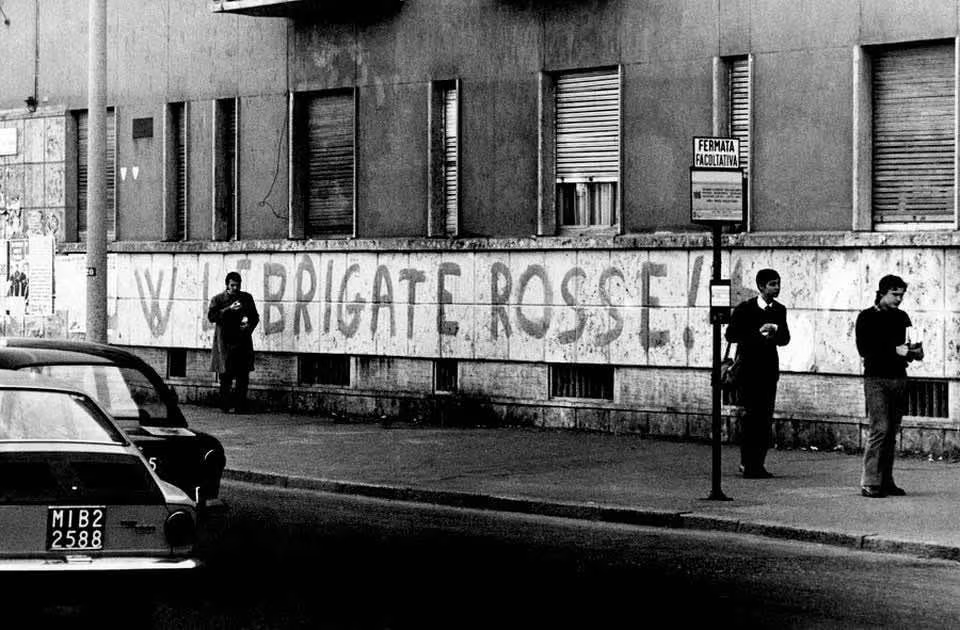
The Biennale was also the scene of scandals: already in the first edition the painter Giacomo Grosso caused a sensation for having presented a painting, The supreme conference, depicting five women above the coffin of a young man very similar to Nietzsche. There have been many talked about episodes: among the most famous is the “disputed” edition of 1968, in which many artists (18 out of 22) refused to participate because the police were guarding the demonstration in order to silence youth protests. Gastone Novelli was one of the exceptions, but he hung his paintings facing the wall and wrote on the back of a canvas: “The Biennale is fascist”.
And again, in 1972, the artist Gino De Dominicis brought to the exhibition an installation next to which there was, sitting in a corner, a young man with Down syndrome, Paolo Rosa: the room was closed and the artist accused of abandonment and theft of an incompetent person. He was acquitted the following year. In 1993 the photographer Oliviero Toscani caused a scandal with photographs that reproduced hundreds of male and female sexual organs in giant format on posters, and the same year the English artist Damien Hirst presented himself with sculptures made up of display cases containing large animals immersed in formaldehyde.
The 2026 exhibition (open from 9 May to 22 November) has also been a site of controversy for a few months, at least due to the political climate that preceded the opening: tensions have in fact emerged between European institutions, the Italian Government and the Biennale Foundation regarding Russia’s participation, to which was added that between the Foundation and the world of civil rights over Israel’s participation. The jury decided to exclude both of them from the possibility of winning prizes, but admitted their presence: the resignation came after the visit of inspectors from the Ministry of Culture and in the midst of political controversy. What made the process even more complex was the death of the curator of the main exhibition, Koyo Kouoh, in 2025: it was decided not to replace her and her project In Minor Keys, was carried out by his collaborators.