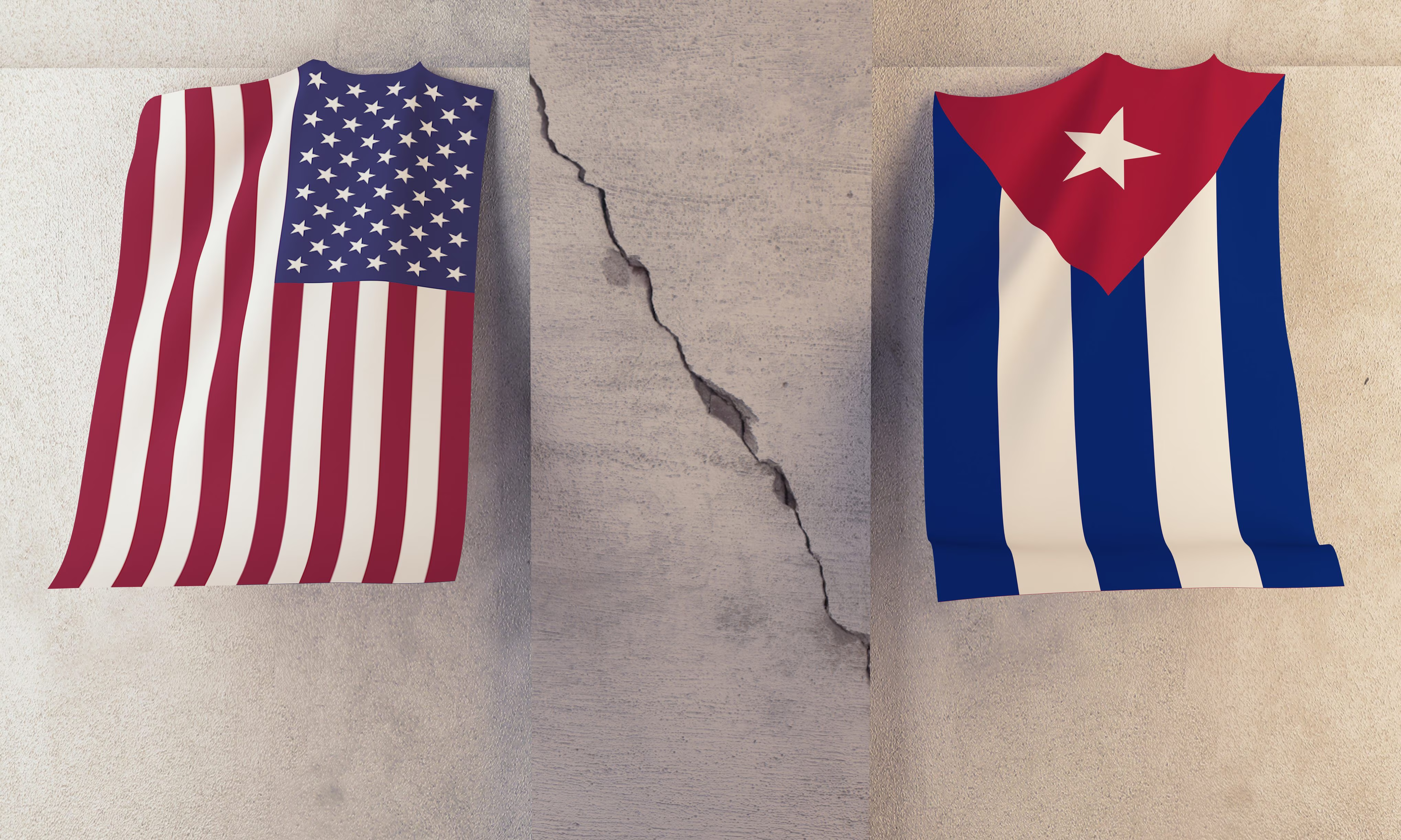
Despite a distant past of profound friendship, the United States has always dreamed of controlling Cuba, considered its “backyard”. The bond was broken in 1959 with Fidel Castro’s Revolution, which transformed the island into a socialist outpost a stone’s throw from Florida, unleashing over sixty years of embargo and Cold War tensions. Today the conflict is at a turning point: with the regime weakened by the economic crisis and blackouts, Washington is openly aiming for a change of government. Between underground diplomacy and the possible involvement of figures within the Castro family, the USA sees the perfect opportunity to bring the island back into its sphere of influence, closing a game open in the last century.
The “backyard” and the Monroe Doctrine
To understand how important Cuba is to the United States we must take a step back in time.
In 1898 the USA helped the island gain independence from Spain. However, this is not an interest-free support.
With the Monroe Doctrine (1823) and slogan “America for Americans” the US had pledged to discourage the presence of European nations in what they consider their backyard.
Subsequently, with the Roosevelt Corollary (1904) they proclaimed themselves “policemen of the Americas”, legitimizing the right to intervene throughout the region to safeguard their interests.
Cuba thus became the laboratory of this strategy:
- with the Platt Amendment Cuba obtains independence from Spain, but effectively ties itself to the USA
- Guantánamo: as a pledge of this submission, the island is forced to cede a naval base which guarantees physical control of the territory.
This policy then dictated the US agenda throughout Latin America for the next century: from Honduras and Panama, to the support of authoritarian regimes and the 1973 coup in Chile.
The Batista era and “mafia island”
Between the 1920s and 1950s, Cuba went through various authoritarian regimes, such as that of Gerardo Machado (the “tropical Mussolini”), up to the rise of Fulgencio Batista, dictators supported from time to time by the United States.
Under the latter, the island became the playground of the Italian-American mafia and American multinationals.
While mafia bosses and godfathers like Lucky Luciano feasted in the large hotels of the capital, Havana, the rural population, especially in the south of the island, was sinking into hunger and social and economic inequality.
This enormous inequality has ended up making Batista, in the eyes of many Cubans, a simple administrator of foreign interests.
1959: the arrival of the “barbudos” and the revolution that changed everything
On January 1, 1959, the so-called barbudos, guerrillas led by Fidel Castro and Ernesto “Che” Guevara, entered the capital Havana, overthrowing the Batista regime.
On January 1, 1959, the entry of the barbudos led by Fidel Castro and “Che” Guevara into Havana not only marked the fall of a dictator, but the beginning of a geopolitical short circuit.
Initially, the insurrection had a national and social character: the new government nationalized mines and industries and initiated an agrarian reform to redistribute the land. But in full Cold Warthese choices directly affect Washington’s economic interests. The American response was immediate: the first trade blocks transformed what was a dispute between “neighbors” into a matter of national security.
Cornered by the embargo and looking for markets to survive, Cuba makes the choice that changes history: the alliance with the Soviet Union. In an instant, the island ceases to be just a rebellious country and becomes the most dangerous “pawn” on the chessboard of the superpowers.
This escalation materializes in two moments of no return:
- The Bay of Pigs (1961): The CIA’s failed attempt to invade the island via Cuban exiles. This attack only definitively pushed Castro into the arms of Moscow, formalizing the socialist character of the revolution.
- The Missile Crisis (1962): The world comes to the brink of nuclear apocalypse when the Soviets install atomic warheads on the island, just 150 km off the coast of Florida. Cuba is no longer just an ideological outpost, but a direct military threat in the heart of the American continent.
From this total clash the regime we know was born: power is concentrated in the hands of Communist Party led by Fidel Castro for almost half a century. “Che”, however, chooses not to stop at the management of power: faithful to the idea of a global anti-imperialist revolution, he will leave the island to export guerrilla warfare to Africa and then to Bolivia, where he will find his death in 1967.
Operation Mongoose
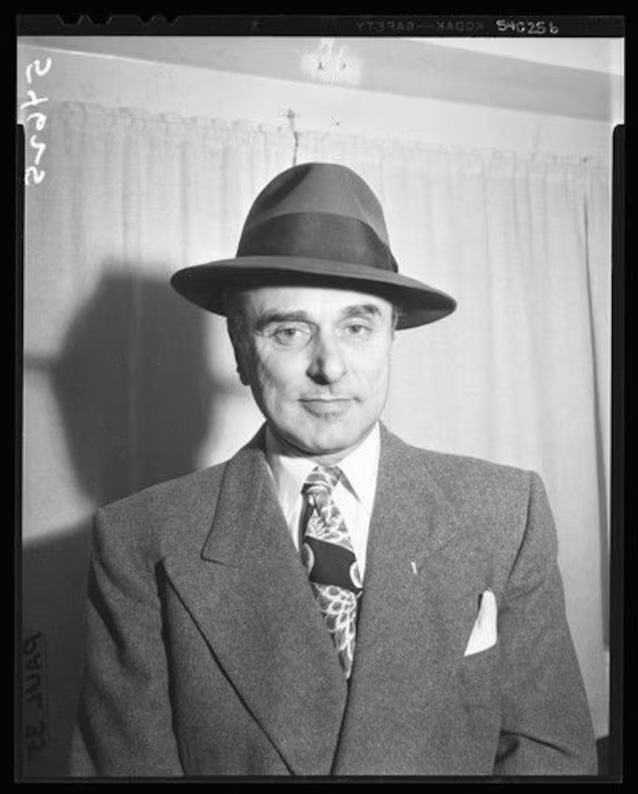
Between 1961 and the 1970s, the CIA coordinated Operation Mongoose, an ambitious and unscrupulous secret plan aimed at destabilizing the Cuban government through economic sabotage, propaganda and attacks.
The plan stood out for the almost surreal inventiveness of the attempts to eliminate Fidel Castro: the secret services devised stratagems worthy of spy cinematography, such as botulinum cigars, contaminated diving suits or LSD sprays to discredit him in public.
Despite the audacity of these plots, “Leader Maximo” survived each plot, eventually passing away of natural causes in 2016.
The operation saw a singular collaboration between state apparatus and organized crime. Among the protagonists were:
- William King Harvey: Nicknamed the “American James Bond”, a central CIA figure known for his drastic methods.
- John Rosselli: powerful mafia figure linked to the development of Las Vegas, recruited for his connections on the island.
Despite an investment estimated at around 50 million dollars at the time (a colossal sum for American taxpayers), the operation proved to be a strategic failure.
“El Bloqueo”: a decades-long siege
In 1963, under the Kennedy administration, the United States formalized the Cuban Assets Control Regulations, consolidating what in Cuba is internationally known as “el bloqueo”.
Although a partial embargo had already begun in 1960 as a response to Castro’s nationalizations, this measure established the total commercial and financial isolation of the island.
For decades, the impact of this isolation was mitigated by massive economic support and favorable trade agreements secured by the Soviet Union.
The collapse of the USSR in 1991 dragged Cuba into the dramatic “Special Period”, suddenly depriving it of its main political and commercial partner.
Rather than easing restrictions, Washington stepped up the pressure in the 1990s:
- In 1992, with the Torricelli Law. the ban on foreign branches of US companies from trading with the island. Sanctions for countries that offer assistance to Cuba
- In 1996, with the Helms-Burton Law, it introduced sanctions for third-country companies that traded with the island, effectively internationalizing the embargo.
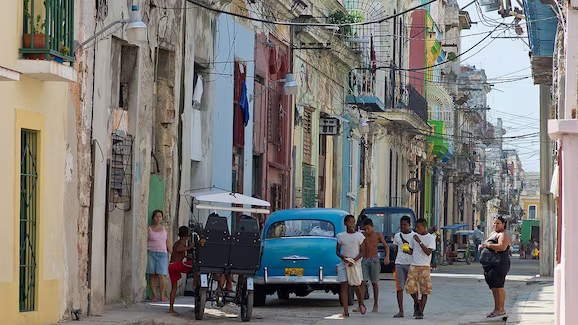
This economic stalemate froze Cuba in time, a phenomenon still visible today in the streets of Havana: the iconic American cars of the 1950s are not a stylistic choice, but a necessity dictated by the impossibility, for decades, of importing new vehicles and spare parts.
The thaw
Between 2014 and 2016, under the presidencies of Barack Obama, United States, and Raúl Castro (brother of Fidel Castro), the world witnessed a historic turning point. Embassies reopened, commercial flights resumed, and Obama became the first US president to visit the island since 1928.
However, this “spring” was short-lived: under the next administration, much of the diplomatic progress was reversed and Cuba was reinstated on the list of “State Sponsors of Terrorism,” turning the clock back decades.
Cuban exiles
Tens of thousands of Cubans fled the Revolution and gave life to a powerful and organized community, capable of transforming the city of Miami into their political capital.
It is estimated that around 1.2 million Cubans live here today. The exiles have not only sought refuge, but have built a lobby capable of heavily influencing American elections and pushing Washington to maintain a very hard line against Havana.
For many of them, the fight against Castroism has become a personal mission, making any attempt at détente between the two countries a true political minefield.
Among these opponents we find the current Secretary of State, Marco Rubio, son of former Cuban exiles.
Cuba, next on the list: what does it mean?
In recent months, the hypothesis of a regime change in Havana has become a very hot topic: President Donald Trump has escalated the issue by defining the island as the “next on the list” after Venezuela and Iran. Washington’s objective is clear: to isolate the current leadership to force it to abdicate peacefully.
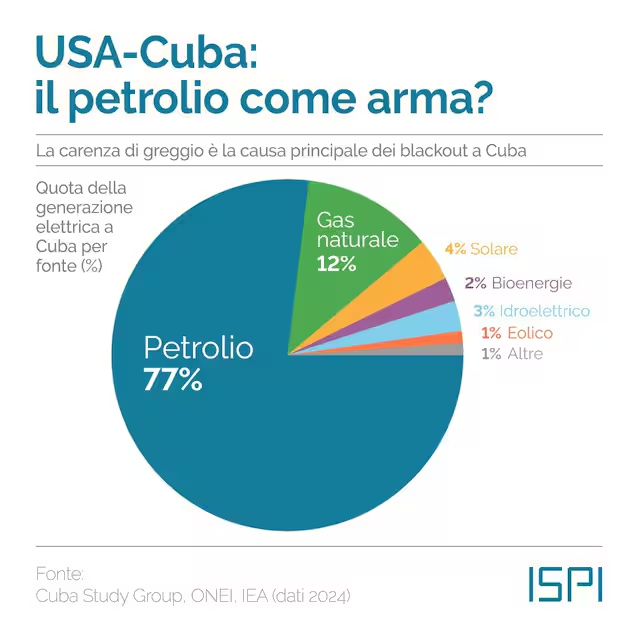
In 2026, due to the strengthening of the embargo, only one Russian oil tanker managed to dock, leaving the island without the crude oil needed to run the old Soviet power plants. The result? On March 16, the national electricity grid collapsed, plunging Cuba into ahumanitarian emergency unprecedented:
- Pending lives: with blackouts lasting over 15 hours a day, hospitals are collapsing and have a backlog of 96,000 surgeries.
- Paralyzed economy: the lack of gas, petrol and diesel stopped transport and water pumps, triggering out-of-control inflation and the devaluation of the peso.
- Human Rights: even UN speakers have condemned the blockade, calling energy deprivation an “unlawful tool of coercion.”
But what is really happening behind the scenes of this crisis?
While the population suffers, one moves underground diplomacy. There is talk of constant contacts between Washington and sectors of Cuban intelligence for a so-called friendly takeover: a smooth transition aimed at avoiding total chaos. A key detail? The rumors about the involvement of figures within the “dynasty”, such as nephew of Raúl Castroa sign that even the leaders of power are looking for a way out to avoid sinking together with the system.
Second FlightRadar24 the US Navy and Air Force reportedly conducted at least 25 military reconnaissance flights. Mainly over the capital Havana and the city of Santiago de Cuba. A pattern similar to what was previously seen at the start of operations in Iran and Venezuela.