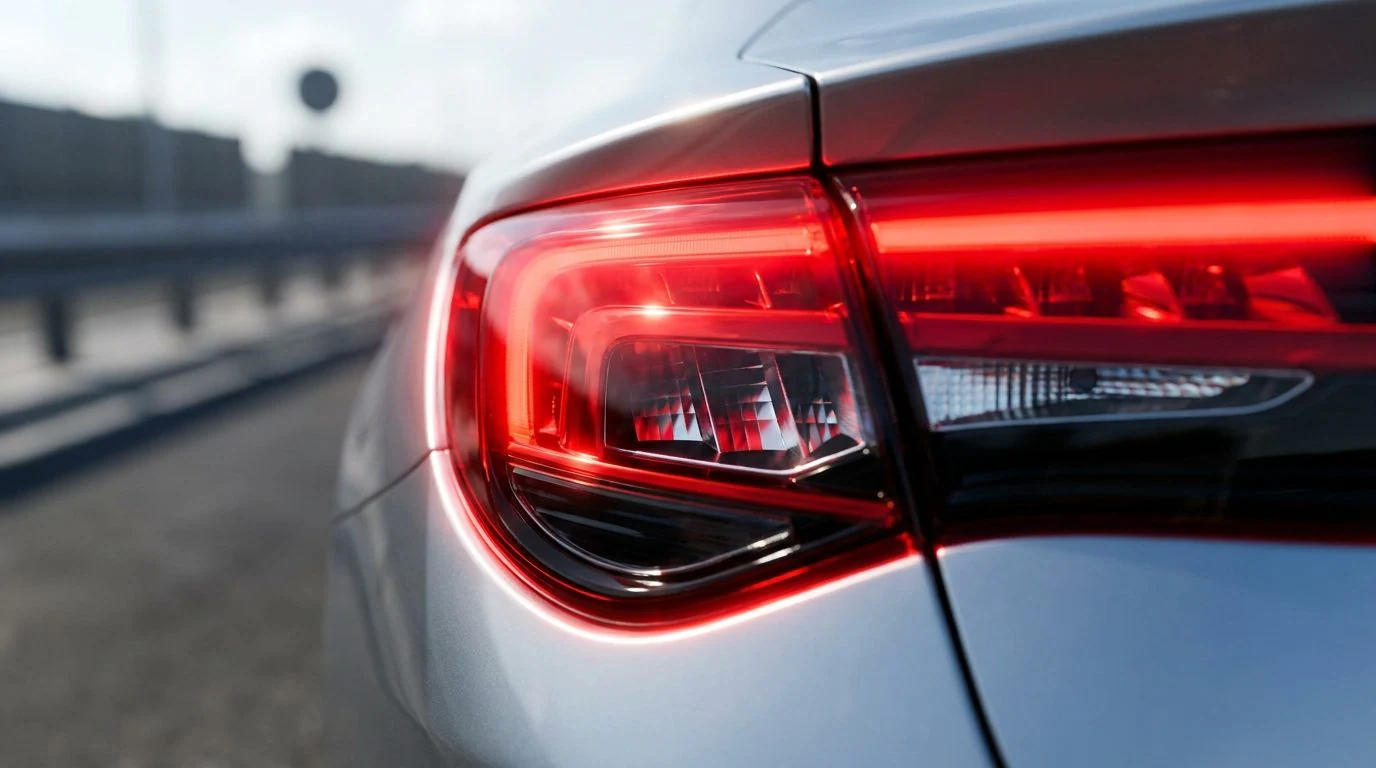
From 7 July 2026, all newly registered cars sold in the European Union will have to be equipped with theEmergency Stop Signal or ESS, an emergency braking warning system already present on some models but which will become mandatory for all new registrations. With this innovation, the rear brake lights, in the event of emergency braking, will no longer remain fixed but will begin to flash rapidly. The obligation was introduced by EU Regulation 2019/2144, the European regulatory package which is progressively redesigning safety standards for cars. The principle behind this system is as simple as it is potentially effective: compared to a fixed light, an intermittent light signal should capture the attention of the driver who is behind the wheel of the car behind the one that has braked. This could allow you to gain fractions of a second which, at high speeds, translate into meters of extra braking distance. The objective is to reduce the number of rear-end collisions, especially on busy roads.
The system is activated only in real emergency conditions, above 50 km/h and in the presence of a very intense sudden deceleration, monitored by the on-board electronics through speed sensors, pressure on the brake pedal, deceleration and ABS status. In some vehicles the flashing also involves the four indicators to further amplify the perception of danger. It should be noted that the rule will only concern new registrations: those who already own a car are not obliged to adapt, and the change will therefore be gradual in the fleet of vehicles in circulation. The ESS therefore joins the list of advanced driver assistance systems, known by the acronym ADAS (Advanced Driver Assistance Systems), some of which are already mandatory from 7 July 2022 on newly homologated cars.
How the ESS system for car warning lights works
The heart of the ESS’s operation is entirely entrusted to the on-board electronics. When the driver presses the brake pedal with sudden force, the vehicle’s control unit processes data from multiple sensors in real time: the instant speed, the intensity of pressure on the pedal, the behavior of the ABS (the anti-lock braking system that prevents the wheels from locking during braking) and the rate of deceleration. If these parameters exceed the emergency thresholds at the same time, the system interprets the situation as critical braking and automatically activates the flashing of the brake lights, without any intervention on the part of the driver of the vehicle. Rapid flashing makes braking much more noticeable than normal fixed stops. On some models, especially high-end ones, the activation can extend to the four indicators, further increasing the visibility of the event even for vehicles located to the side or further away. Some premium segment cars have already had this technology for a few years, but so far it is a minority compared to the entire European fleet.
The other security systems designed by the EU
However, ESS is only one element of a much larger technological ecosystem. EU Regulation 2019/2144 also introduces or will make mandatory in the coming years other systems, including advanced automatic emergency braking, Lane Keep Assist (which automatically corrects the trajectory if the car unintentionally leaves the lane), the recognition of speed limits via ISA (Intelligent Speed Assistance), i.e. the intelligent speed assistance system, the monitoring of driver fatigue and the provision for the alcohol lock, the device that prevents the engine from starting in the presence of a blood alcohol level above the permitted limit. The hope is to reduce road accidents as much as possible.