Stress is an adaptive response of our body: faced with a threat or a request perceived as excessive, the body goes on alert, activating a series of physiological and psychological mechanisms. But is it true that smartwatches can measure stress?
Can stress be measured?
Yes, but partially and not with just one number. Stress is observed on multiple levels. There is the subjective one: how much a person feels pressured and out of control. There is the physiological one: heartbeat, breathing, blood pressure, sweating, skin temperature. And there is the hormonal one, for example cortisol, which however must be interpreted with caution, because it changes during the day and depends a lot on the moment in which you measure it.
Among all these parameters, one of the best known is heart rate variability, the so-called HRV. Simply put, it measures how much the interval between heartbeats varies. The heart, in fact, does not beat like a perfect metronome. In general, a more flexible HRV is associated with better adaptive capacity. But be careful: it should not be transformed into a magic formula, because it is influenced by many factors. It is useful, but alone it is not enough.
How can a smartwatch tell we’re stressed?
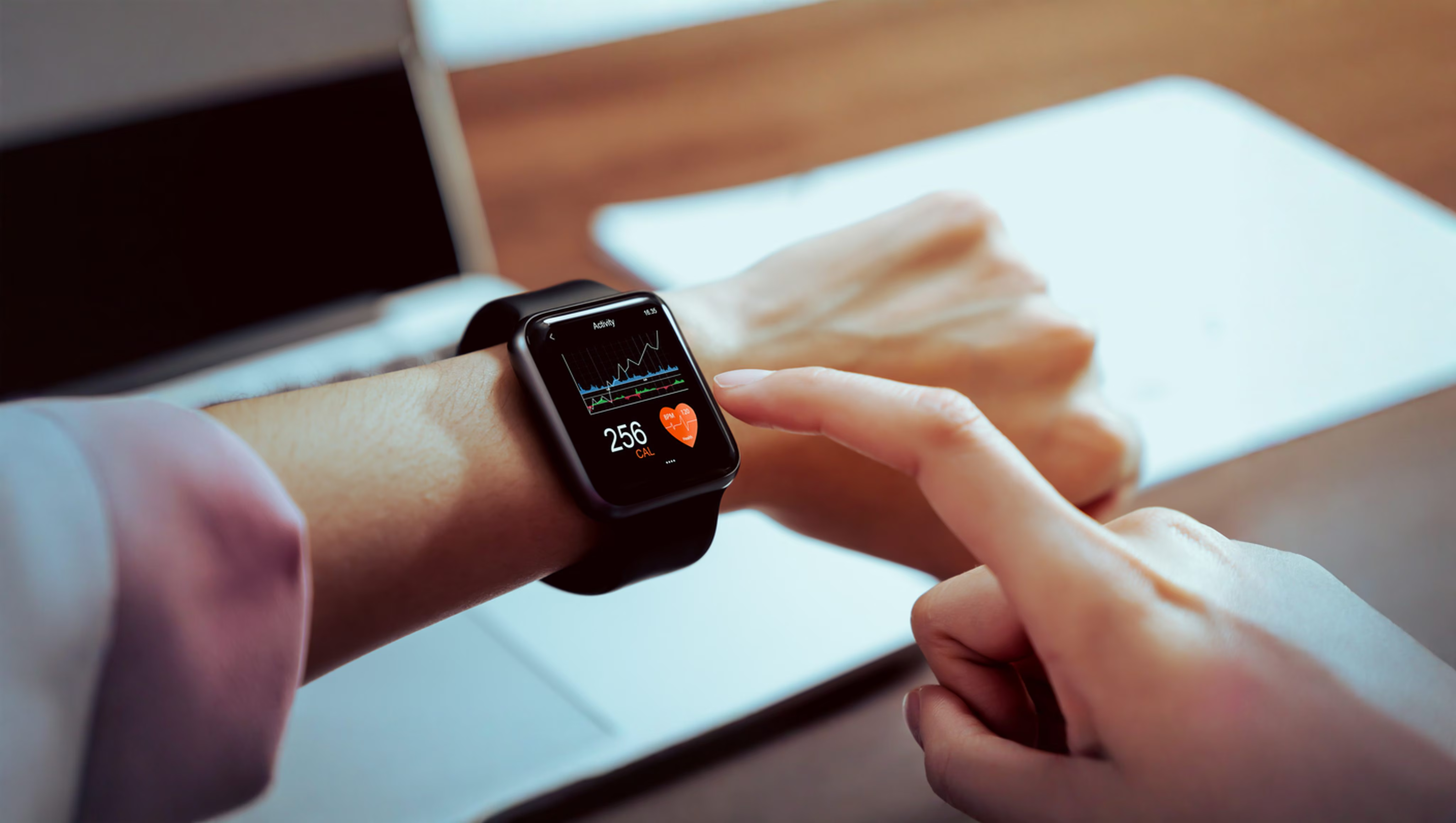
Many smartwatches use an optical sensor on the wrist — called a photoplethysmograph, or PPG — that detects changes in peripheral blood flow. From there they estimate the heart rate and obtain, with some limitations, also indices linked to the variability of the heartbeat. Some devices add other signals: movement, sleep quality, skin temperature and, in some cases, electrodermal activity — small changes in skin conductance related to sweating.
This makes sense, because when the autonomic nervous system is activated, cardiac variability, vascular tone, sweating and recovery quality really change. Then the algorithm comes into play. The device compares these signals with your usual behavior, looks for patterns compatible with a state of greater physiological activation and, if it finds them, returns an estimate that it calls stress.
In a certain sense, therefore, the smartwatch does not see your anxiety: it sees the traces it leaves in the body.
The limit of smartwatches: the study by Leiden University
Our heart rate increases not only when we are under pressure. It also increases when we are excited about something positive, when we play sports, when we have drunk coffee. The smartwatch sensor detects physiological activation which is often linked to many factors external to stress.
A group of researchers from Leiden University put this very discrepancy to the test in a recently published pre-print. For three months they collected data from nearly 800 students wearing a Garmin Vivosmart 4, asking them up to four times a day how they felt via short questionnaires on their smartphone. The result? For most individuals, there was almost no correspondence between what the device classified as stress and what people said they felt. “Stress sensor data is clearly not an objective measure of what we perceive as stress,” said Eiko Fried, one of the study’s authors.
For sleep, however, the correspondence was more solid: people who slept more hours also tended to judge their night better. But for stress, the gap between the number on the display and the actual experience was systematic and difficult to explain with simple measurement errors.
So are these tools really necessary?
Smartwatches may therefore be useful for capturing general trends in physiological activation, but their limitations in measuring stress are real and documented. The data they produce are not a direct measure of the subjective experience of stress, and treating them as such risks leading to misleading interpretations. Research in this field is still ongoing, and greater transparency about the algorithms used by manufacturers would be a necessary step to truly evaluate their accuracy.