The United States is reportedly negotiating with Denmark to open three new military bases in Greenland. The news comes after months of tensions between the two countries, with US President Donald Trump having repeatedly reiterated his desire to purchase or control the Arctic island, also threatening to resort to military force.
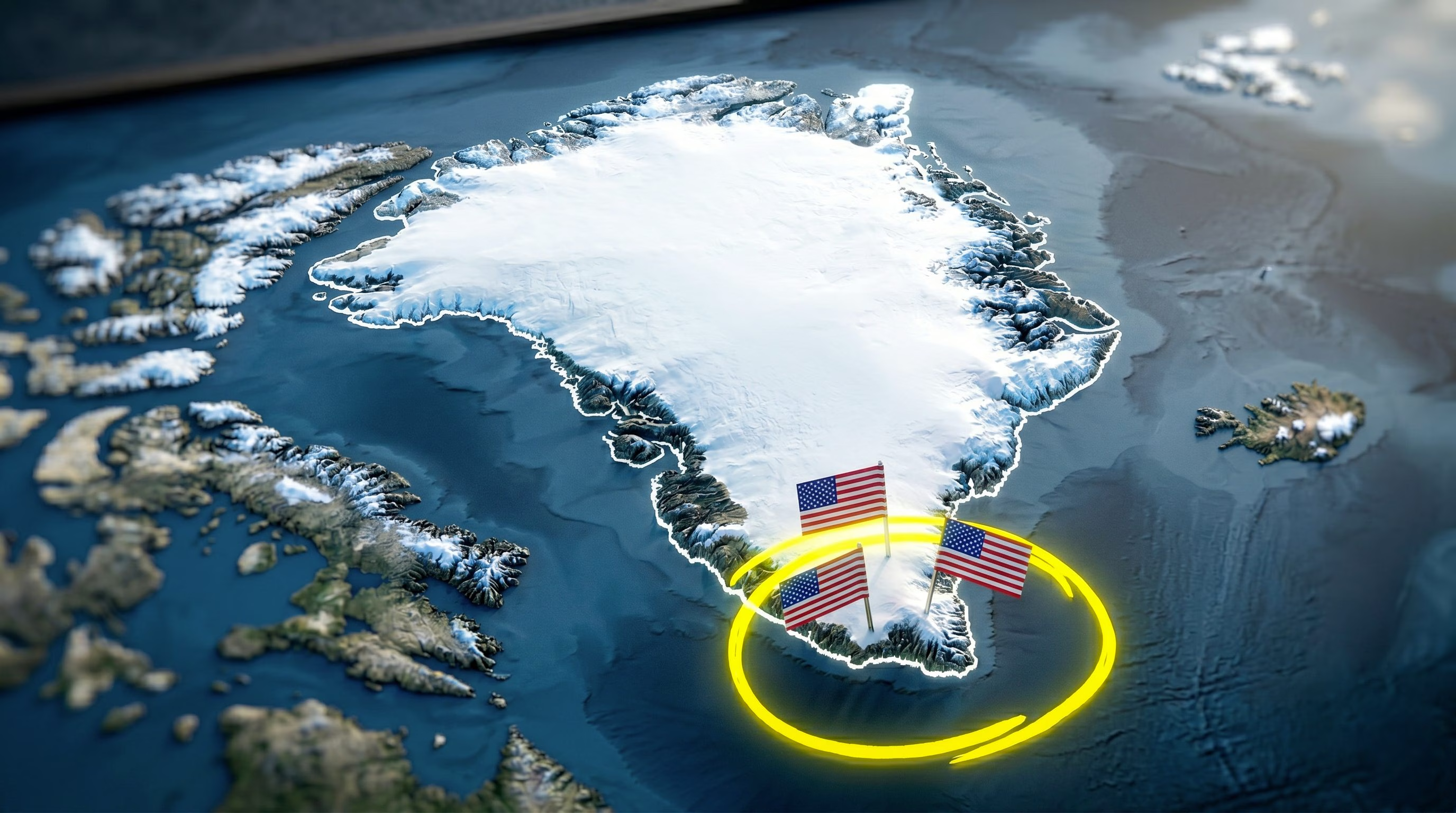
The plan, fully feasible from a legal point of view thanks to an agreement dating back to 1951, would provide for the construction of military installations in the south of the island, in a different strategic position compared to the historic Pituffik base (located in the north-west), today the only American military presence on Greenlandic territory.
It must be said, however, that at the moment nothing is certain: negotiations are still ongoing and we do not know whether the USA will actually be able to build all three bases, nor any possible timing.
Clearly, Washington’s goal would be to strengthen its presence in the Arctic and monitor maritime activities in the area conducted by Russia and China. But the negotiation is not just a question of military logistics: as reported by BBCIn fact, the American delegation would have asked for the new bases to be recognized as sovereign US territory, a request which, if confirmed, would go well beyond what is foreseen by the agreements in force and would move the discussion to an openly political level.
Even in this case, however, it is not a given that Denmark and Greenland will accept this possible transfer of sovereignty: the situation, therefore, is still in full flux.
The 1951 agreement: the legal basis that allows the opening of bases
The opening of new US military bases in Greenland would be completely legal and would not require new treaties: the legal basis on which the entire negotiation is based, in fact, is the Defense Agreement of 27 April 1951, an agreement stipulated between the United States and Denmark at the height of the Cold War. The Pact, created at the request of NATO from a defensive perspective, authorizes Washington to build and maintain military installations on Greenlandic territory, while formally maintaining Danish sovereignty on the island.
The heart of this agreement is Article II, which regulates the creation of the so-calleddefense areas” (i.e. defense areas) in Greenland. The article provides that the two governments may agree, from time to time, on the establishment of new defense areas that Denmark is not able to manage alone.
For these areas, the agreement recognizes a number of operational rights in favor of the United States, including the ability to improve and adapt the site for military use, build and maintain infrastructure and equipment (including weather and communications systems), station personnel, manage aircraft take-offs and landings and ship movements, and even deepen ports and canals.
On paper, therefore, the sovereignty of the defense areas would remain Danish: in reality, however, the USA obtains almost total operational control over the installations entrusted to them.
The agreement, among other things, was updated in 2004 by including, for the first time, the autonomous government of Greenland as a signatory, and no longer as a simple consulted entity. Article 1 of the updated agreement establishes that the Pituffik base is the only defense area still present in Greenland (compared to the 17 installations created during the Cold War years and now decommissioned), but explicitly confirms that the rules of Article II of 1951 – which allow the opening of new defense areas – remain fully applicable.
The 2004 update, however, introduced consultation obligations: any significant changes to US military operations or facilities in Greenland must be preceded by discussions with the Danish and Greenlandic governments. That’s why the US delegation is negotiating with its European counterparts. The number of bases, however, is not yet definitive and it is possible that it will change during the negotiations.
The political issue, however, is another: according to some sources cited by BBCAmerican representatives reportedly requested that the three new military bases be designated as sovereign territory of the United States. This would go well beyond the mechanism envisaged by the 1951 agreement – which recognizes Danish sovereignty over defense areas, while granting extensive operational rights to the Americans – and would represent an important change not only from a strategic point of view, but also and above all a political one.
Where would the 3 new military bases in Greenland be located
At this point, however, one question remains: where would the new US military bases be created? According to local media, the 3 military installations would be built in the south of Greenland, in a different strategic position compared to the current US base of Pituffik, which is instead located in the far north-west of the island.
In particular, the first military base could be built in Narsarsuaq, in southern Greenland, where a small airport and a deep-water port are already located. It is a former US military base, active during the Second World War and then abandoned in the 1950s.
For the second base, however, the American delegations are reportedly evaluating Kangerlussuaq, in the south-west of the island, also an old American base dating back to the Cold War, decommissioned in the 1990s and subsequently returned to the Danish and Greenlandic authorities. Kangerlussuaq already has a long airstrip, capable of accommodating large aircraft, and some port infrastructure. Finally, a different matter for the third location, whose position has not been disclosed.
In short, the underlying logic seems to be the same: reuse sites that already have infrastructures (such as landing strips and ports) that can be modernized and upgraded, avoiding having to build plants from scratch in an extremely hostile Arctic environment.
As can be imagined, the geographical position of these locations is not at all random: the new military installations could thus be used for the surveillance of Russian and Chinese naval activity in the so-called GIUK Gap, the strategic area of the North Atlantic between Greenland, Iceland and the United Kingdom, considered crucial for monitoring the traffic of submarines and warships.
It must be said, however, that the plan for the construction of three new bases had already been anticipated by General Gregory Guillot – head of the United States Northern Command – in a speech to the US Senate in March 2026, during which he declared the need for “greater access to various bases throughout Greenland, given the growing threat and strategic importance” of the island.
There is already a US military base in Greenland, Pituffik
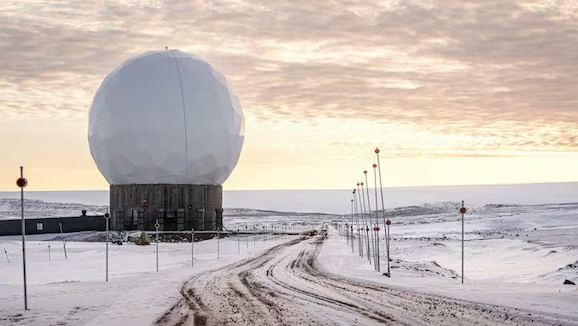
As mentioned, today the United States already has a military base in Greenland, namely the Pituffik Space Base (known until 2023 as Thule Air Base), located on the northwestern coast of the island. It is the only base that the USA has in the Arctic, as well as the northernmost of those operated by the US military, being approximately 1,100 km north of the Arctic Circle.
Today, the installation hosts approximately 150 US military personnel, as well as Danish and Greenlandic personnel, and consists of an approximately 3,000 meter landing strip. It currently carries out missile warning and space surveillance functions: inside, in fact, there is the BMEWS radar system, capable of promptly tracking the launch of intercontinental missiles towards North America, calculating the route and impact time and starting the various phases of warning for the defense of the continent. In this case, the geographical position plays a fundamental role: at latitudes such as the Arctic, in fact, the curvature of the earth means that the warning can be greater than at other sites located in more southern latitudes, which means an important advantage of several minutes to activate defense procedures or countermeasures.
The central point is that Pituffik, however crucial, has a structural limitation: the base is configured for missile and space monitoring, but is not equipped for maritime surveillance operations. The new bases in the south of the island would serve to fill this gap, allowing the United States to improve monitoring of naval activities in the North Atlantic, at a time when strategic competition in the Arctic between NATO, China and Russia is intensifying.