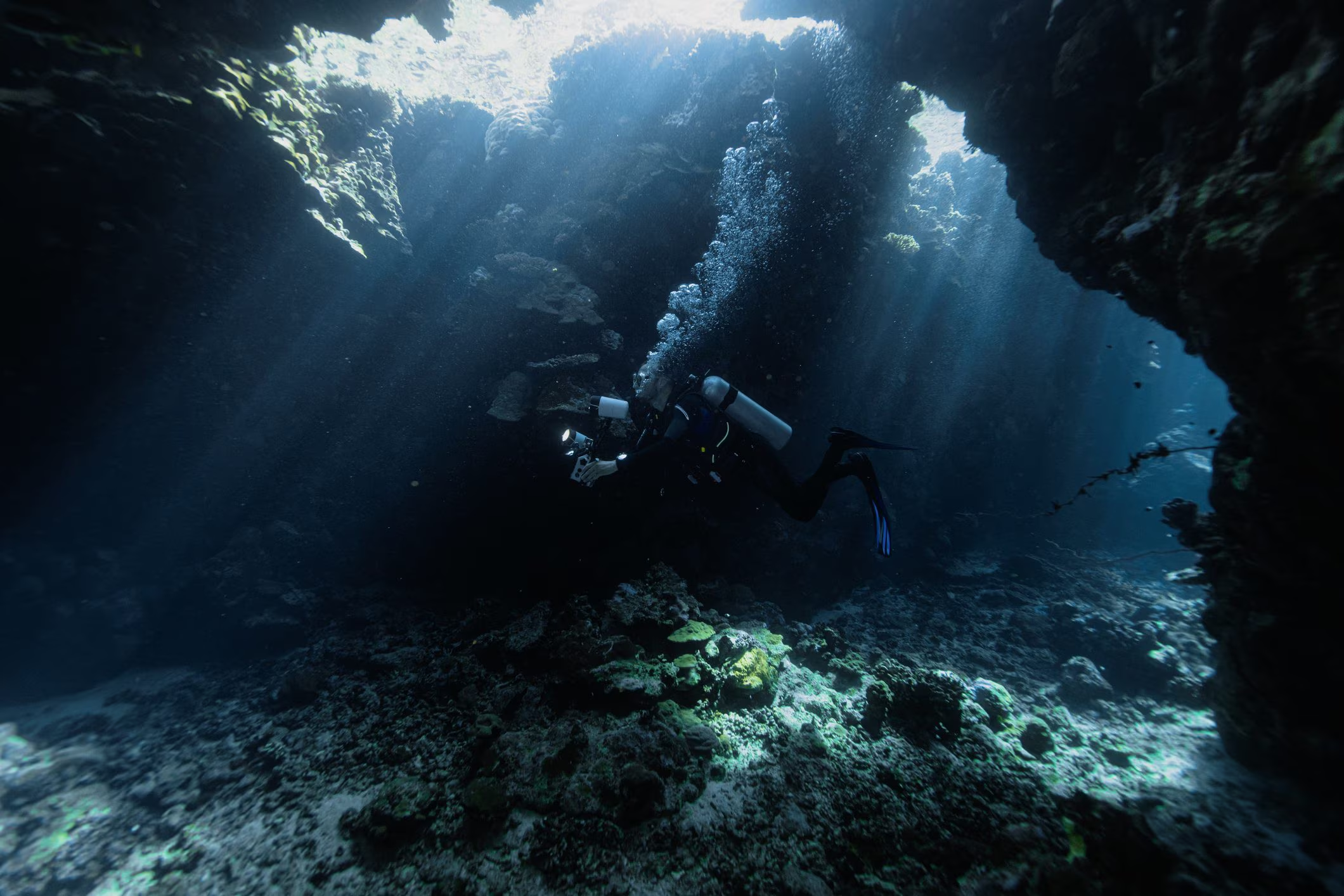
Tragic accident in the Maldives: five Italians lost their lives during a dive at over 50 meters deep, in the underwater caves of the Vaavu atoll. The episode was defined by local authorities as one of the worst diving accidents in the history of the Maldives (made up of 1,192 small coral islands distributed over approximately 800 km in the Indian Ocean). Meanwhile, victim recovery operations have officially begun after a series of delays caused by adverse weather conditions. The specialized personnel of the Maldivian Coast Guard have reached the area, accompanied by an expert Italian diver, who is collaborating with the authorities in the most delicate phases of the intervention.
The causes of the accident have not yet been clarified, but in the last few hours there has been talk of the possibility that the group was trapped in a cave about 60 meters deep, as well as the hypothesis that they encountered a sudden current that would have pushed them downwards. To better understand how diving at depths of over 50 meters works and the possible causes of the accident, we interviewed Dr. Pasquale Longobardi, Medical Director of the Hyperbaric Center of Ravenna and Vice President of the Italian Society of Underwater and Hyperbaric Medicine (SIMSI).
We are talking about dives beyond 50 metres, technical dives and recreational dives, what is the difference?
We talk about technical diving when you make a change of breathing mixture, that is, technically you change the tank and breathe a different gas during the dive. If we imagine the diver with tanks on his shoulders, it is not a technical dive but a recreational dive (or tourist, as we call it). If, however, I carry one or more tanks on my side (sometimes even three) and change the mixture during the ascent, then that is technical diving.
In the case of the accident in the Maldives we could define it as an open circuit dive, because it did not fall within the scope of recreational-tourist diving, but nowhere does it appear that they had accessory tanks with different mixtures. According to the information we have available, the group was in the Maldives to carry out scientific diving, part of a project authorized by the local government, but this specific dive was not part of the scientific programme.
How do you plan a dive to 50 meters depth?
To plan a dive, including those deeper than 50 metres, a risk analysis must be carried out, starting from the top. The first aspect to evaluate is the suitability and training of the diver: in this case, of five people, at least two had recently taken suitability exams. The other two were instructors who lived in the Maldives, therefore aware, and a girl in her early twenties. In short, from a health point of view they shouldn’t have had any problems.
On the training front, Professor Montefalcone had just this year received the Golden Trident, a recognition from the International Academy of Underwater Sciences and Techniques given to the best in the world in the field of the sea. Having that award means being extremely competent, and the other members of the group also had experience and skills.
Once these conditions have been verified, we move on to the actual planning: we decide when and where to dive, with which mixture and with which equipment.
What breathing mixture should be used for these dives?
To understand this point we must start from a fundamental concept: our body does not “read” the depth, but the density of the gas we are breathing. The human tolerance limit for the density of the gas is 4 grams per liter: above this value, the body triggers an inflammatory response.
That said, if you want to go down to 50-60 meters deep, you usually use a mixture of nitrogen, oxygen and helium. Helium, in fact, is fundamental because it has a very low density (0.5 g/l) and serves to lighten the total mixture. However, helium is almost never used in the Maldives because it is very expensive and difficult to transport.
Alternatively, therefore, air is used, despite knowing that at 50 meters we are right at the operational limit since at those depths it reaches a dangerous density of around 9 grams per litre, exposing the body to inflammatory stress.
And what about Nitrox?
What they certainly couldn’t have used is Nitrox, which is air enriched in oxygen: normally air contains 21% oxygen and 79% nitrogen. With Nitrox I can increase the oxygen (to 30% or 40%) and consequently reduce the nitrogen, which is responsible for the so-called “decompression accident”.
However, if you increase the oxygen too much you risk oxygen toxicity: an excess of this element increases the electrical activity in the cells with the risk of convulsions.
The causes of the accident are not yet known: are there any hypotheses that you would exclude, considering that it involved an expert group?
Among the three most frequent causes of death during diving is entrapment in the cave, until the mixture runs out. In this specific case, I would tend to exclude the hypothesis of entrapment: in the Maldives the caves are bright, composed of coral material, so the idea that they got lost is unlikely, especially if we consider that in the group there were two expert instructors who knew the area.
The hypothesis of carbon monoxide (generated by poor combustion in the compressor that charges the cylinders) is also possible but unlikely. In history there have been cases of diving deaths due to intoxication from this compound, but the cylinders had been loaded in closed areas, with awnings blocking the air intakes. Here we are talking about a large yacht and a serious company, with many divers who dived every day without problems. It becomes a minority hypothesis, but it cannot be ruled out until the cylinders are analyzed.
So what could be the most probable hypothesis?
The hypothesis that I consider most likely is that of the unexpected current. The alert was yellow, the sea was not good and the currents in that area are strong. The real problem, in my opinion, may have occurred during the exploration: they found a very strong and unexpected current and had difficulty managing the situation.
The current can take you upwards (and in that case maybe you’ll be saved) but also downwards. If you are already 50-60 meters away with the throttle at the limit, it’s like having a Ferrari and driving at 200 km/h on the motorway: you’re safe, but just a little is enough to cause a big accident. They had a mixture that was at its limits, because the density was already high, and they had tight deadlines, maximum half an hour.
Then there is the phenomenon of the whirlpool, a centrifugal current that takes you up and down: it is possible that one of them, perhaps the younger girl, has inadvertently ended up in the whirlpool or in a descending current. At that point the group tries to save the person in difficulty: the mother does not leave her daughter and the two instructors do not leave the clients alone. They all end up in the whirlwind, in the current, until the air runs out.
How will the authorities reconstruct the dynamics of the accident?
To reconstruct the definitive dynamics, however, we will have to wait for the analysis of two key elements. The first is the contents of the cylinders: if they find nitrox, then there may have been a technical error in the loading. On the contrary, if they were to find air, the causes would have to be looked for elsewhere.
The second, fundamental element is wrist computers. From those you print the profile of the dive and you understand everything: if from the profile you see that the group remained stationary in one point, then the hypothesis is that of entrapment with asphyxiation. If, however, the computer detects a sudden and deep descent, then it happened as I hypothesized before: the group, or part of them, was caught by the current, dragged downwards, without the possibility of going back up.