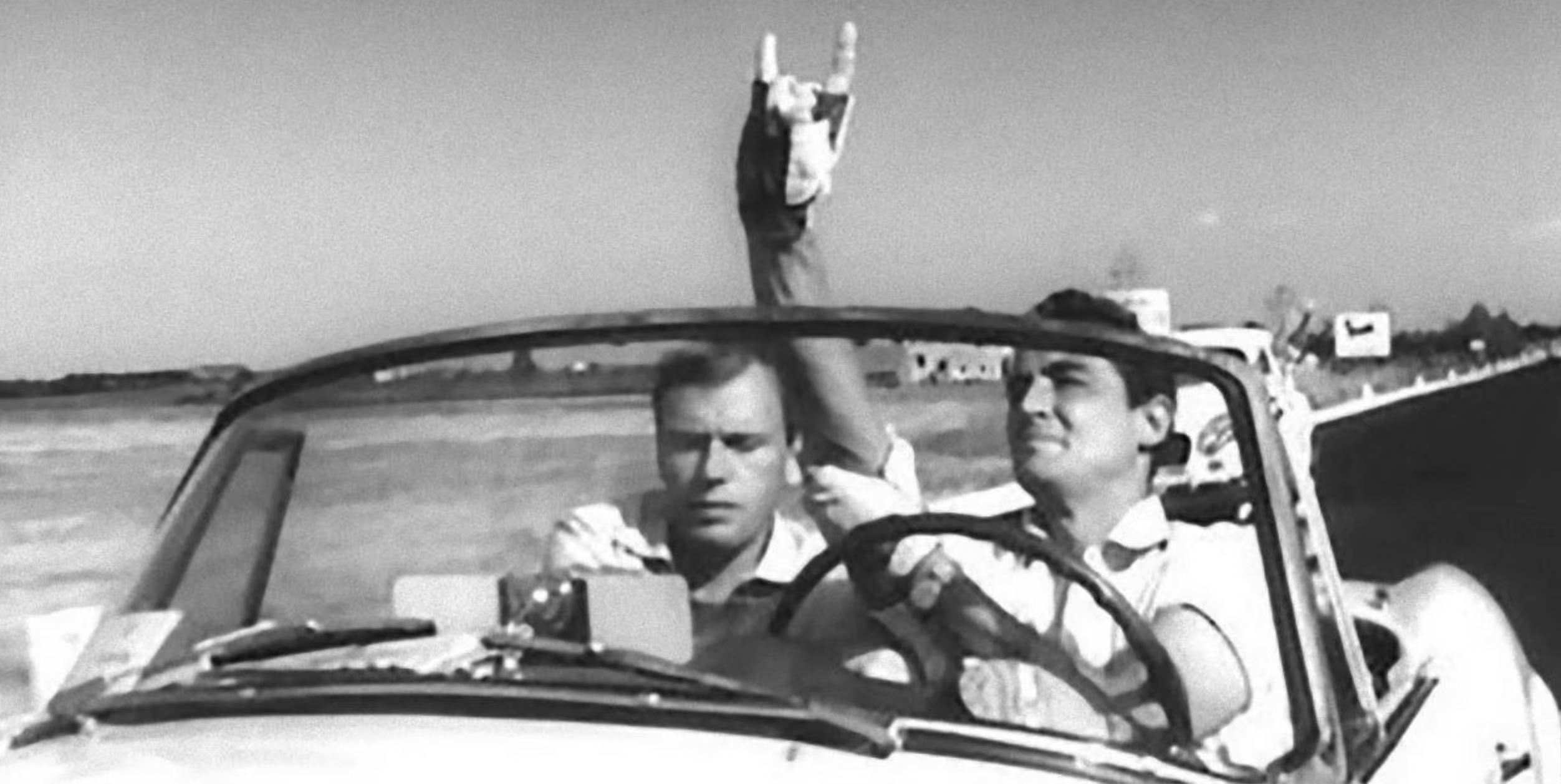
With the expression “economic boom”, often combined with post-war economic miraclewe mean an unprecedented growth season in Italian history, particularly concentrated between 1958 and 1963. Italy changed profoundly in the space of a few years: from an agricultural country it became a country with an industrial vocation. This radically redefined daily rhythms, private consumption, collective identities, needs and expectations of citizens.
A new Italy in another world
The Italian economic boom occurred after the Second World War, following the transition from the monarchic-fascist state to the republican-democratic state. The phenomenon was neither sudden nor random but can be explained starting from a series of events and contributing factors.
First of all, the machinery and industrial plants already present on the peninsula had only been partially destroyed during the conflict: there was therefore a minimum basis from which to start. The need to reconstitute and strengthen the productive fabric it immediately became a priority and attracted attention, investment and capital. Very important was the Marshall Plan (ERP)the large aid program launched by the United States to benefit the post-World War II reconstruction of Europe, as a move of anti-Soviet hegemony in the context of the Cold War.
After 1945, with governments led by the Christian Democrats (DC), Italy strengthened industrial sectors such as chemical, mechanical and iron and steeladopting a hard line to stabilize the national currency, the Lira, and curb inflation.
PHOTO OF THE LIRA: https://www.istockphoto.com/it/foto/100-lire-moneta-italia-1977-gm175192963-21814544?searchscope=image%2Cfilm
Another decisive factor was Italy’s position within a completely new international framework, generally centered on cooperation and projected towards economic interdependence. Think for example of the birth and participation of Italy in the UN, the United Nations Organization, founded in 1945 specifically to maintain peace and security between nations.
Inserted in the Western bloc, Italy he rejected isolationism. It signed the General Agreement on Tariffs and Trade (GATT) in 1947, entered the Organization for European Economic Co-operation (OSCE) in 1948 and the European Coal and Steel Community (ECSC) in 1951, and then contributed to the birth of the European Economic Community (EEC) in 1957.
The economic miracle: the growth numbers
The paradigm shift pushed national companies – public and private – towards a organizational and technological modernization. There was also a sort of “Americanization”: a wider adoption of Anglo-Saxon managerial models and systems based on the Fordist assembly line.
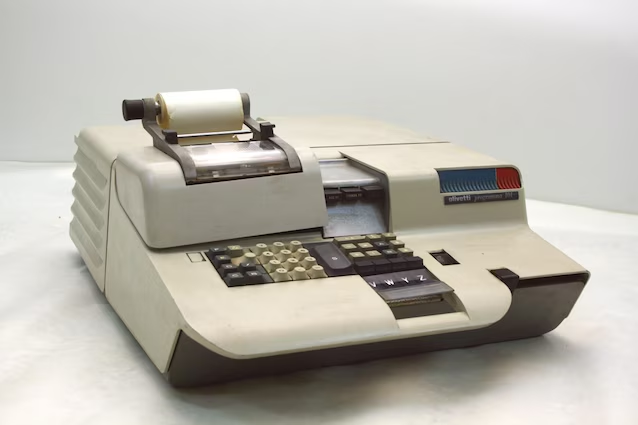
Combining public intervention by the State and the entrepreneurial ability of private individuals, Italy, starting from the 1950s, reduced the gap with the more advanced countries. Not only that: he also managed to distinguish himself in cutting-edge sectors such as precision mechanics and electronics (with Olivetti of Ivrea, for example).
Generally speaking, from 1958 to 1963 the average GDP growth was approximately 6.3% per year (compared to 4.3% in Western Europe and 2.7% globally). Between 1954 and 1964 net national income almost doubled and industrial production increased by 84%. The same exports supported development: between 1951 and 1963 grew by 12% per year.
All this, together with the ability to contain the deficit and make investments in infrastructure, strengthened the economy and created the conditions formassive employment of millions of workers.
Inside the Italy of the boom: consumption, songs and migrations
The Italian economic boom it was an effective tool fight against poverty. As he wrote historian Paul Ginsborg:
For the first time the majority of the population had the opportunity to live decently, to stay warm and well dressed, to eat well, to raise their children almost without the fear of malformations or malnutrition.
From the point of view of popular culture, the discontinuity between pre-war and post-war Italy appears very evident. Take for example the history of music, in fascist Italy in 1939 one of the best known songs was A thousand lire a month of the singer Gilberto Mazzi, capable of expressing the widespread and modest desire for better living conditions. The text began like this:
If I could have
A thousand lire a month
Without exaggerating
I would be sure to find
All the happiness
In republican Italy in 1958, however, the singer-songwriter Domenico Modugno won the Sanremo Festival, who, playing In the blue, painted blue with Johnny Dorelli, conveyed a feeling of momentum towards the future. The text concluded like this:
In the blue of your blue eyes
Happy to be down here
Year after year, Italy was filled with cars and motorcycles, televisions and household appliances; new ways to spend the day were born free time. Overall, the structure of employment also changed: male and female workers active in industry outnumbered those employed in agriculture.
Industrialization, concentrated in the North, also reshaped other productive areas of the peninsula, from Veneto to Friuli Venezia-Giulia, from Tuscany to Emilia-Romagna up to Marche and Umbria. The South itself, although burdened by long-standing problems, benefited from extraordinary interventions, as happened there Checkout for midday (established in 1950).
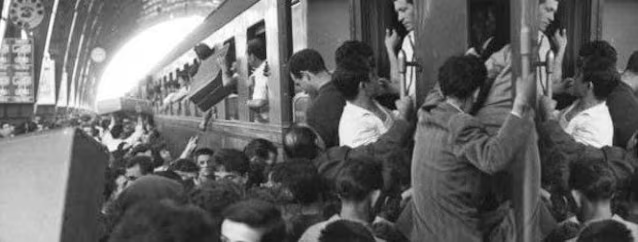
In any case, many people, not finding stable employment in the South, they chose another path: emigration towards central-northern cities, thus intercepting the demand for manpower large industrial complexes. Between 1955 and 1970, interregional migrations involved 9 million Italian men and women. More than 1,000 people arrived in the area of Milan, Turin and Genoa 1.5 million individuals. Integration was far from simple and thousands of immigrants suffered serious discrimination.
The limits of Italian modernization
Italian modernization presented, alongside the many lights, even shadows. This aspect is sometimes overlooked in reconstructions dedicated to years of the economic miracle. The Italy of the boom was also an Italy of delays and distortions.
The speed of economic development did not always and not everywhere coincide with social progress. They stayed strong rigidities and inequalities. Attempts to carry out incisive reforms were often inadequate and sometimes hindered. The drive towards individual or family consumption exceeded spending on public housing, schools, universities and public health. As the historian Guido Crainz wrotethe Italian miracle was an “unregulated” miracle.
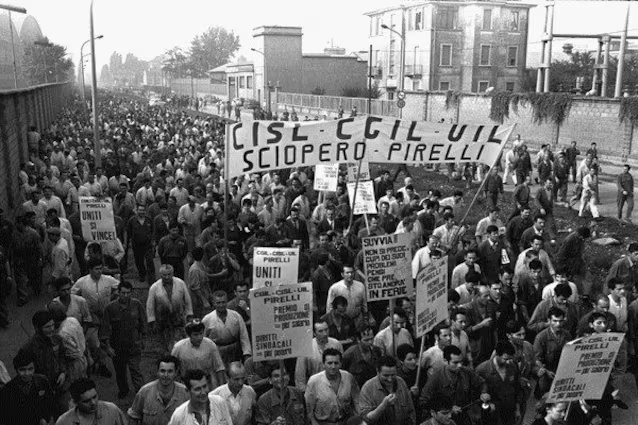
Relations between the state, businesses and unions were not adequately updated: the growth of wages it was very slow compared to that of profits. The limits on the freedom of action of vested interests remained weak and there were episodes of property speculation, illegitimate enrichments and distortions of market dynamics.
In 1962 the weekly of the Italian Communist Party, Rebirthwith an in-depth analysis of Diego Novelli (future mayor of Turin) denounced the “housing crisis in the large cities of the North”, also due to the lack of urban planning. In the same year a long report by the journalist Giorgio Bocca he described the most ambiguous aspects of the post-war boom, the “Italian miracle”, such as uncritical consumerism or the lack of consideration for culture on the part of rising sectors of the national bourgeoisie. In 1963 the economist Paolo Sylos Labini on The Astrolabe he noted:
Today Italy is a halfway advanced and civilized country: alongside areas of relative well-being, areas of shameful poverty coexist; in public and private administrations, in public life, swamps of putrefied water coexist alongside civil oases.
The development, tumultuous and asymmetrical it then encountered a general backwardness imprinted in customs, conventions and laws. For this reason, in the following period, we witnessed numerous student protestsworkers’ mobilizations and demands for women’s rights, which marked the history of the peninsula from 1968 until much of the Seventies.