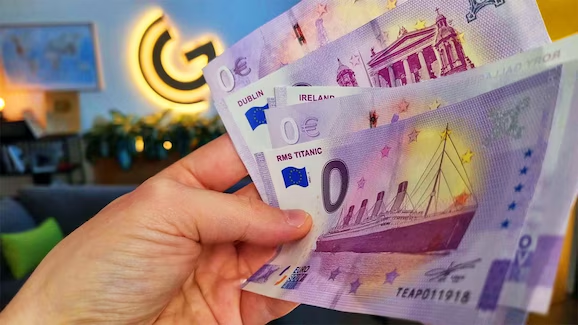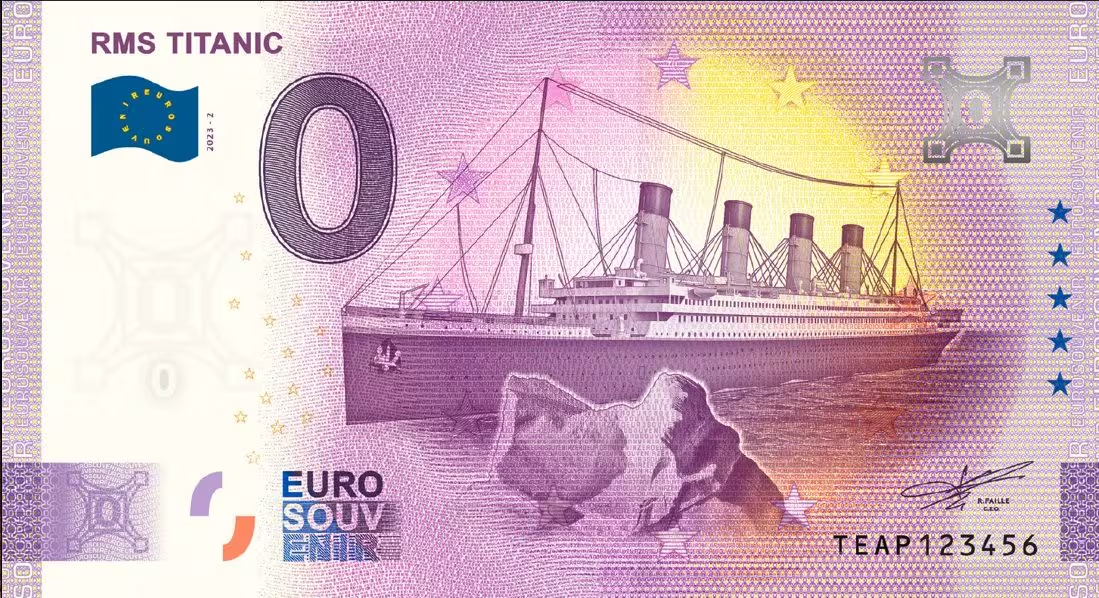
In Europe there is a 0 euro banknote. It is not a joke or a printing error: it is a real object (whose issue was authorized by the European Central Bank) printed on the same pure cotton paper as the authentic euros and equipped with a watermark, hologram, microwriting and elements visible to UV rays. The only difference, besides the “0” printed prominently, is its value: these banknotes are simply souvenirs, they have no legal value and cannot under any circumstances be used as a means of payment.
Born in 2015 from an idea by the French entrepreneur Richard Faille, for some time the 0 euro banknote has been experiencing a new wave of popularity among collectors, with some examples on the market reaching figures much higher than their initial selling price – which generally is around 2/3 euros.
These 0 euro banknotes, however, they are not distributed either in banks or post officesbut they are mainly sold in souvenir shops of museums or other points of cultural interest.
What is the 0 euro banknote for and how much is it worth
Let’s start from a premise: as also reported by the ECB, the only euro banknotes with legal value are those printed by high security workshops accredited by the Eurosystem, distributed by the national central banks in denominations of 5, 10, 20, 50, 100 and 200 euros (the 500 ones have no longer been printed since 2019, but are still valid and retain their value).
The 0 euro banknote is not included in this list and is not considered legal tender (therefore recognized as a valid means of payment). What is it for then? It is simply a souvenir, a collector’s item disguised as a banknote.
The idea of creating a 0 euro banknote dates back to 2015, driven by the French entrepreneur Richard Faille, who had been producing commemorative coins sold in museums and tourist sites since the 1990s. Faille proposed the initiative to the European Central Bank, the authority responsible for establishing the volumes of euro banknotes printed each year (although for reasons of efficiency, the physical printing of the banknotes is shared between the various national central banks). At that point, the institute accepted the production and authorized its issue.
How they are made, who issues them and how to get them
Finding 0 euro banknotes is simpler than it seems: they can be found in official points of sale in places of tourist interest throughout Europe (such as museums, monuments or archaeological sites), but also online on the sites of authorized distributors.
The average price is generally low and ranges from 2 to 3 euros at vending machines, up to 4-8 euros for the more refined editions sold online or in stores.
But the success of these banknotes is also linked to their appearance: from a technical point of view, these banknotes are made practically like the real ones. They are printed on pure cotton paper (the exact same material as authentic euros) and produced by accredited security workshops (such as the French Oberthur, one of the printers authorized to produce real euro banknotes for the ECB).
Just like banknotes with legal value, these “euros” also have a personalized watermark, a security strip, a hologram, microwriting, iridescent inks, elements visible only under UV rays and a unique progressive numbering.
In practice, if it weren’t for the “0” printed in clear letters and the clearly visible word “souvenir”, they would look like a 5 or 10 euro banknote in all respects. And it is precisely for this reason that the ECB had to authorize its production and issuance: printing a sheet of paper that resembles a banknote is normally prohibited and regulated by very strict regulations, because it risks confusing the public.
However, it must be remembered that it is not the ECB that directly prints the 0 euro banknotes: the central banking institution limits itself to authorizing private companies to issue them, ensuring that the difference with the real euros is immediately perceptible.
Because the collector craze has broken out
But why is this 0 euro banknote craze re-exploding now? If the most common versions cost a few euros, rare pieces reach much higher prices on the collectors’ market. It is the classic mechanism of numismatics: the lower the circulation, the more sought after the subject; the more perfect the banknote is, the more its value increases.
What drives this success, however, is a combination of factors. The first is the infinite variety of subjects: from 2015 to today, 0 euro banknotes have multiplied in all European countries and depict everything from famous monuments such as the Eiffel Tower, the Colosseum, the Sagrada Familia to historical figures such as John Fitzgerald Kennedy, Saint Patrick or Freddie Mercury. There are even series dedicated to events and anniversaries (like the Titanic), religious themes or cult films.
The second engine is the possibility of customization, with some sites that allow you to send your own photograph to be printed on the banknote.
The third factor is the quality of the product: as mentioned, in fact, a 0 euro banknote has the same security features as real euros (watermark, hologram, UV, microprint), which makes it a physically fascinating object even for those who are not avid collectors.