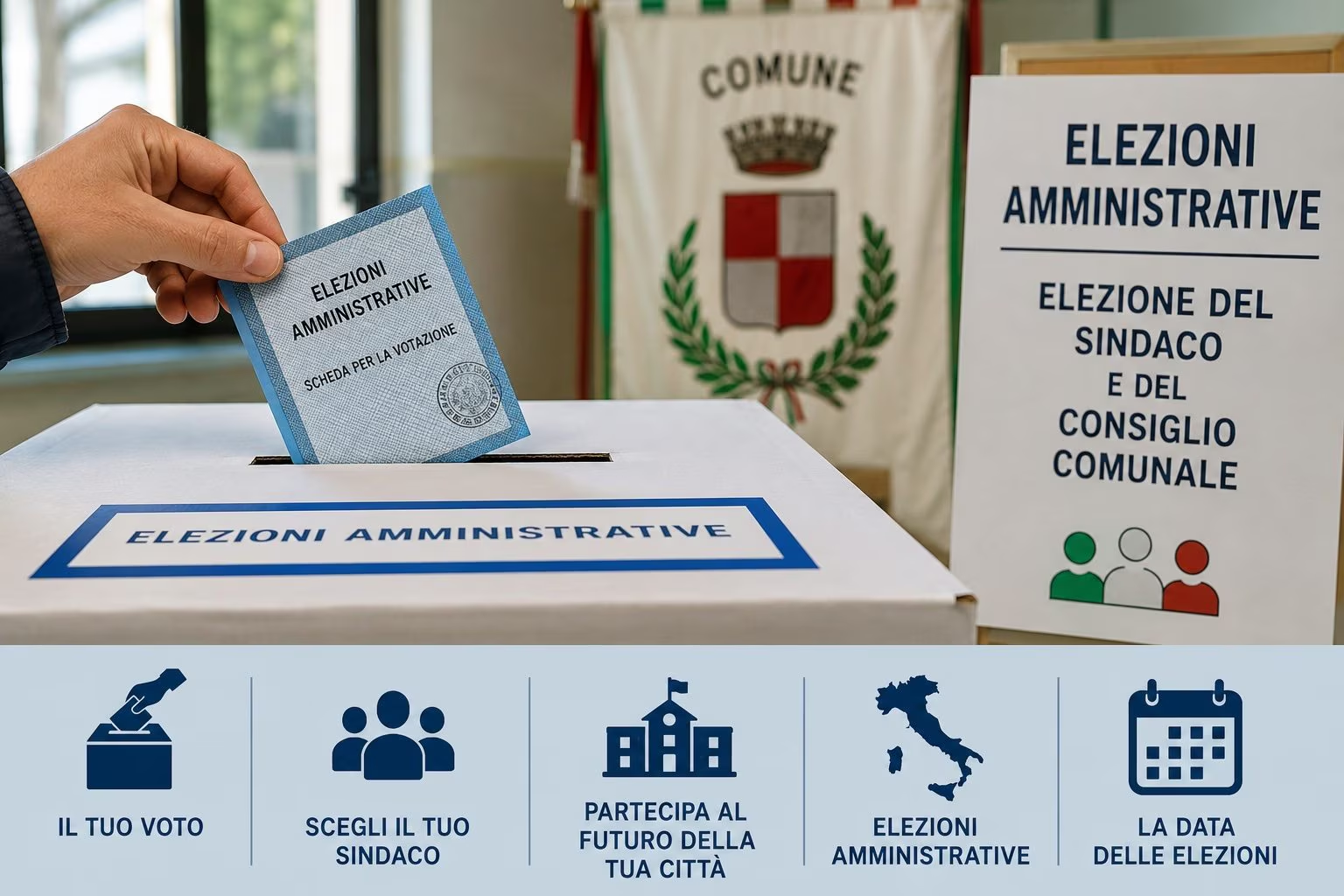
Local elections are held to elect mayors and municipal councils. They are held at different times depending on the municipality because the mandates of the mayors do not expire at the same time (in the past, many mayors have resigned or been disqualified: consequently the mandate lasted shorter and early elections were held). The administrative elections 2026 in the regions with ordinary statute, in Friuli-Venezia Giulia, Sicily and Valle d’Aosta are scheduled for Sunday 24th (from 7am to 11pm) and Monday 25th May, with a run-off round on 7th and 8th June. In Trentino-Alto Adige on 17 May, with a run-off on the 31st, in Sardinia 7-8 June, with a run-off on the 21st and 22nd.
The administrative electoral system provides for the direct election of the mayor. In municipalities with more than 15,000 inhabitants there is also a second round, the run-off, between the two candidates who have obtained the most votes (if a candidate obtains an absolute majority in the first round, the run-off is not held); in municipalities with a smaller population, a run-off is not foreseen and the candidate who obtains the relative majority of votes in the first round is elected.
The elected mayor obtains a pre-established number of municipal councilors, chosen from among the candidates of the lists connected to him, based on the number of preferences. In administrative elections, the municipal council is not elected, which is a sort of local authority government and is made up of councilors appointed by the mayor.
What are local elections and what are they for?
Local elections are elections to elect mayors and municipal councils. They are therefore different from political elections (which elect deputies and senators), from regional elections (which elect president and council of the region) and from European elections (which elect members of the European Parliament).
The administrative elections are held at different times depending on the municipality because the previous council meetings (i.e. the mandate of the mayor and councilors) did not have the same duration: in many cases the mayors resigned before the end of their mandate and, consequently, it was necessary to call the next electoral consultation in advance. As a result, elections are held on different dates. However, for practical reasons, the elections of the municipalities in which the mayor’s term of office falls in the same period are generally held on the same day.
Until 2014, provincial elections were also included in the administrative elections, which were used to elect the president of the province and the provincial council. However, since 2014, universal suffrage elections have been replaced with second-level elections: only the mayors and municipal councilors of the municipalities participate in the vote.
How to vote: the threshold of 15,000 inhabitants
The administrative electoral system is centered on the direct election of the mayor. The names of the candidates are shown on the ballot paper.
However, the system changes depending on the size of the municipalities. In those with a population exceeding 15,000 inhabitants, one or more lists of councilor candidates are linked to the mayoral candidate; voters vote for a mayor, for a list (not necessarily among those connected to him: split voting exists) and can express up to two preference votes for councilor candidates (of two different genders). In the event that no mayor obtains an absolute majority of the votes (50% + 1 of the votes), a second electoral round, the run-off, is scheduled between the two mayoral candidates who obtained the most votes (there is no run-off between the lists). The run-off is held two weeks after the first round (in the case of the elections of 24 and 25 May, it will be held on 7 and 8 June).
The elected mayor has 60% of the councilors (unless he has obtained a higher percentage of votes); the remaining 40% is divided among the defeated candidates. The councilor candidates who have obtained the highest number of preferential votes are elected.
In municipalities with less than 15,000 inhabitants the system presents some differences. First of all, there is no run-off: the mayor who obtains the most votes wins, even in a percentage lower than 50%. Two thirds of the seats are attributed to its list (or lists); the remainder go to the opposition lists. Split voting is not foreseen.
The electoral system is different in the regions with special statute (Sicily, Sardinia, Valle d’Aosta, Trentino-Alto Adige and Friuli-Venezia Giulia).
What functions do the elected bodies have: mayor and city councilors
In the administrative elections, first of all, the mayor is elected: he is the “head” of the municipal administration, he is the representative of the citizens, he can issue ordinances (including urgent ones), in some cases he acts as the representative of the State on the territory, he legally represents the municipality and, more generally, he has the task of implementing the council’s decisions and establishing the political direction of the administration. In essence, the mayor is a bit like a “president of the council” of the municipal territory.
In addition to the mayor, councilors are elected in the administrative offices, who form the municipal council. The number of councilors changes depending on the size of the municipalities: from 10 in municipalities with less than 3,000 inhabitants, to 48 in municipalities with more than 1,000,000 inhabitants (i.e. Rome and Milan). The council is a sort of “parliament”, in which the majority and opposition are represented, and acts as a steering and control body: it approves the budget, urban plans and all the most important documents; monitors the actions of the mayor and the council; can possibly disqualify the mayor, causing him to lose his confidence (which requires that a commissioner be appointed pro tempore and new elections are called).
The governing body of the municipalities is instead the council, made up of councillors, who are not elected by the citizens but appointed by the mayor from among the councilors or even from people not present on the council, to assist him in his government action. The number of councilors varies from 2 for municipalities with up to 3,000 inhabitants to 12 for municipalities with more than 1,000,000 inhabitants. Each councilor is assigned specific functions: urban planning, social policies, the budget, etc. This is a bit like what happens at a central level for ministers.
The powers and size of the council and council change in the special statute regions.