ChatGPT could soon change its face. After revolutionizing the way millions of people interact with artificial intelligence, OpenAI’s chatbot is preparing for a transformation that goes far beyond a simple graphic update or the introduction of new features.
The intent, according to what emerges from an investigation by the Financial Times which collects the testimonies of current and former OpenAI employees, is to overcome the traditional conversation-based model and transform ChatGPT into a platform capable of integrating specialized tools, intelligent agents and external services within a single ecosystem. A strategy that could redefine the very role of generative AI in the coming years and which is described internally as one of the most important evolutions since the birth of the service in 2022, and allow the company to build a sustainable business before arriving on the stock exchange at the end of the year.
What «Chat is dead» really means
Among the most interesting elements highlighted by the investigation is a phrase attributed by a senior OpenAI employee to the company’s top management: “Chat is dead”, literally “chat is dead”.
The statement may seem paradoxical, considering that ChatGPT is OpenAI’s best-known product today, but its meaning is very different. Chat is not destined to disappear, but continues to represent the main access point to artificial intelligence, without however being the center of the user experience.
The vision described in fact shifts the attention from simple conversation to the execution of concrete activities. From this perspective, dialogue with the user becomes the means through which to define an objective, while artificial intelligence takes care of the steps necessary to achieve it.
The goal is to turn ChatGPT into a complete platform
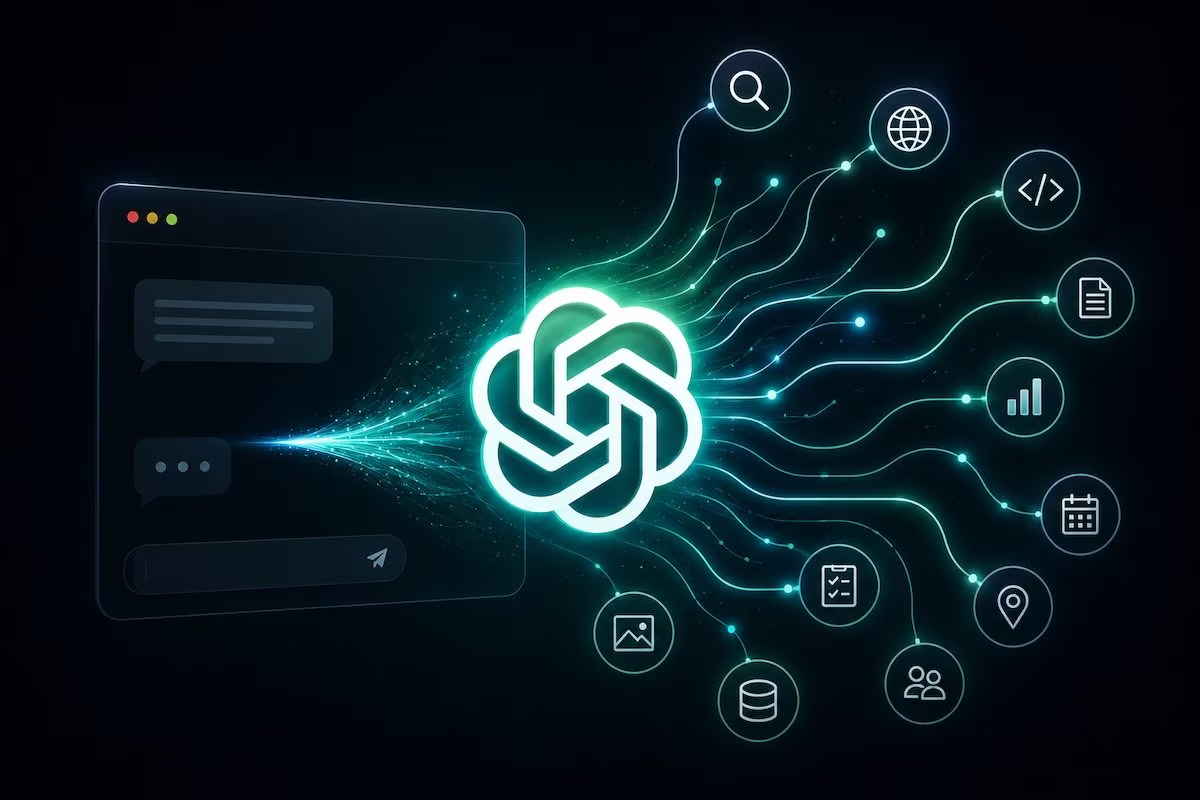
The project aims to evolve ChatGPT from a chatbot to a multifunctional platform. The idea is to concentrate a series of tools currently distributed across different applications and services in a single digital environment.
Already today, ChatGPT is able to write code, generate images, perform web searches and use external tools. However, the new approach outlined aims to take a further step forward, bringing these features from accessory elements to central components of the user experience.
Among the changes reported by the investigation there is also a revision of the interface, designed to give greater visibility to the advanced tools and make access to the various functions more immediate.
External partners already connected to the platform, such as Canva and Booking.com, also find space in this ecosystem. The mission is to make ChatGPT a single access point to numerous digital services, following a logic that recalls that of the so-called “superapps”, widespread especially in some Asian markets.
Why OpenAI focuses on intelligent agents
At the center of the new course are AI agents, i.e. systems designed to carry out complex tasks relatively autonomously. Unlike traditional chatbots, which simply respond to user requests, an agent can analyze a goal, plan a series of actions, and use different tools to achieve the desired result.
This is one of the most promising sectors of the entire artificial intelligence industry. It is no coincidence that companies such as OpenAI itself, but also Anthropic, Google and Microsoft are investing ever greater resources in the development of systems capable of automating activities that until recently necessarily required human intervention.
In this context, Codex, the OpenAI solution dedicated to programming assisted by artificial intelligence, takes on particular importance and is gaining ever greater importance within the company and could become one of the key elements of the future evolution of the platform.
The growing importance of the corporate market
There are not only technological reasons behind this plan. An important part of the initiative concerns the enterprise market, i.e. that of companies.
The investigation highlights how OpenAI is allocating more and more resources to professional products, considered fundamental for the future growth of the company. The intention is to increase the weight of business customers within the company’s turnover, leveraging advanced tools and intelligent agents.
The choice is part of a context of growing competition. In recent years, the generative AI sector has become increasingly crowded, with numerous organizations developing solutions aimed at both private users and the professional world.
For OpenAI, offering tools capable of carrying out concrete tasks can represent an important competitive advantage over traditional conversational chatbots.
How it could change the user experience
If the project were to materialize, the change could also be significant for users.
Today the use of ChatGPT is mainly based on a rather simple scheme: the user formulates a request and the system provides a response. In the future, however, the interaction could be much more oriented towards achieving a result.
For example, instead of asking for information about a trip, AI could be entrusted with the task of planning it or, again, instead of receiving instructions to carry out an activity, its execution could be delegated directly to the system.
OpenAI has not officially announced such a major overhaul of the platform, but the information gathered outlines a rather clear direction. More than decreeing the end of the chat, this strategy seems to mark the beginning of a new phase, in which artificial intelligence does not limit itself to responding to user requests, but aims to directly carry out an increasing part of the activities entrusted to it.