On 25 May 2026, in Rome, Ferrari unveiled the Ferrari Luce, the first fully electric car in the history of the Prancing Horse. A historic moment, and it is not an expression used by chance.
We at Geopop were present at the presentation as guests of Ferrari, with whom we have started an editorial collaboration.
I had the honor and pleasure of seeing the car in person, talking to the engineers, project managers, exploring the interior and exterior and telling you everything from the inside. What you read here is our complete story, with the official data, direct observations and reflections that this car aroused in me.
The exterior design of the Ferrari Luce
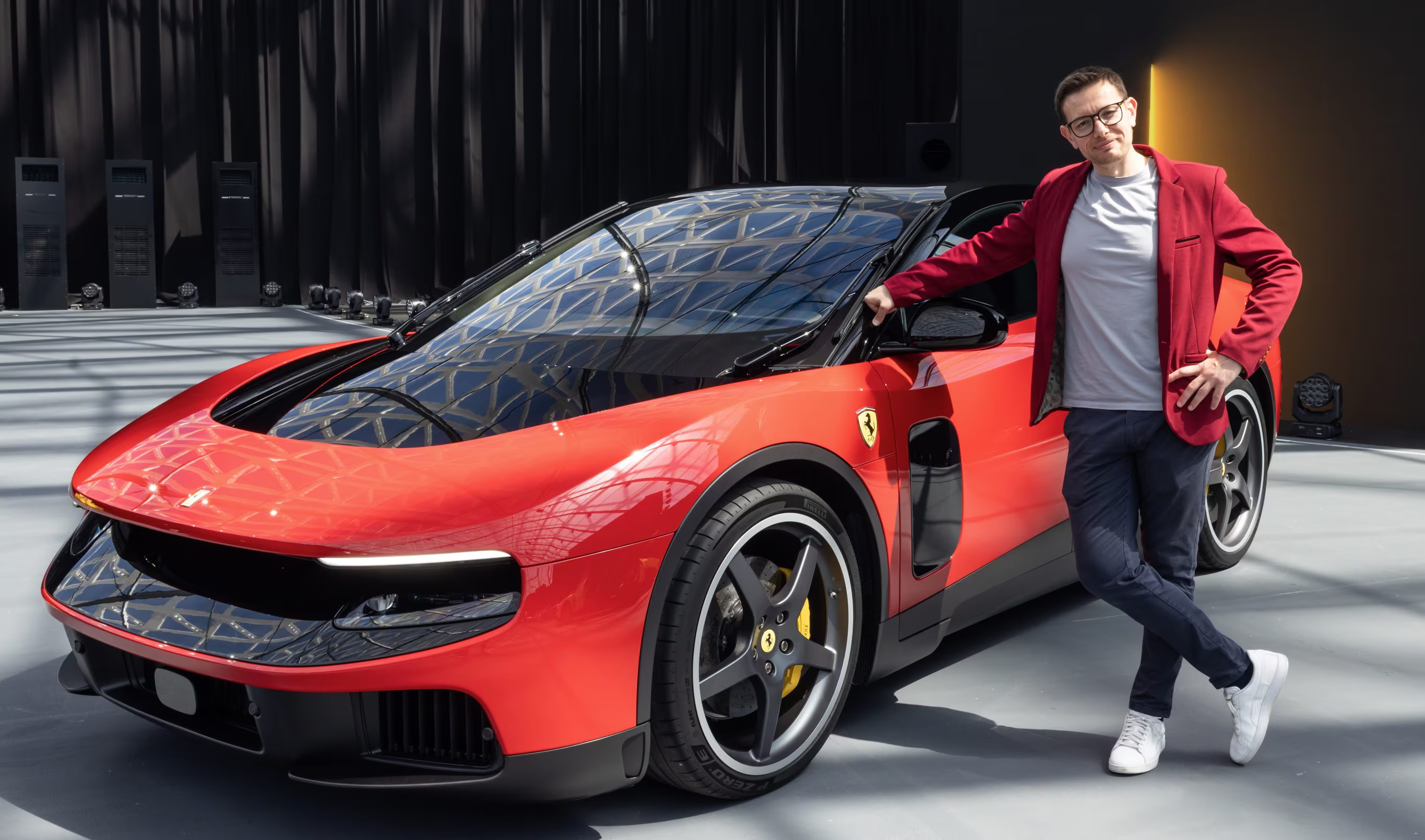
The exterior design surprises you: it’s not what you expect. The first thing that shocks you when you approach the Light is the hood. On classic Ferraris it is huge. On the Light it is short and short, because there is simply no need for it to be big. As the Ferrari engineers explained to me during the presentation, the short and low bonnet allows for an aerodynamic profile in direct continuity with the windshield. It is an aerodynamic advantage that cannot always be achieved on a car with a combustion engine: for many cars with a combustion engine (not so much for cars with a rear engine) you always need space for the engine and/or the air intakes and other things. Electric architecture, however, frees up the geometry of the car, and designers can design shapes that were previously physically impossible.
A glass bubble dressed in aluminum
If you look at the Luce in profile, the structure becomes clear: the passenger compartment is conceived as a large glass bubble, enveloping and continuous, which extends from the windscreen to the rear window without clear interruptions (to improve aerodynamics). It’s glass that dominates the top of the car, not “sheetmetal.” This bubble is then “dressed” by the aluminum bodywork, which envelops it from below. The result is a sensation of lightness and transparency that you wouldn’t expect from a 2,200 kg car: from the inside you have panoramic visibility, from the outside the Light seems almost suspended between glass and metal. It is an architecture made possible precisely by the absence of the combustion engine in front: without a high and long bonnet, the roof line can start much lower and the glass can dominate the profile.
The lighthouses: the East in front, tradition behind
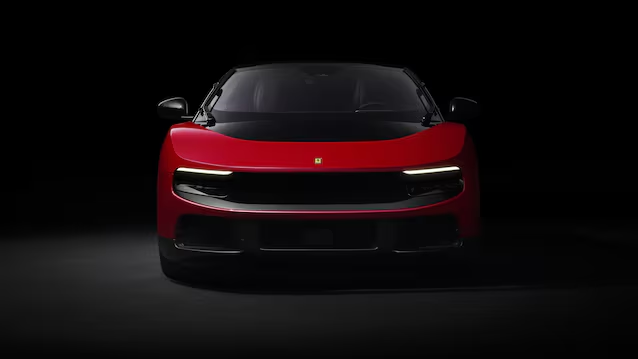
The front headlights (which I’m sure will make many people turn up their noses) have an elongated, tapered cut, reminiscent of something oriental. It is very likely that it is a choice designed to wink at Asian markets, in particular China, South Korea and Japan, which represent an increasingly important slice of global luxury customers. It is a design language that is perceived as refined and contemporary in those markets.
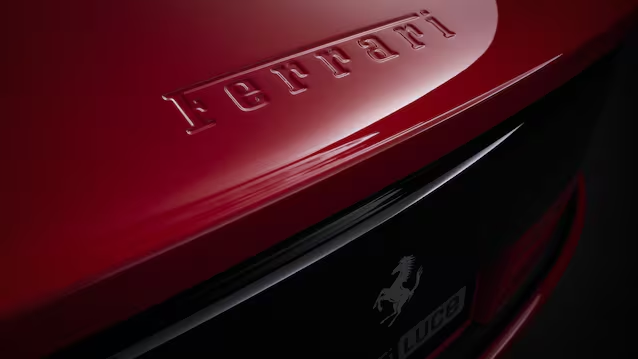
The rear, however, is a direct homage to the history of the Cavallino. The light clusters are circular, a reference to the Ferrari tradition that has characterized the tails of the Reds for decades. My personal interpretation is this: the eyes in front look to the future, those in the back to the past, or rather to tradition and history.
A Ferrari with a (large) trunk
There is a detail that those who know Ferraris will immediately notice: the Luce has a real, roomy trunk. Some might say “but Ferraris never had space”. Correct. But it wasn’t a stylistic choice: it was a physical limit. Until today there was no space because it wasn’t possible. Electric technology, on the other hand, allows you to have more internal and load volume for the same size. Translated: you can have a monstrously high-performance car, with five seats and a trunk. The concept remains: electric is a new concept, even of spaces: it would be foolish not to exploit them.
The overall proportions perhaps recall the 2011 Ferrari FF and the GTC4Lusso that was its evolution — the only front-engined four-seater Ferrari grand tourers of recent years. Light collects its formal legacy but translates it into a completely new language.
The interiors of the Ferrari Luce
You get on board and the first sensation is clear: it reminds you of the dashboard of one of those light planes.
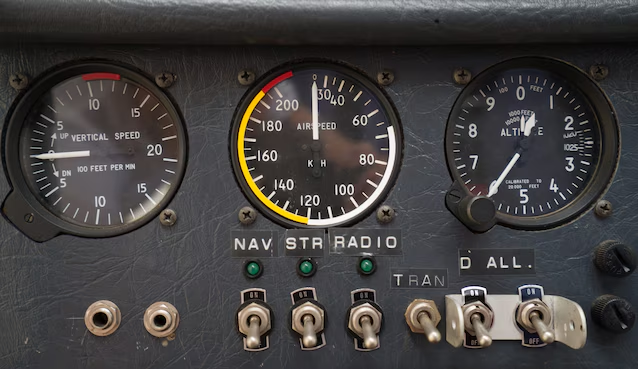
In a world where all electric cars look like smartphones on wheels — dominated by a huge screen instead of a dashboard — Ferrari called Jony Ive, Marc Newson and the LoveFrom studio, the minds behind twenty years of Apple products, to do the exact opposite.
The organizing principle is simple but revolutionary: the essential controls and feedback must be directly in front of the pilot. You don’t have to take your eyes off the road. No menus to search for, no screens to scroll. Everything at your fingertips. I very much agree with this choice: it is safer. Every second you spend searching for a menu on a touchscreen is a second you’re not looking at the road.
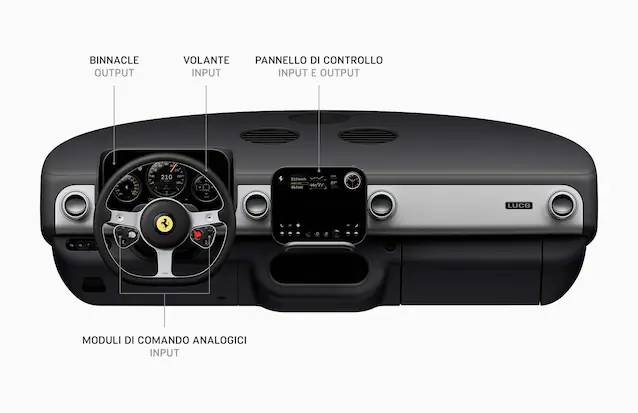
The steering wheel is made of aluminum milled from solid, pure design, homage to the Ferraris of the sixties and seventies. Above you will find two analogue control modules, which can be reached without taking your hands off.
On one side (on the right, the one in red) the iconic Manettino, which changes the dynamic character of driving, with the ICE, WET, DRY, SPORT and ESC modes (the latter mode means that all controls are excluded).
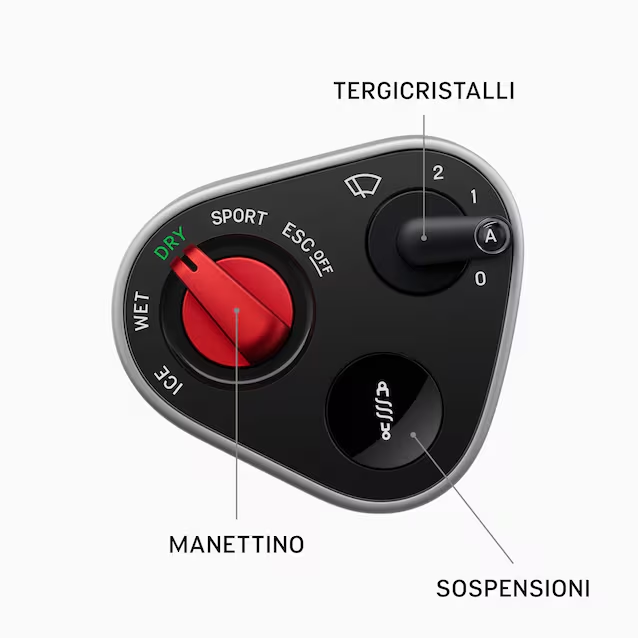
On the other hand, the new so-called e-Manettino, which manages the modes of energy use and autonomy (Range, Tour and Performance).
At the center of the passenger compartment: very high resolution OLED (touch) screen, laminated on glass, framed in aluminum milled from solid material. Behind, an aluminum bracket that forms the handle and hand rest.
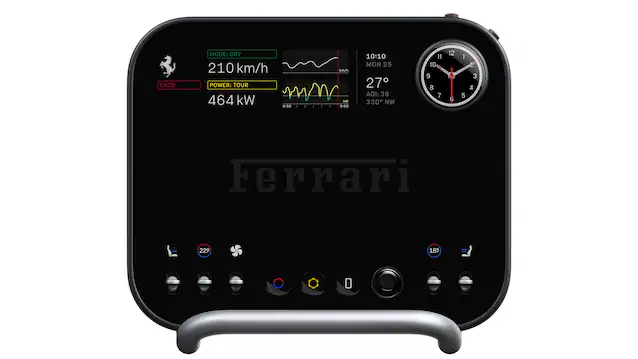
Below the screen, three physical levers: temperature, fan, seat heating/cooling.
Three central buttons. In an age where car manufacturers hide everything inside touchscreen menus six levels deep, Ferrari said: important things are done by pressing a button. The touchscreen is for advanced settings, not for those you need while driving at 200 mph.
The screen panel rotates: the rider and passenger can orient it towards themselves.
There is also the Multigraph, a multifunction instrument with mechanical hands and digital dial: clock, compass or chronometer. In Launch Control mode it automatically becomes a 5 second stopwatch.
The technology of Ferrari Luce
Under the body: four electric motors, two per axle, advanced all-wheel drive, each motor on a single wheel. Total power: 1,050 horsepower. Performance: 0-100 km/h in 2.5 seconds, 310 km/h top speed. For a 2,200 kg five-seater grand tourer, these are impressive numbers. The explanation lies in the physics of electric motors: the torque is maximum and instantaneous. There is no turbo lag, no rev rise times. Press the accelerator and the thrust is immediately there.
122 kWh battery pack. For comparison: a top-of-the-line Tesla Model S has around 100 kWh. The battery pack alone weighs approximately 600 kg.
Autonomy: approximately 500 km in the standard cycle. DC charging up to 350 kW. At that power, you can recover a good part of the distance in about 15 minutes. But be careful: 350 kW charging stations are not yet everywhere today, and the real autonomy depends on the driving style and the selected mode.
The suspensions
The Luce is a grand tourer, not a track car. The suspension is designed to offer a balance between comfort and grip: it must handle 2,200 kg on the road at high speeds, but also ensure a comfortable ride for five people with luggage. The weight of the batteries in the floor helps: the low center of gravity makes the car more stable and predictable than the weight would suggest. Ferrari has worked on the integration of the electric motors with the traction control systems to make the cornering response natural and progressive, despite the instant torque which could easily become a problem on a thousand horsepower car.
The levers of (non)”change”
Being electric, the car does not have a gearbox, but Ferrari has invented a new concept, which provides the driver with a “shifting” and “engine braking” experience similar to what happens on a supercar with a combustion engine.
The paddles behind the steering wheel have been reinterpreted and reconverted, let me explain: the one on the right controls the level of torque in manual mode, to make acceleration progressive; in fact the result is similar to a gear shift, so when you accelerate and insert a greater torque value, you have the classic “bang” of gear shifting.
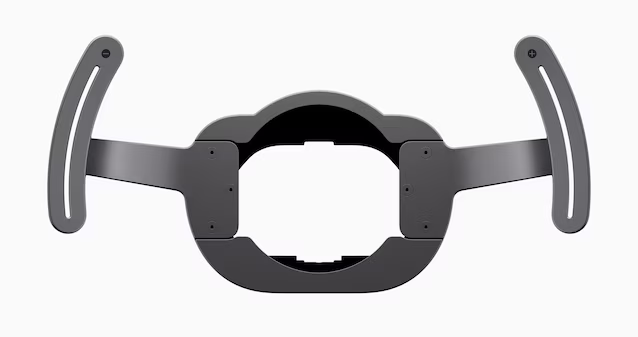
The other lever, the left one, regulates regenerative braking, that is, how much energy to recover when you leave the accelerator; translated, if you press the left lever you increase the braking effect, just like when downshifting in a car with a combustion engine. This thing is genius and I hope to try it one day!
An indicator above the speedometer signals the optimal moment to increase the torque level, just like the “lights” that lit up on Schumi’s steering wheel (in reality there is still this type of visual indication on F1 cars today). The paddles have a magnetic mechanism that returns clear, decisive, satisfying feedback. It’s a brilliant solution: in a car where gear doesn’t exist, Ferrari has given you something better to do with your fingers. Manual torque control is a feature that gives the rider the feeling of being an active part of driving, not a passenger on a very fast train.
And then there’s Launch Control. On the top panel there is a physical lever — a pull, not a menu — that activates the optimal start. Torque and stability are automatically adjusted, extra power is provided, and all Binnacle instruments turn orange to indicate maximum power is being delivered. A 5 second stopwatch starts on the Multigraph. In 2.5 of those seconds, you’re at 100 km/h.
The sound inside the passenger compartment: another brilliant gem
It’s the question everyone asks: what sound does an electric Ferrari make? There is no roar of the V12, there is no crackle of the exhaust. Ferrari didn’t add artificial sounds pumped out of the speakers, as many electric cars on the market do. In other words they didn’t want to “simulate the thermal”, rightly I dare say! It would not have been in line with a pure idea of electric.
The sound of the Light is the actual sound of its electric motors running. It may not seem like much, but it is a choice of design honesty consistent with the entire interior philosophy: nothing fake, nothing simulated. What you hear is what is there. The concept is like that of an electric guitar: without amplifier and without pick-up you hear very little, but it has a sound! Similarly, the Light has its “pickups”, that is, a sound amplification system, which comes out of the speakers. The intensity of the sound is linked to the mode: in sporty driving it is more intense.
How much does the new electric Ferrari cost?
Starting price: 550,000 euros. Ferrari is the brand that, more than any other, has embodied the combustion engine for eighty years. The roar, the pistons, the petrol, the mechanics. When a brand like this decides to make an electric car, it is not following a trend: it is telling the world that it is this too. And he’s saying it in his own way, with great courage, knowing that this car will cause discussion. Ferrari dared, and in my opinion, thank goodness: thank goodness that there are companies like Ferrari that dare to bring innovation not only technologically but also, and above all, in thought.
Summary technical sheet of the Ferrari LUCE
- 5 seats with 4 electric motors
- power of 1,050 horsepower
- 0-100 in 2.5 seconds
- maximum speed 310 km/h
- declared max autonomy of approximately 530 km
- 122 kWh battery
- DC charging up to 350 kW
- Price: 550,000 euros.