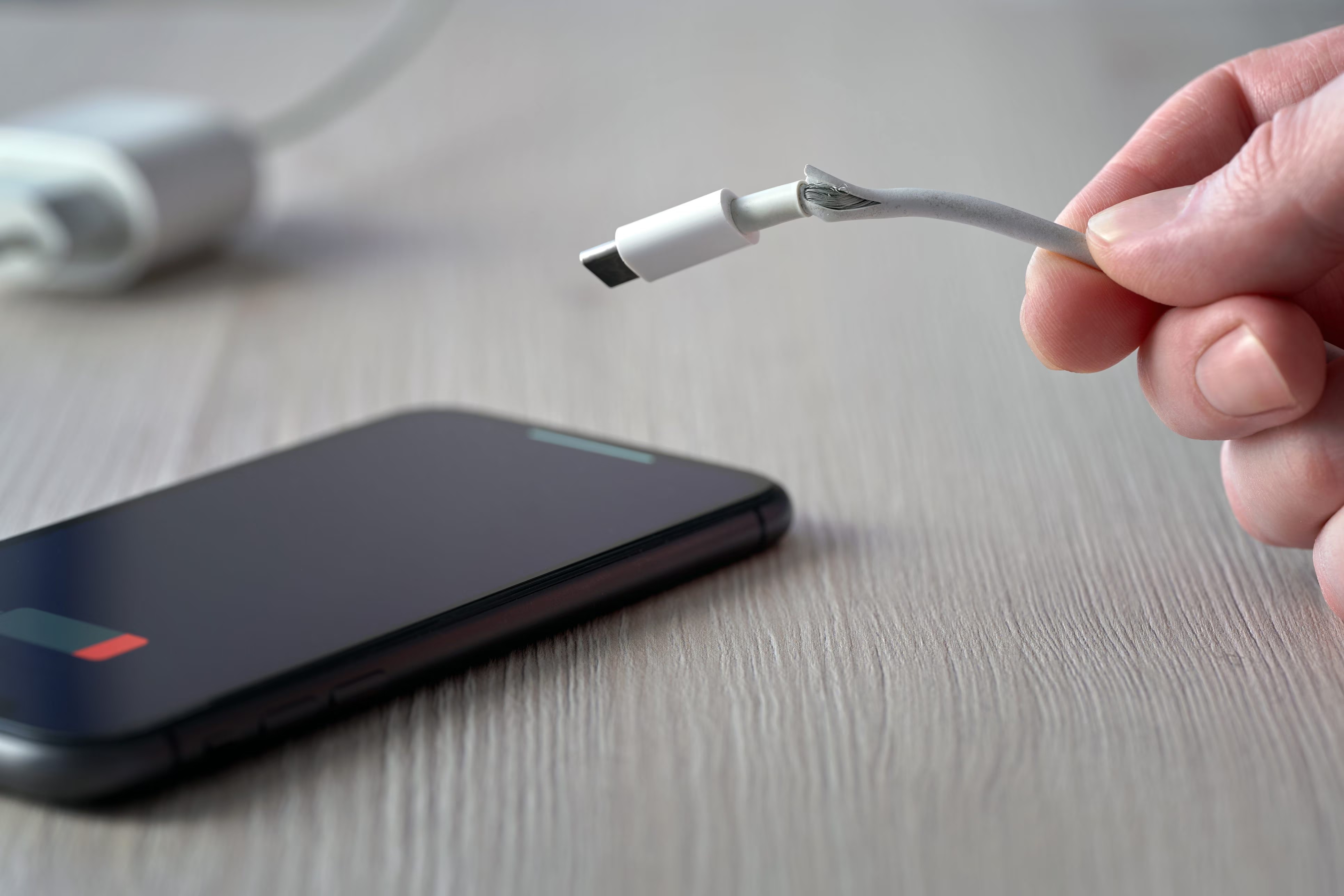
Probably you too, at least once in your life, will have disintegrated a charging cable, perhaps that of your smartphone. If you have happened to break more than one, you will probably have noticed that this one tends to get damaged near the connector, the end that we “attach” to the USB-C port of the phone to charge it. But why is that part the most easily damaged? The junction point between the flexible wire and the rigid pin constitutes a critical structural fulcrum where all mechanical stresses are concentrated. When we bend the cable at sharp angles, place the weight of the smartphone on the connector, or pull on the wire rather than the plug to disconnect it, we subject the thin internal metal conductors to mechanical stress that exceeds their elastic limit, leading to invisible microfractures and subsequent structural failure of the cable itself.
How the charging cable breaks
To understand the nature of this phenomenon, we must do a sort of anatomical analysis of the accessory. A common charging cable contains thin insulated metal filaments that transport energy. When we insert the plug into the device, the rigid part acts as a fixed anchor point. As a result, every movement or traction is discharged entirely on the end of the flexible wire, right next to the connector.
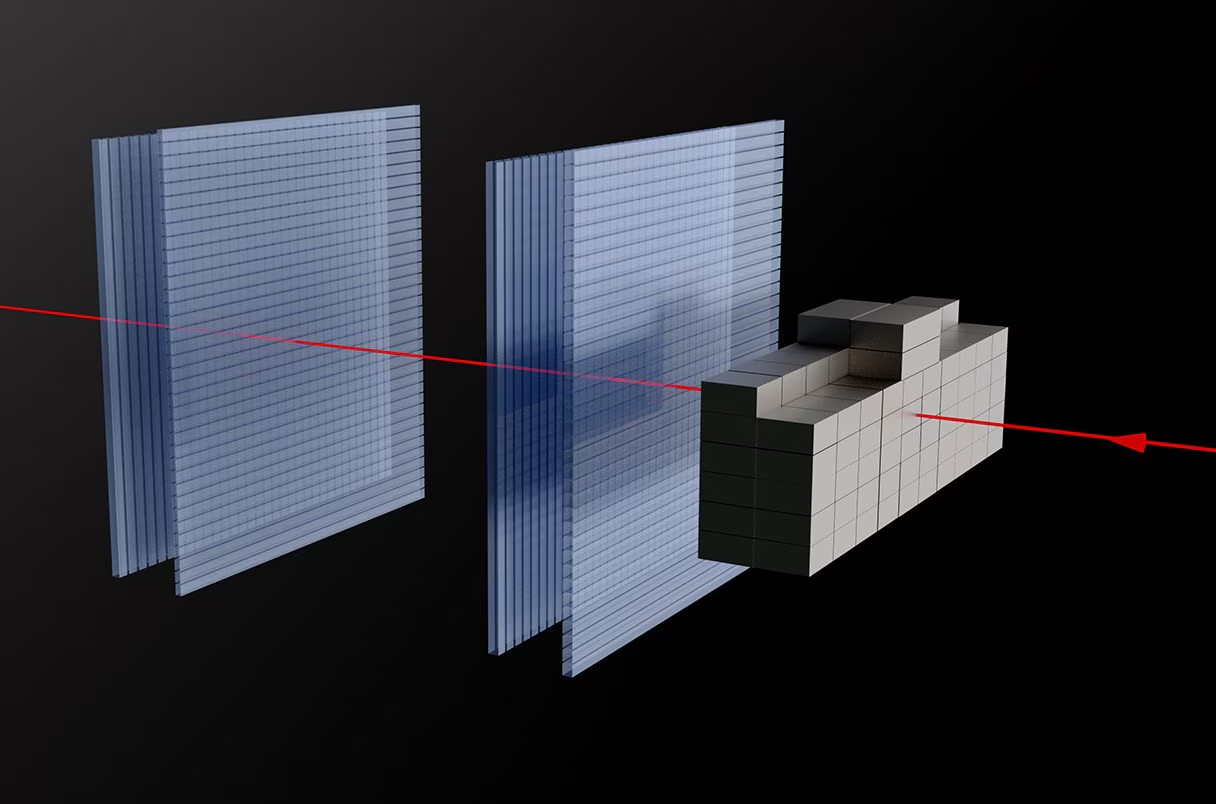
At the microscopic level, if we repeatedly bend a metal beyond its elastic limit, we induce the sliding of the crystalline planes and the accumulation of lattice dislocations. This process generates an accumulation of structural defects and, over time, these cause localized hardening of the metal which loses its ductility and ends up breaking irrevocably, interrupting the passage of current.
The prof. Robert Hyers, head of the mechanical and materials engineering department at the Worcester Polytechnic Institute in the United States, explains the phenomenon with an effective simplification:
At a microscopic level, bending it beyond the elastic limit causes the bonds between the atoms to break and reform, causing them to change position. This creates an accumulation of defects, called dislocations, in which the atoms do not align, like the folds in a carpet.
Incorrect behaviors to avoid
There are daily dynamics of use that drastically accelerate this deterioration. Let’s think about when we use the smartphone in bed or on the sofa while it is charging, forcing the end of the cable, bending it in an unnatural way, or when we pull the cable remotely to disconnect it instead of grabbing the power supply to disconnect it from the wall socket. Another common and harmful behavior for our cables occurs in cars, when we connect the phone and insert it vertically into the cup holder, discharging the entire weight of the device and the vibrations of driving exactly on the junction point.
In addition to physical stress, the environment plays a key role: high temperatures soften the internal insulating sheaths and accelerate the aging of polymers, while extreme cold makes plastic coatings rigid and prone to cracking.
How to prevent damage to USB cables
To prevent these problems and optimize the life of our accessories, prevention and purchasing choice are two factors that cannot be ignored. First, we need to make sure we use the correct length cables to avoid structural tension. When purchasing, it is advantageous to choose quality products that have a braided nylon or dense fabric shield rather than those with the classic plastic sheath, which is much more perishable. This configuration distributes tension forces more evenly along the cable body and offers superior mechanical strength.