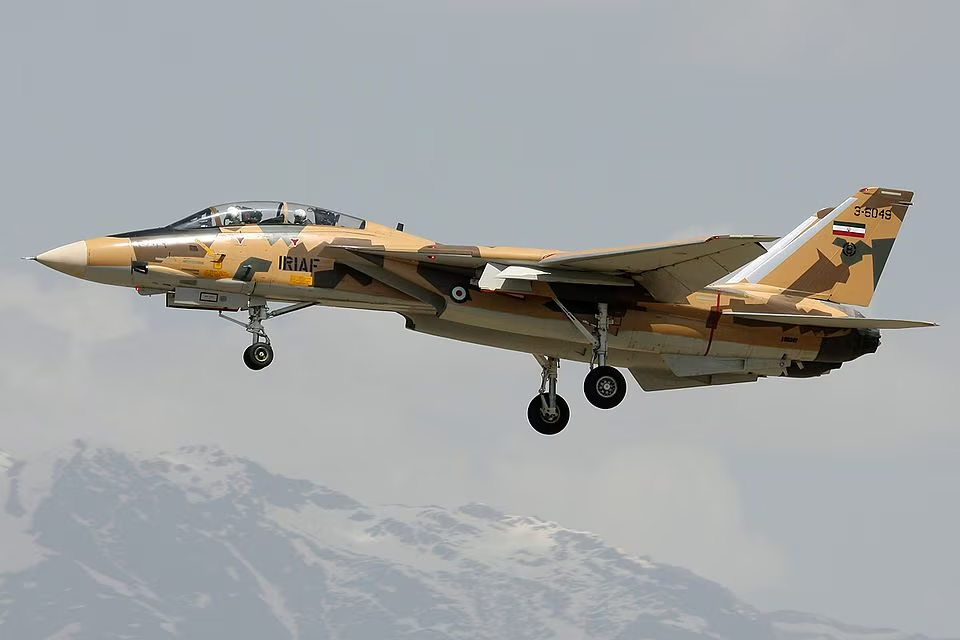
In the collective imagination, the Grumman F-14 Tomcat still constitutes the living representation of American air power in the second half of the 20th century. In addition to its excellent technical characteristics, this fame was also cemented by the success of some films in which it played a leading role, such as The Final Countdown (in Italian: Countdown size zero) of 1980 and, above all, Top Gun of 1986. However, few know that, in addition to the United States Navy, the Air Force of a country now considered a bitter enemy of the USA, Iran, have also used the Tomcat extensively for decades.
Iran’s “Persian King Project”: the agreement with the USA on aircraft
During the early 1970s, Iran, then under the leadership of Shah Mohammed Reza Pahlavi, was aiming to become the leading military power in the Middle East thanks also to the strategic partnership with the United States of America, which allowed Tehran to purchase the best in military technology from the conglomerates of the Stars and Stripes military-industrial complex. The mammoth Iranian rearmament plan was justified by the fact that the country perceived both the Soviet Union and the Arab countries of the region as threats to its survival and, at the same time, the leadership in power in the imperial palaces talked about the possibility for Iran to return to the ancient imperial glories of pre-Islamic Persia.
In this context, the “Persian King Project” was launched, on the basis of which the Shah negotiated the purchase, starting from January 1976, of 3 lots comprising 30, 50 and 70-75 aircraft respectively, for a total of 150-155 Grumman F-14 A-GR (depending on the sources consulted). The contract also provided for the training of flight crews and mechanics in the USA, the supply of large stocks of spare parts, logistical support in Iran by the Americans and access to the entire range of armaments supplied with the aircraft, among which the AIM-54A Phoenix long-range air-to-air missile stood out, a very powerful weapon developed by the Hughes Aircraft Company to be compatible with the F-14’s AN/AWG-9 detection radar. With the F-14A-GR/AN/AWG-9/AIM-54A combination in service with the IIAF (Imperial Iranian Air Force), Mohammad Reza Palhavi was confident that his country was capable of dominating the skies of the Middle East for at least the next 10 years.
Iranian Grumman F-14 Tomcats in the war against Iraq
The Iranian Revolution of 1979, the fall of the Shah and the establishment of a theocratic government led by Ayatollah Ruhollah Mostafavi Musavi Khomeini, quickly changed all the geopolitical balances in the region, transforming the Islamic Republic of Iran into a bitter enemy of the United States of America and of the West in general. Iraq tried to take advantage of this situation of general chaos which, under the leadership of Ṣaddām Ḥusayn ʿAbd al-Majīd al-Tikrītī, launched a military aggression against Iran on 22 September 1980 which began a major conventional war that lasted 8 years, until 1988.
At the outbreak of hostilities, the Iranian Air Force (now renamed IRIAF) nominally had a total of 77 F-14s spread across 5 incomplete-ranked squadrons. In fact, out of 150-155 aircraft ordered, only 80 had been built up to that point and of these 79 had been delivered to the Iranians between January 1976 and February 1979 while 1 had been impounded in the USA. Furthermore, 2 of the delivered planes had in the meantime been lost in as many accidents which occurred respectively on 30 April and 15 November 1977. The revolutionary chaos then led to the complete interruption of the supply of spare parts and logistical support by the Americans, as well as the implementation of real purges against military personnel deemed not sufficiently aligned with the dictates of the Khomeinist Revolution.
Despite this, driven by operational contingencies, the Iranians managed to overcome these difficulties and make profitable use of their F-14s during the war and, in the hands of expert pilots like Jalil Zandi, they transformed into authentic “bete noires” for their Iraqi counterparts. Overall, the Iranians lost 12 F-14s during the Iran-Iraq War, however only 5 of them were destroyed during the air combat while the Iraqis for their part complained about the shooting down of a number between 160 and 250 aircraft, depending on the sources, due to the action of the Iranian Tomcats, which would translate into a loss-victory ratio of 1:32 or even 1:50 in favor of the Iranians. Iranians.
A half-century-long career
At the end of the Iran-Iraq War, only about fifteen F-14s, out of a total of 65 that had survived the conflict, were still in condition to fly and, throughout the 1990s, the overall conditions of the flight fleet remained fluctuating given the changed Iranian strategic priorities in the post-war period. Things changed radically starting from 2002 when, in response to the invasion of Afghanistan in 2001, that of Iraq in 2003, the increase in hostility on the part of the United States and, finally, the outbreak of the Arab Spring and other armed conflicts in the Middle Eastern area, the political and military leaders of the Islamic Republic decided to invest again in their fleet of Tomcats by approving a two-track plan which first envisaged a restoration of the flight and combat capabilities of the aircraft and, secondarily, an ambitious program of modernization and updating of operational capabilities.
The plan to modernize and increase operational capabilities (called “Project Baba’i”) was officially inaugurated in 2012 when the first example of the F-14AM (with performance essentially comparable to that of the F-14D, the last variant of the F-14 produced by the United States of America before the aircraft was removed from service on 22 September 2006) was officially presented. According to the original plans, the aircraft should have been modernized at a rate of 5 per year in the IACI (Iranian Aircraft Industries) factories until 2024 when the program would have ended with the upgrade of the entire fleet which could thus remain competitive until 2040. The outbreak of the COVID-19 pandemic, in December 2019, and the subsequent economic crisis had the effect of slowing down the program, the end of which was postponed to 2030, leaving Iran today in possession of a mixed fleet of F-14As and F-14AMs.
Today’s situation in the war in the Middle East
At the outbreak of the new Great Middle East War, in the aftermath of the Hamas attack against Israel on 7 October 2023, the IRIAF had a total of 61 F-14s in service distributed between 3 different squadrons, having lost a total of 4 due to accidents over the 35 years following the end of the Iran-Iraq War (in 2004, 2012, 2019 and 2019 respectively). 2022). Being still the most powerful aircraft in service with the IRIAF today, it is therefore no coincidence that the F-14s have continued to serve on the front line during all the crises, small or large, that have affected Iran during this period of time, and given their potential danger, this has also made them priority targets for Israeli and American military planners during both the Twelve Day War of June 2025 and during the current Iranian War in 2026.
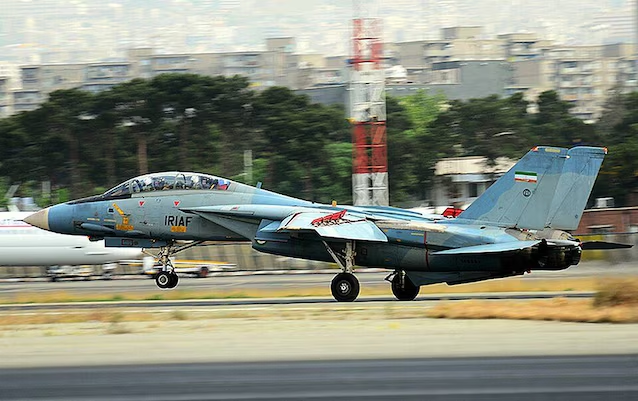
When commenting on the events of the last year, however, things become very opaque given the scarcity of reliable information and the massive use of propaganda by all the actors involved in the war events. During the conflict in June 2025, for example, the Israelis claimed on two separate occasions the destruction of 5 F-14s in the complex, publishing, in support of their claims, a couple of videos which received considerable media coverage but which in reality showed the destruction of fake mock-ups.
Equally difficult is the assessment of the current situation given that, in the face of the usual bombastic declarations about “the end of the Iranian F-14 fleet”, the photographic material published to date during the current Iranian War would seem to support the destruction of only two F-14s while during the weeks of the active conflict, despite the Internet blockade imposed by the authorities of the Islamic Republic, at least 2 videos have emerged which would show as many F-14s engaged in an attempt to intercept enemy aircraft exiting space Iranian plane. In any case, in the current state of affairs and given the scarcity of reliable information and the poverty of attention, talking about the “end of the F-14’s career” is still premature.