Not everyone has an air conditioner at home or at work, but we have certainly all seen and used one at least once. This device seems obvious to us today, but have you ever wondered who invented it?
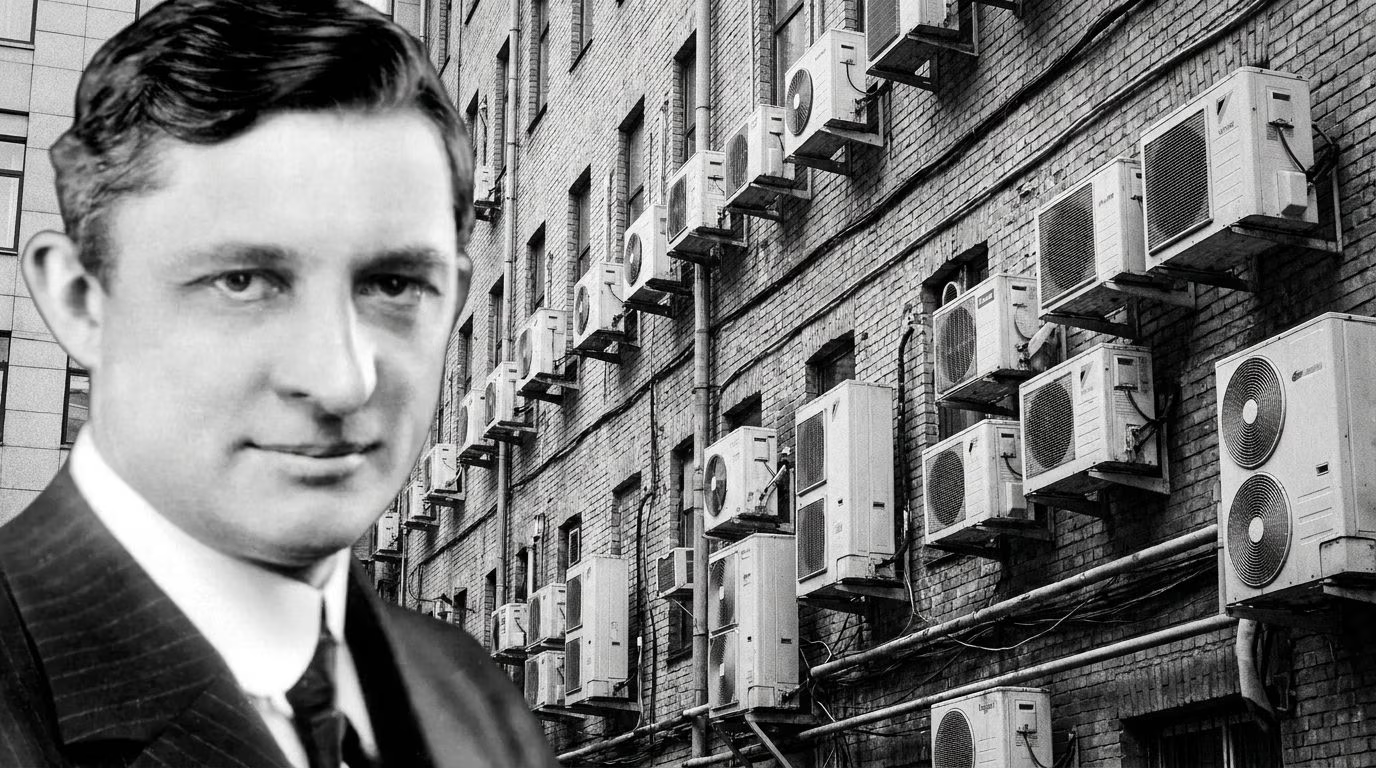
And most importantly, did you know that it was not originally created for the comfort of humans? In fact, the history of the modern air conditioner begins over a century ago to solve a problem that has nothing to do with our sweat, but rather with humidity and printed paper and the inks of Sackett & Wilhelms Lithographing & Publishing Company in New York. This invention bears the name of Willis Haviland Carrier, at the time a twenty-five-year-old freshly graduated engineer, named by Time Magazine as one of the 100 most influential people of the last century.
Carrier’s solution to a Brooklyn printing company’s problem
To understand how we arrived in the cool of our homes, we must go back more than a century, to the early 1900s. We find ourselves in a printing house in Brooklyn, New York, in 1902. Here, the continuous seasonal changes in humidity and temperature were causing quite a few problems: the paper, in fact, was continually wrinkled due to the humidity and the inks were not drying correctly, forcing the Sackett & Wilhelms to continuous production interruptions. To resolve the situation, the company relied on a young 25-year-old mechanical engineer who had recently graduated from Cornell University: Willis Haviland Carrier, born in 1876 in Angola, New York.
Carrier was tasked with finding a way to control the humidity of the air inside the building. It is said that the inspiration came to the engineer while observing nature and the reality around him in a moment of waiting. In fact, he was on the platform of a train station in Pittsburgh, in the fog, when he had the flash of genius. He realized that by passing air through water he could “dry” it, thus creating air with a specific amount of controlled humidity.
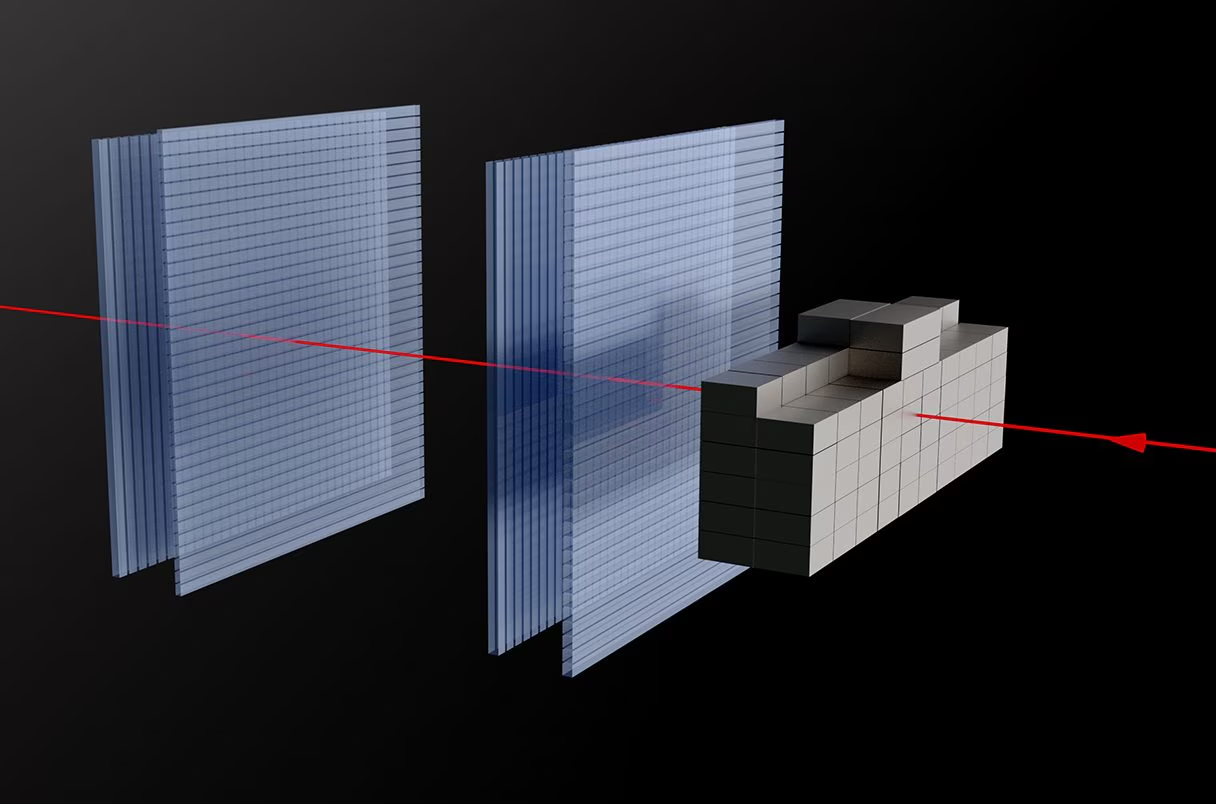
Thus, on July 17, 1902, Carrier completed the project and installed the world’s first modern air conditioning system inside the printing house. Taking inspiration from mechanical refrigeration concepts developed in previous years, Carrier’s system passed air through coils filled with cold water, cooling the air while simultaneously removing humidity from the environment. Previously, ventilation was increased to counteract it.
His system took up a physical principle theorized a century earlier by the English physicist and chemist Michael Faraday: the compression and expansion of a gas causes the gas itself to cool. Carrier’s real genius, however, was to confine the refrigerant fluid in a closed circuit, unlike previous systems which dispersed ammonia into the environment and could only be used for short periods.
So Carrier was the very first?
The one designed by Carrier was not the first artificial cooling system ever. In ancient times, the very first to use water to cool rooms were the ancient Egyptians: they hung wet mats at the entrance to the house. When the water evaporated, it reduced the internal temperature of homes and humidified the overly dry air. The Romans, on the other hand, exploited the aqueducts to circulate fresh water inside the patrician villas.
A few years before Carrier’s flash of genius, in 1886, the African-American inventor Lewis Howard Latimer, who worked as a draftsman and designer for Thomas Edison, had already patented an “Apparatus for cooling and disinfecting”. Even earlier, in the mid-18th century. In 1758, the American politician and inventor Benjamin Franklin, together with John Hadley, began to experiment with the cooling effects of certain liquids, having established that they are linked to the speed with which it evaporates. It was then in 1820 that the aforementioned Michael Faraday discovered that by compressing and liquefying ammonia and then letting it evaporate it was possible to cool the air inside his laboratory.
The device, presented by Carrier as the “Apparatus for Treating Air”, began to be called “air conditioning” a few years later: the expression was in fact later coined by another scholar, Stuart Warren Cramer, who had created a similar device. Carrier, in any case, is considered the “father of air conditioning” because he integrated the scientific method with technology by creating the first real machine capable of continuously and safely regulating temperature and humidity.
Carrier filed several patents: it was granted to him in 1914 as a “Method for humidifying the air and controlling its humidity and temperature”. The following year he founded Carrier Engineering Corporation. This invention, he said: “More particularly concerns methods or systems for humidifying and regulating the humidity and temperature of air in textile factories. However, the invention is applicable generally to humidifying and regulating the humidity and temperature of air, regardless of the use to which the air is put.”
In 1933, the Carrier Air Conditioning Company of America developed an air conditioner that used a belt-driven condensing unit, along with an associated fan, mechanical controls, and an evaporator coil. This device helped standardize modern residential air cooling systems and spread throughout the United States and beyond.
The air conditioning revolution in cars, cinemas and homes
If you think that the first air conditioners were as safe as today’s, you are wrong. The gases used initially, such as chloromethane and ammonia, were in fact highly toxic or flammable and the accidental failure of a compressor could be fatal. It was only in 1928 that these dangerous gases were replaced by Freon (chlorofluorocarbons), which were much less toxic to humans and flammable – although, sadly, we would discover decades later that they were harmful to the ozone layer.
Once made safe and its potential was understood, the air conditioner left the factories, to enter supermarkets, shops, offices, our homes and cinemas: in 1931 engineers HH Schultz and JQ Sherman developed the first air conditioner for homes, to be installed on windowsills; in 1939 air conditioning entered cars with the American company Packard and, later, in other means of transport.
The invention debuted in theaters in 1925 during Memorial Day weekend for the grand opening of the Rivoli Theater in Times Square, New York. It was such a success that within a few years Carrier installed its cooling units in around 300 cinemas throughout the United States: people began to flock to cinemas not so much for the films, defined as Blockbuster by the 1970s, but to find refuge from the suffocating heat, since it would still take time for the systems to spread into the homes of those who could afford it, by the 1950s. Even in Italy, where today more than one in two families have it – in the United States 9 out of 10! – air conditioning arrived after the Second World War.
Carrier died on October 7, 1950 and did not have time to see all the evolutions that his brilliant invention had in the following years and up to today. From there on, air conditioning changed the world, making possible not only modern offices and shopping malls, but even transatlantic travel and modern data centers.