The Prix Versailles has drawn up a ranking of the most beautiful museums in the world in 2026. There are seven awarded structures, scattered throughout the world: from the United Arab Emirates to the United States, passing through Uzbekistan, China and Japan. The awards, awarded every year at the UNESCO headquarters in Paris, have the aim of valorising the buildings that have the greatest ability to transform exhibition spaces into narrative places, where architecture becomes an integral part of the visitor’s experience.
Since 2015, the Prix Versailles has been one of the most prestigious international awards dedicated to contemporary architecture and rewards various categories of buildings: airports, hotels, restaurants, university campuses, sports facilities and, from 2024, also museums. In particular, in 2026 seven structures entered the list of “World’s Most Beautiful Museums 2026”, which highlights how contemporary museums are no longer just exhibition spaces, but true immersive experiences. Among the winners there is also a European museum: the Lost Shtetl Museum in Šeduva, Lithuania.
Zayed National Museum in Abu Dhabi
Inaugurated in December 2025 in the heart of the Saadiyat Cultural District, the great cultural hub of Abu Dhabi, the Zayed National Museum is dedicated to Sheikh Zayed bin Sultan Al Nahyan, founding father of the United Arab Emirates. Its six permanent galleries tell over 300 thousand years of history of the Emirati territory, from the Paleolithic to the contemporary era.
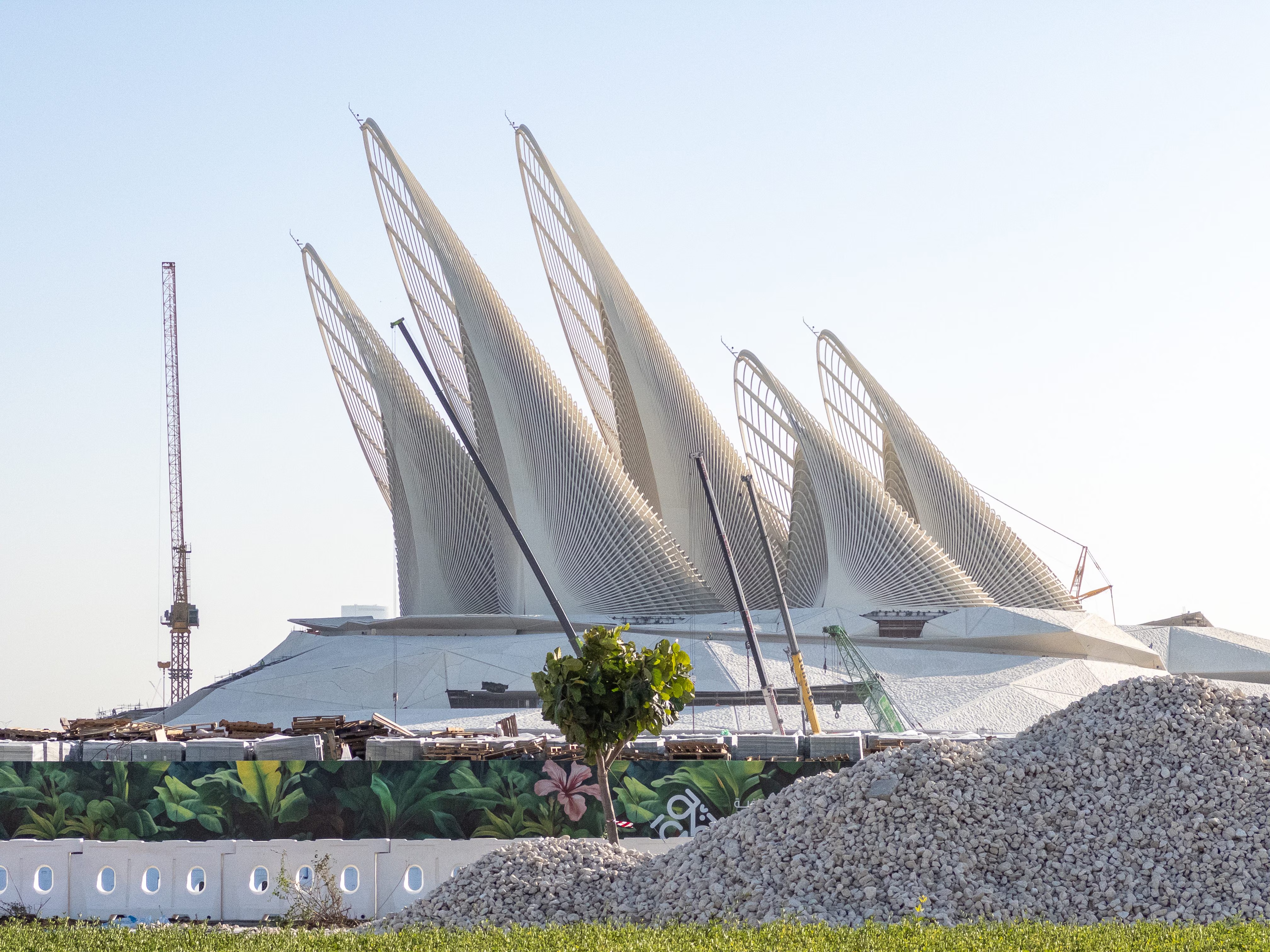
What is most striking, however, is the architecture of the building: 123 meters high, the museum is characterized by five steel towers inspired by the wings of a falcon in flight, symbol of the Emirati tradition of falconry. The towers do not only have an aesthetic function: they also act as natural thermal chimneys, promoting passive ventilation of the building and reducing its energy consumption.
Science and Technology Museum in Shenzhen (China)
The Science and Technology Museum in Shenzhen, China, is the first museum in the world dedicated to the theme of “digital civilization”. Opened in May 2025, its interior hosts around 950 installations dedicated to artificial intelligence, space exploration and intelligent industry. Even its architectural structure reflects the theme of the future: the museum resembles a gigantic spaceship that seems to emerge from the city. Furthermore, the facade is composed of approximately 95 thousand irregular stainless steel panels that create a unique color gradient that goes from intense blue to various shades of grey, depending on the light and the angle from which you look at it.

Xuelei Fragrance Museum in Guangzhou (China)
Among the most original museums in the ranking there is also the largest perfume museum in the world. The Xuelei Fragrance Museum in Guangzhou (China) tells the story of the evolution of fragrances from ancient ritual origins to the most modern production technologies. The structure is composed of eight large cylindrical volumes in red brick, inspired by the tools for distilling and refining the raw materials for the production of perfumes. Inside, around 300 interactive stations then transform the visit into an immersive sensorial experience, allowing visitors to explore aromas, raw materials and production processes.
MoN Takanawa: The Museum of Narratives in Tokyo
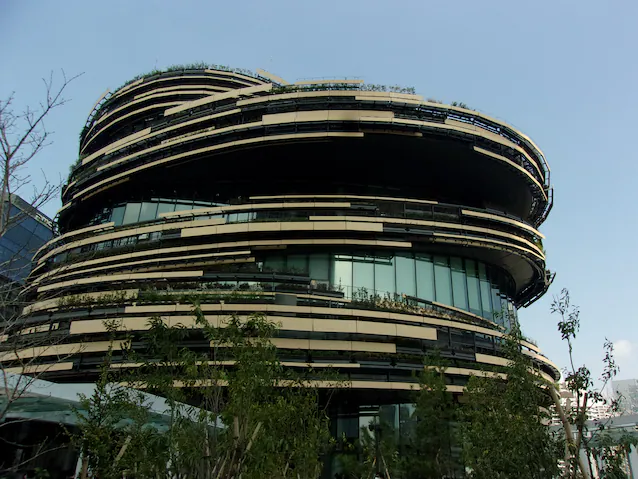
Opening in Tokyo in May 2026, MoN Takanawa is located within the large Takanawa Gateway City complex, built on the site of Japan’s first railway line. The museum focuses entirely on the concept of immersive storytelling in which architecture, scientific innovation and Japanese popular culture intertwine to transform the visit into an interactive experience through activities that range from performing to visual arts, also including manga, anime, music and gastronomy.
The facade, made of wood and laminated glass, develops in an ascending spiral integrating over 200 plant species and the final effect is that of a building that dissolves the boundary between inside and outside and changes appearance with the seasons. Just like the museum, which will be renewed twice a year through thematic programs involving Japanese and international institutions and creatives.
Lost Shtetl Museum in Šeduva (Lithuania)
The only European museum featured in the 2026 list is located near the historic center of Šeduva in Lithuania. The museum tells the story of a world that no longer exists, symbolically reconstructing one shtetl, the small Jewish villages of Eastern Europe destroyed during the Holocaust. The architectural design also recalls this idea: the museum is organized as a collection of individual houses, each dedicated to a different theme presented in the museum. The objective is, in fact, to create a route that allows visitors to immerse themselves in the cultural and social memory of the disappeared Jewish communities.
National Medal of Honor Museum in Arlington (Texas, USA)

Located in Texas, the National Medal of Honor Museum is dedicated to recipients of the Medal of Honor, the highest U.S. military honor. The building is supported by five enormous columns, each symbolizing one of the branches of the United States Armed Forces. At the center of the structure there is a large oculus which illuminates the internal spaces with natural light and symbolically recalls the US Space Force.
Center for Islamic Civilization of Tashkent (Uzbekistan)
The Tashkent Center for Islamic Civilization is the largest cultural, scientific and educational complex in Uzbekistan. In addition to the museum, it houses libraries, science laboratories, educational departments, traditional craft centers and a research institute. The architecture is inspired by the Timurid tradition, with large monumental portals and a central dome 65 meters high. One of the most spectacular environments is the Koran Room, where lights, sounds and multimedia elements are used to create an immersive and contemplative atmosphere.