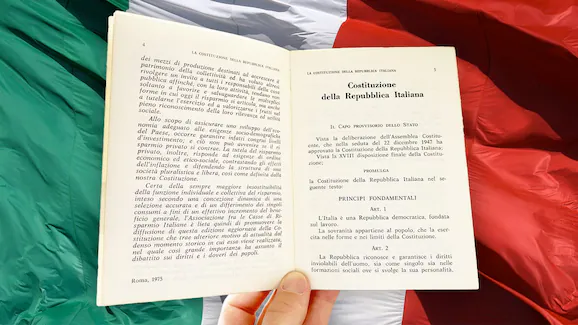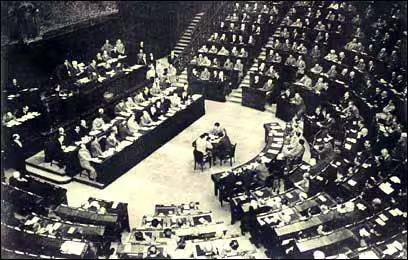
The Constitution of the Italian Republic was written by the Constituent Assembly, elected by the citizens on 2 June 1946 and composed of the exponents of the political parties that had led the war of liberation against fascism and against the Nazi occupation. The main political forces were the Christian Democrats, the Socialist Party and the Communist Party.
For the drafting of the text of the Constitution – the writing process of which was a great exercise in collective writing and political compromisedivided into precise phases -, a commission of 75 deputies was elected within the Constituent Assembly, which in turn appointed three subcommissions competent on specific matters. All articles were discussed in the plenary session. The final text of the Constitution was approved on December 22, 1947.
The composition of the Constituent Assembly: parties and deputies
The Constituent Assembly was elected by the citizens on 2 and 3 June 1946, at the same time as the institutional referendum through which the republican form of the Italian State was established.
The Assembly was composed of 556 deputies. It met at Palazzo Montecitorio and was supposed to close the works in eight months, but the duration was extended.
The exponents of the main anti-fascist parties, who had led the war of liberation against the dictatorship and intended to give a democratic order to the country, were part of the Constituent Assembly. The main parties that emerged in the June 2 elections were as follows:
- Christian Democracy, with 207 seats
- Italian socialist party of proletarian unity, with 115 seats
- Italian Communist Party, with 104 seats
- Italian Liberal Party, with 33 seats
- Everyman’s Front, with 30 seats
The other seats were allocated to smaller parties.
Among the members of the Assembly were the leaders of the main political forces, such as the Christian Democrat Alcide De Gasperi, who was also prime minister, the communist Palmiro Togliatti and the socialist Pietro Nenni. Among the other exponents, there were names who would have had a decisive role in the history of the Italian republic, to give a few examples: the Christian Democrats Amintore Fanfani, Giovanni Leone, Aldo Moro and Giorgio La Pira; the communists Concetto Marchesi, Giuseppe Di Vittorio and Umberto Terracini; the socialists Lelio Basso and Sandro Pertini.
Also present were internationally renowned intellectuals such as the economist Luigi Einaudi and the jurist Piero Calamandrei, as well as political leaders of pre-fascist Italy such as Francesco Saverio Nitti, Ivanoe Bonomi and Vittorio Emanuele Orlando, who had been prime ministers before Mussolini’s rise to power.
Most of the deputies were male, but there were 21 women (admitted to voting only for a few months): the “constituent mothers”.
The parties of the Constituent Assembly had unanimously led the Resistance against fascism, gathered in the National Liberation Committee, and, at the time of the election of the Assembly, they governed the country together through a government of national unity, presided over by De Gasperi and composed of exponents of different political forces. However, profound ideological differences existed among the parties of the Constituent Assembly and in May 1947 national unity failed: the Christian Democrats formed a government without socialists and communists. Nonetheless, the deputies of the Constituent Assembly worked harmoniously, even after the end of the government of national unity, and managed to produce an innovative document of exceptional value, which is our Constitution: “the most beautiful in the world”, according to a popular definition.
The presidents of the Constituent Assembly
The Constituent Assembly was presided over by two deputies. At the first session, Vittorio Emanuele Orlando was appointed provisional president, but Giuseppe Saragat, a socialist exponent and future president of the republic, was immediately elected as effective president. In February 1947 Saragat, who in the meantime had left the socialist party and had formed another party (Socialist Party of Italian Workers, then Social Democratic Party) was replaced by Umberto Terracini, a member of the communist party, who during fascism had spent long years in prison and confinement.
The functions of the Constituent Assembly
The Constituent Assembly was responsible, first of all, for drafting the text of the Constitution. However, in the absence of a Parliament (only the Constitution would have established its powers), the Assembly also carried out some typically parliamentary functions: it gave confidence to governments, approved electoral laws, ratified international treaties (including the peace treaty signed in 1947). The legislative power belonged, in theory, to the government, which could therefore enact laws, as parliaments usually do. However, by virtue of the country’s parliamentary tradition, the government often submitted the most important provisions to the Constituent Assembly for approval, which thus also found itself exercising legislative power.
The “Button Room”: the Commission of 75
The main task of the Constituent Assembly, as we have said, was to draft the Constitution. To prepare the draft text, the deputies elected a small group, the Constitution Commission, known as the Commission of 75, from the number of deputies that made it up. The Commission was made up of representatives of all parties, including 26 Christian Democrats, 13 Communists and 7 Socialists. Five women were also part of it: Maria Federici, Angela Gotelli, Angelina Merlin, Teresa Noce and Nilde Iotti. The president was Meuccio Ruini, a long-time politician, known for his skills as a mediator.
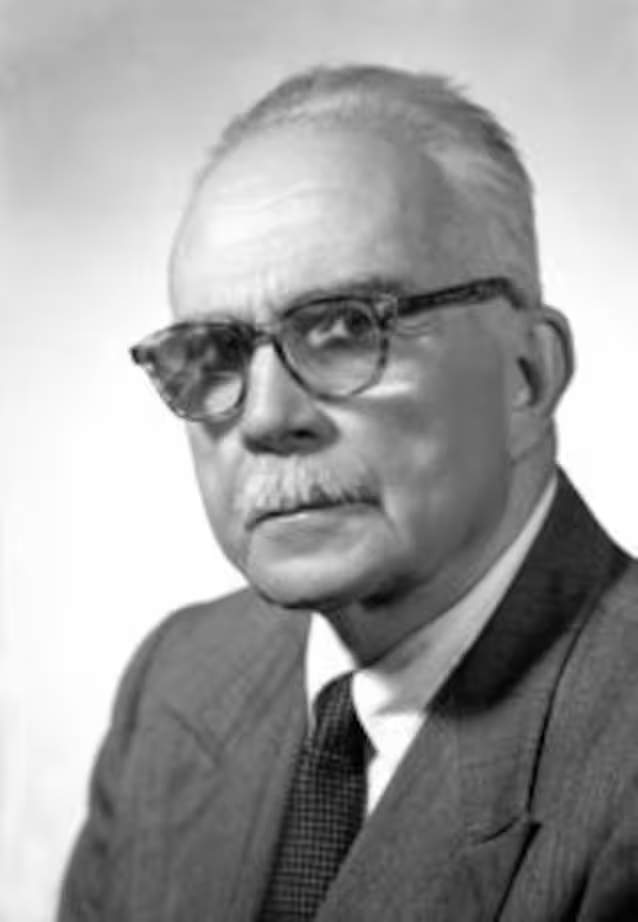
The Commission divided the work into three subcommissions, each of which was responsible for preparing the draft of specific parts of the constitutional text.
- Rights and duties of citizens, chaired by the Christian Democrat Umberto Tupini;
- Constitutional organization of the State, chaired by the communist Umberto Terracini;
- Economic and social relations, chaired by the socialist Gustavo Ghidini.
A smaller committee, made up of 18 deputies chosen by the Commission of 75, took care of physically drafting the text, harmonizing the drafts drawn up by the three subcommissions. The Commission of 75 finished its work on 12 January 1947. From the following 4 March the debate began in the chamber, with the participation of all the deputies: the articles were discussed and modified one by one. Some underwent changes only from the point of view of form, others were changed in a more substantial way.
For example, after the work of the Commission of 75, article one had this wording
Italy is a democratic republic. It has as its foundation the work and effective participation of all workers in the political, economic and social organization of the country. Sovereignty emanates from the people and is exercised in the forms and limits of the Constitution and laws.
In the classroom the text was modified and became what we know:
Italy is a democratic Republic, founded on work. Sovereignty belongs to the people, who exercises it in the forms and limits of the Constitution.
A linguistic masterpiece
The Constituents wanted the Constitutional Charter to be understandable to all citizens and not just to professionals. For this reason, they also paid particular attention to linguistic and stylistic aspects. A first revision of the language was made in February 1947, after the work of the Commission of 75, by the writer Pietro Pancrazi. At the end of the debate in the chamber on the individual articles, when the text of the Charter was already ready from the point of view of content, the famous Latinist Concetto Marchesi was commissioned to carry out a further revision to harmonize the language and style of the text.
In this way, a masterpiece was also created from the point of view of language: the text of the Constitution deals with a very complex matter in clear and understandable terms for everyone, without degenerating into forms of “legal” writing (as often happens with ordinary laws), and is therefore considered a model of normative writing.
The entry into force
The final text of the Constitution was approved by the Constituent Assembly on 22 December 1947 and was promulgated on the following 27 December with the signatures of the provisional Head of State, Enrico De Nicola, the Prime Minister, Alcide De Gasperi, the President of the Constituent Assembly, Umberto Terracini and the Minister of Justice Giuseppe Grassi. It came into force on January 1, 1948. The Constituent Assembly held its last session on January 31, 1948. A few months later, on April 18, the first parliament of republican Italy was elected.