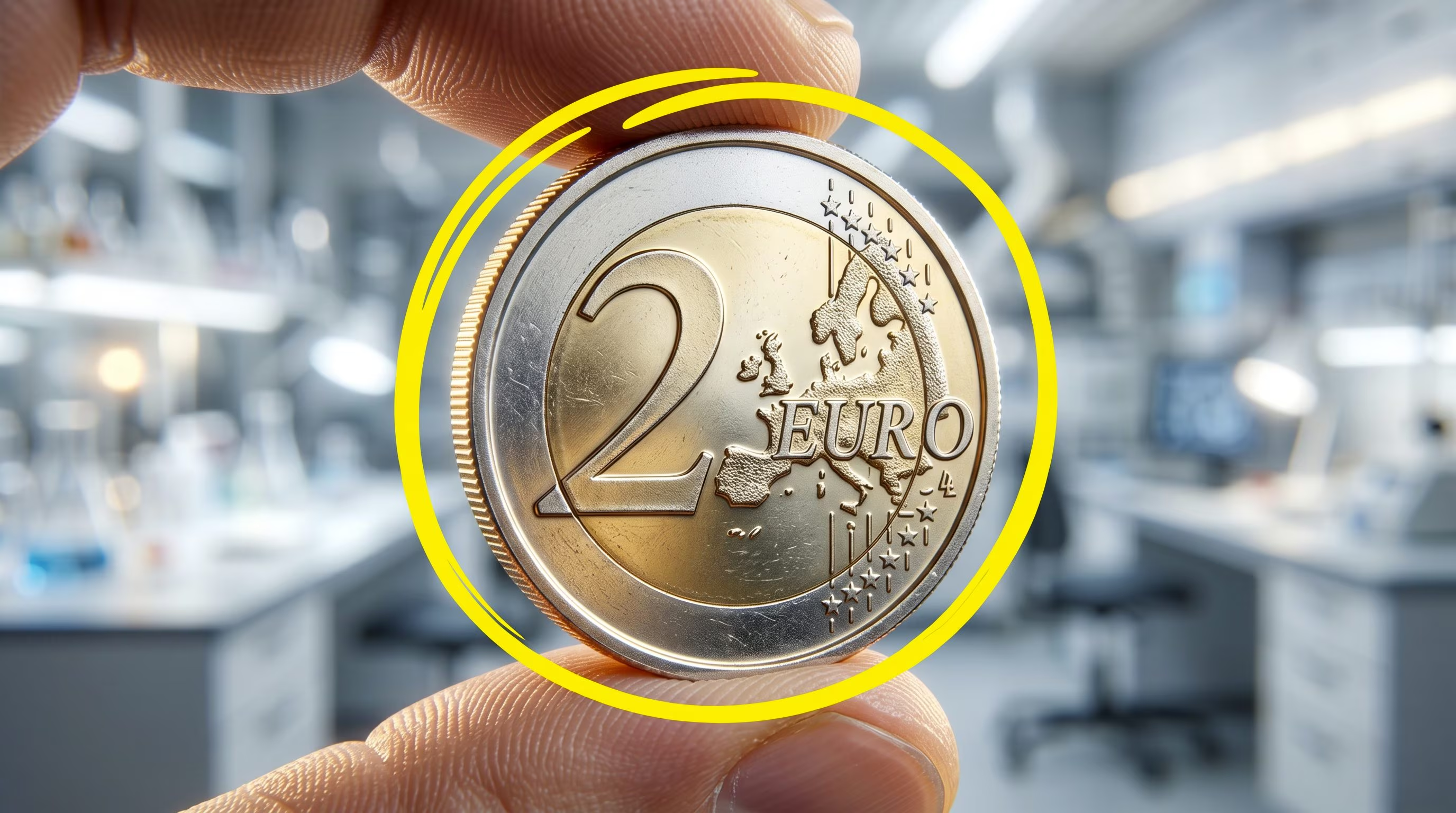
In Prato, a criminal gang that produced counterfeit 2 euro coins that were almost indistinguishable and spread throughout Europe was dismantled: the Prosecutor’s Office started investigations but, according to initial rumors, the fake pieces were produced for slot halls and bingo halls, resulting so similar to the originals that they could potentially even deceive the anti-fraud systems of the State Mint and the European Central Bank.
As also confirmed by the Bank of Italy, euro coins, like banknotes, have security characteristics that can be verified by mechanical devices: at the same time, however, there are also elements that we can verify independently without particular tools, such as colour, writing engraved on the edge or weight, or with the help of a magnet.
How to recognize a fake 2 euro coin? The details and the test of the magnet
The 2 euro coin is certainly the one most targeted by counterfeiters for a simple reason: it is the denomination with the highest value among the coins in circulation and is continuously exchanged in daily life. Precisely for this reason, it is also the one that incorporates the greatest number of safety features.
As indicated by the European Central Bank and the Bank of Italy, the 2 euro coin is made with bimetallic technology and layered composition, i.e. the internal disk (silver colour) and the external ring (gold colour) are composed of different metal alloys, assembled through a sophisticated manufacturing process.
This structure is not just aesthetic: it gives the coin very specific magnetic properties and is exactly what allows automatic devices (such as dispensers or change machines) to distinguish an authentic coin from a fake. The 10, 20 and 50 cent coins, however, are made with a special alloy called Nordic gold, used exclusively for minting and particularly difficult to melt, which makes it complicated to replicate.
A specific security element of the 2 euro coin is the writing engraved on the edge. Each country in the euro area has its own inscription: for Italian coins, for example, the number “2” and stars alternate on the edge in relief. The engraving is fine, regular and well defined and represents one of the first details to check.
In daily practice, therefore, there are elements that we can control even without professional tools:
- the first is the weight: an authentic 2 euro coin weighs exactly 8.5 grams. It is not something that can be verified by eye, but a coin that is significantly lighter or heavier than usual (perhaps perceptible to the touch when comparing it with others) can be a first sign.
- the second element is the border: the inscription must be clear and uniform. In fakes, the writing on the edge is often absent, incomplete or otherwise irregular.
- the third aspect concerns the reliefs on the two sides: in authentic coins the details of the design (both on the common side and on the national side, which varies between the EU countries that adopt the euro) are well defined and clear. In counterfeits, however, the reliefs tend to be flatter, blurred or with less precise contours.
- finally the last element, the colour: the chromatic contrast between the silver internal disc and the golden external ring must be clearly distinguishable. In fake coins the difference in tone may be less marked, or the two parts may have a more homogeneous appearance.
Then there is a final test that could be done with a simple magnet: authentic 2 euro coins, in fact, have a particular magnetic behavior thanks to their layered composition and are attracted slightly by the magnet (although not remaining strongly attached). Accordingly, if a coin does not react to the magnet at all or, on the contrary, sticks to it firmly, this may be a sign of a possible counterfeit.
How anti-fraud systems work and how much fake money is withdrawn every year
But, then, how do you spot fake coins and banknotes? The fight against the counterfeiting of euro coins in Italy is based on a multi-level system, which involves various bodies. The heart of the mechanism is the CNAC (Coin National Analysis Centeror the National Coin Analysis Centre), established in 2001 at the State Printing and Mint Institute (IPZS). The Centre, in fact, is the national authority which has the task of analyzing all suspected counterfeit coins found on Italian territory and represents the operational arm required by European legislation (EU Regulation 1338/2001).
The way it works is this: every time a so-called “cash handler” (such as banks, post offices, security transport companies or investment firms) comes into possession of a suspicious currency, it is obliged by law to withdraw it from circulation and send it to the CNAC for technical assessment. If the coin turns out to be fake, no refund will be given to the person who presented it. However, if it is authentic, the reimbursement is arranged by the Ministry of Economy and Finance through the Special Fund for State debt coins.
The work of the CNAC, however, goes beyond the single appraisal. Every type of counterfeit is studied and cataloged and the information collected feeds an archive that the police use to identify and dismantle clandestine mints. At a national level, coordination is ensured by the UCAMP (Central Anti-Fraud Office for Means of Payment), which operates within the Treasury Department of the Ministry of Economy and uses an IT system called SIMEC (Euro Card Monitoring System), capable of generating automatic alarms by cross-referencing withdrawal data with geographical and temporal factors.
UCAMP publishes every year a statistical report on euro counterfeiting, with data on coins and banknotes withdrawn from circulation. To give you an idea, in 2024 (last year available) many were seized in Italy 92,759 fake coins, of which well 78,800 in cuts from 2 euros, 8,032 in cuts from 1 euro And 5,782 in cuts from 50 cents. The overall value was almost 170,000 euros, with Lombardy being the region with the highest seizures: over the course of the year, 18,491 2 euro coins were seized (around 23.5% of the total).