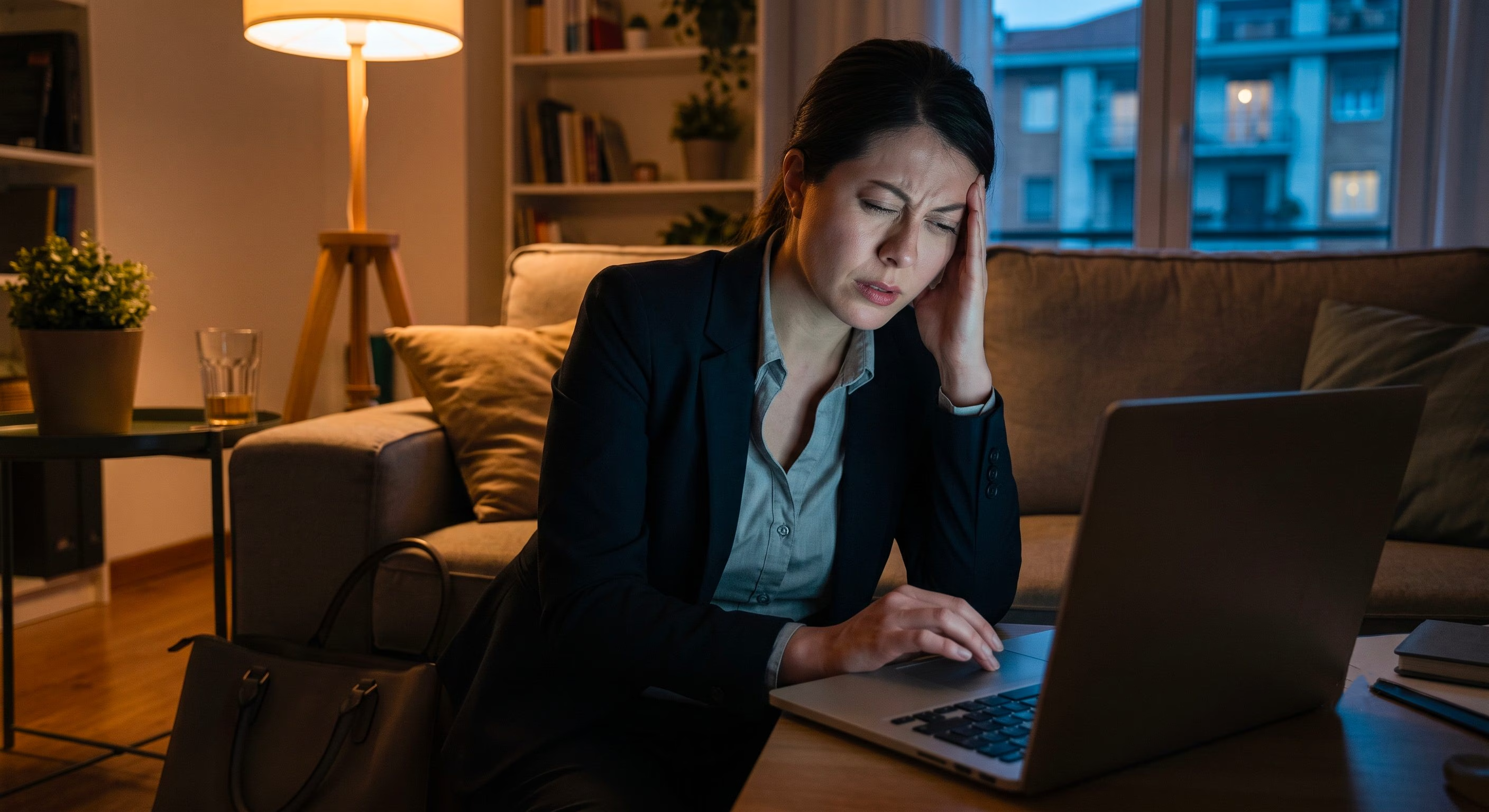
There is a psychophysical condition where you get sick regularly on weekends or when you start your holidays: it’s called “leisure sickness”. Imagine the scene: busy days at work, deadlines, stress, quick meals and little sleep. Then finally comes Friday evening or the first day of summer vacation. You sit on the sofa, relax and here they are: headache, tiredness or that annoying tingling in the throat that heralds the flu. You held out through the worst of times, and you get sick right now. But how is this possible?
That’s no coincidence: It’s a condition in which certain physical symptoms, such as migraines, chronic fatigue, muscle aches, nausea, and flu-like symptoms, appear just as work stress breaks down and the body finally goes into rest mode. The paradox is that this condition contrasts sharply with the almost absence of symptoms during the working period. In the midst of stress, that is, we are fine; as soon as we stop, the body seems to give way.
Does the “free time disease” really exist?
A team of Dutch psychologists from Tilburg University, led by Professor Ad Vingerhoets, gave scientific dignity to this dynamic. In the early 2000s, they analyzed a representative sample of the Dutch population to study how widespread this phenomenon was. The study data showed that:
- approximately 3% of the population (both men and women) reported getting sick when they were resting;
- the symptoms generally appeared on the second or third day of the break;
- in chronic forms, the phenomenon could last for years (often over 10) and was often associated with periods of strong psychophysical pressure.
Then, in 2007, Vingerhoets developed a “biopsychosocial” model to explain the phenomenon in more detail: in his scientific article “Leisure Sickness: a Biopsychosocial Perspectiveexplains how the “free time disease” is not simply a reaction of the body, but a complex response involving the nervous system, immune system and psychological factors.
In other words: the problem is not “relaxation”, but the way our body switches from stress mode to recovery mode.
Why it happens, between psychology and biology: the most common symptoms
We all know it: Under stress, we often function better than we should. Or rather, we resist. When we experience intense days, the brain enters an adaptation mode, activating a series of biological systems that keep us performing. The body increases the production of adrenaline and cortisol, hormones that serve to keep us alert and focused, to cope with frenetic rhythms. It’s a bit like when we lift a very heavy box: while we carry it, the body provides us with the energy to do it without feeling tired; when we place it on the ground we realize how much effort we have made. This artificial alert state helps keep inflammation on standby and supports our immune system.
There are two effects that we can notice:
- The “inertia” effect of stress, which prevents us from really stopping. According to Ad Vingerhoets’ biopsychosocial model, one of the central aspects of leisure sickness is the difficulty in transition between periods of high activation and moments of rest. After days or weeks of continuous stress, the body becomes accustomed to functioning at high speed; that is, the organism maintains a state of adaptation to daily demands: high attention, sustained pace, reduced recovery. Stress research shows that this state does not end instantly when the external stimulus ends (the body does not have an immediate ON/OFF switch).
In psychophysiology we talk about delayed recovery, that is, a gradual recovery: the systems that have supported the stress load take time to return to baseline levels. In other words, the brain continues to behave for a while as if there was still something to do: it’s that strange feeling when you’re finally free, but you can’t relax because you feel a sort of restlessness that pushes you to action. It’s like a high-speed train: the driver brakes, but the vehicle doesn’t stop immediately. It continues to roll along the tracks for a while, before stopping completely. - The “let-down effect”, when the body presents the bill. After a few hours, or at most a couple of days of rest, the brain finally realizes that the “threat” has passed and at that point, orders the engines to be turned off. And this is where what psychologist Marc Schoen called the “let-down effect” comes into play. Cortisol and adrenaline levels plummet. This sudden chemical change is the real trigger of the symptoms:
– the cerebral blood vessels, which had remained contracted for days due to the adrenaline, suddenly dilate together. This sudden vascular change is the scientific cause of the classic weekend migraine;
– the cortisol “shield” suddenly drops. All the latent inflammation, accumulated muscle pain, and viruses that had been kept at bay by the biochemistry of stress can emerge at once;
– furthermore, you may feel an emotional collapse or deep sadness.
Added to all this is cognitive distraction: during the week we are so focused on work that we actively ignore signs of discomfort. When we unplug, the mind frees up and we finally begin to perceive how exhausted our body actually is. In short, everything that remained in offline mode can emerge. As if the body and brain were telling us: now that you no longer have to resist, we can take care of everything else.
Who does it hit? The identikit of the perfect victim
Vingerhoets’ study traced a very precise psychological and behavioral profile of the people most exposed to leisure sickness. It does not affect everyone in the same way, but focuses on those with certain characteristics:
- Hyper-responsible and perfectionists: people who feel an enormous burden of responsibility towards their work and who struggle to delegate.
- Workaholics (workaholics): those who live according to work, maintain a very high pace and are never able to mentally switch off, not even in the evening.
- People with “switching” difficulties: subjects who have a strong psychological rigidity in moving from a situation of high activation (work) to one of total relaxation (holiday). Their body doesn’t know how to handle the “emptiness” of free time.
The leisure sickness it’s not just an organic matter. There is also the way we experience free time. For many people, accustomed to days marked by objectives, commitments and responsibilities, work is not just work: it is structure, identity, control. It’s something that fills our days, no matter how stressful it may be.
When this structure is abruptly interrupted – on the weekend, on holiday, or in a moment of break – not only does stress disappear: the mental system that organized the day also disappears. And this is where the discomfort emerges. During the week, in fact, the mind is constantly busy and this hyperactivation also functions as a sort of continuous distraction. In free time, however, mental silence increases and can become truly unbearable.
Many people report suddenly feeling restless as soon as they stop. After a few hours they feel the need to fill the time, to do something, to be productive. If your brain has learned that you are worth what you do, staying still can become destabilizing, even making you feel guilty, with an increase in anxious-depressive symptoms.
How to prevent
The good news is that yes, it can be avoided; or at least in part. The key is not to avoid rest, but to avoid abrupt transition. Vingerhoets himself suggests never going from 100 to 0 suddenly.
To “trick” the body and mitigate the hormonal collapse, experts recommend lightening the load in the days before the holidays, not concentrating all the stress in the last 48 working hours, maintaining regular sleep patterns and above all introducing small moments of recovery during the working week.
It could also be very useful to do physical activity on Friday evening or on the last day before holidays: physical effort limits work stress in a healthy way, helping the body to gradually dispose of adrenaline and make a smoother transition towards relaxation.
In short, the bottom line is that we don’t get sick when we’re stressed, but when we can finally allow ourselves to realize how stressed we were.