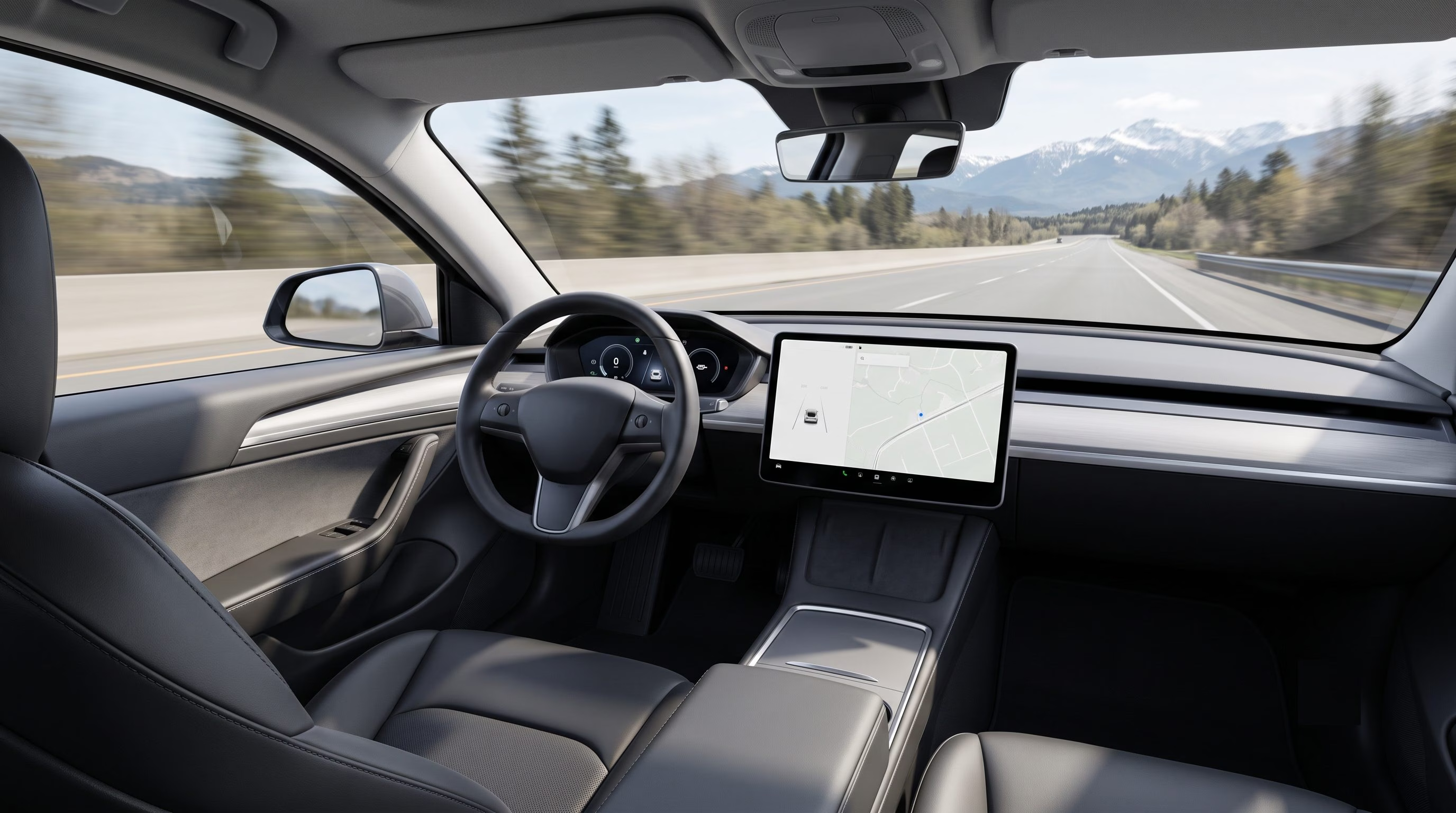
The images of the woman asleep at the wheel while her car was driving along a Canadian highway with two children on board quickly made the rounds on the web, bringing a very widespread misunderstanding back to the center of attention: confusing driver assistance systems with true autonomous driving. Beyond the responsibilities of the specific case, which the local authorities are investigating, the fundamental point is one: the cars on the market today are not capable of completely replacing the driver. Even the most advanced systems require the driver to remain alert and ready to intervene. So, was it legal for the driver to sleep while the car was moving? No. Even when automatic assistance systems are active, in fact, the driver remains responsible for driving and must maintain control of the vehicle. What happens in the video is not allowed either in Europe or Canada.
Autonomous driving: what levels of automation really mean
When we talk about autonomous driving we often tend to equate very different technologies. In reality there are different levels of automation, defined by the classification of SAE InternationalThat they range from level 0where the driver manages all functions, up to level 5which identifies a completely autonomous vehicle capable of moving without human intervention in any situation.
The most common cars on the market today mainly belong to level 2. These are ADAS systems (Advanced Driver Assistance Systems) which can simultaneously control acceleration, braking and steering in certain conditions, for example on the motorway or in heavy traffic. These technologies can make driving easier and safer, but they do not transform the car into an autonomous vehicle: The driver must continue to monitor the road, maintain attention and be ready to intervene.
Level 3 (currently approved in Germany on some vehicles) represents a further step: in specific and authorized conditions, the system can temporarily take over driving responsibility, allowing the driver to take his eyes off the road. However, the driver must still be available to take back control when requested and sleeping is absolutely not permitted. Levels 4 and 5 represent true autonomous driving, but today they are not a reality for private cars that can be purchased by citizens.
Do fully autonomous cars already exist? Yes, but not as personal cars
In some countries, such as the United States, China and the United Arab Emirates, There are already vehicles capable of operating without a driver on board thanks to level 4 systems or experiments close to level 5. The fundamental point, however, is that these cars cannot be purchased and used like normal private cars. They are mainly used as public transport services or autonomous taxis, operating within controlled areas and conditions. Cars that drive completely by themselves, therefore, exist, but no one can buy them and use them as a personal vehicle. This aspect is important to correctly interpret episodes like the one that occurred in Canada: the fact that some cities already have driverless “robotaxis” does not mean that a person can sleep while traveling in a normal car equipped with automatic systems.
What does Italian law provide?
In Italy research into autonomous driving has been ongoing for several years, but the use of automated vehicles on public roads is under scrutiny very strict rules. The main reference is the Smart Road decree, which came into force in 2018 and subsequently updated, which regulates the testing of automated vehicles on routes authorized by the Ministry of Infrastructure and Transport. The goal is to test not only the vehicles, but also the digital infrastructures necessary for the future development of autonomous mobility, such as vehicle communication systems, sensors and intelligent signage. However, during these experiments the presence of personnel capable of intervening if necessary is expected.
For cars on the market today the principle remains unchanged: driving responsibility remains with the driver. Assistance systems can help, but they cannot replace the driver. Falling asleep at the wheel while an automatic system is active therefore constitutes a violation of the rules, not only in Europe but also in countries such as Canada, where the driver must still maintain control and supervision of the vehicle.
Because Germany and France are ahead of Italy
If in Italy the spread of autonomous driving proceeds mainly through experimentation, other European countries have already introduced regulations more favorable to advanced systems. Germany was among the first European countries to adopt a regulatory framework dedicated to highly automated vehicles and allows the use of level 3 systems in specific situations, for example on certain motorway sections and with precise limits. Also France has updated its legislation to encourage the progressive introduction of automated vehicles and the development of the necessary digital infrastructure.
The difference between European countries, therefore, does not so much concern the availability of different cars, but rather the regulatory framework that establishes where and how certain functions can be used. Fully autonomous driving already exists in some parts of the world, but today it remains confined to dedicated services: it is not yet a technology that allows a private motorist to buy a car, activate autonomous mode and stop driving.