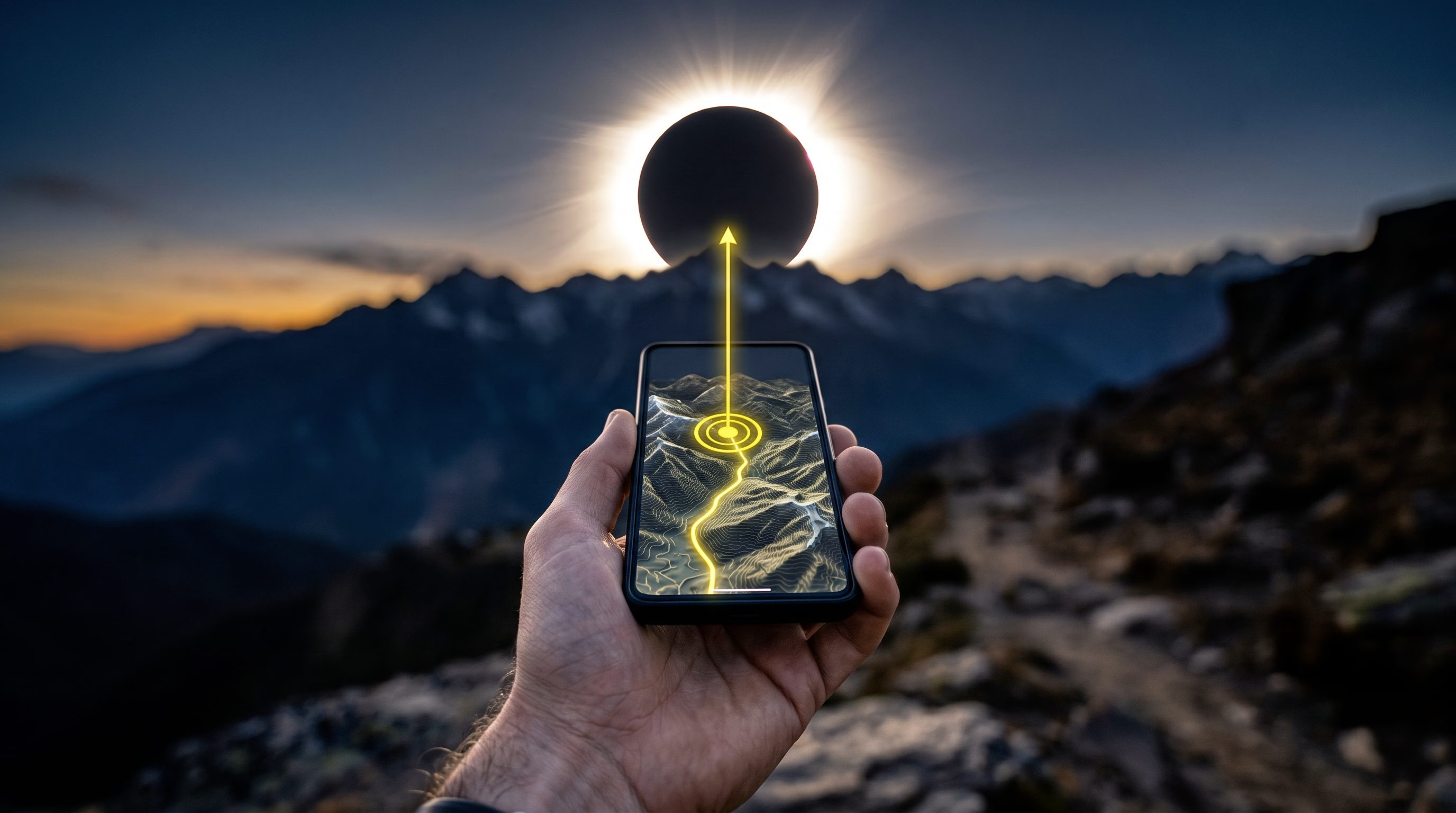
On 12 August 2026, Europe will experience its first total solar eclipse since 2006: for just over a minute the disk of the Moon will completely cover that of the Sun, just before sunset, in a band that will cross Greenland, eastern Iceland and above all central Spain, from Asturias to Valencia and the Balearic archipelago.
In total, according to Time and Date data, about 980 million people will be able to observe at least part of the eclipse, but only 0.19% of the world’s population (about 15.2 million people) will be in the range of totality.
In Spain, totality will occur around 8.30pm local time, with the Sun about 5° above the western horizon, therefore very close to sunset. This makes the choice of observation location even more critical than for other eclipses: any obstacle in the west direction (a building, a hill, even a group of trees) could compromise the entire experience.
In Italy the eclipse will only be partial, with coverage ranging from around 20% in Salento up to a maximum of 97.6% in the Asinara National Park and 94.9% in the Ventimiglia area. Much of the North, however, will have coverage of 90% and above.
But how to choose the exact point from which to observe? Today there are several digital tools that can make the difference in choosing the ideal place to admire the astronomical event of the year.
Apps and websites for planning eclipse observation
Planning your viewing spot in advance is essential, especially for an eclipse that will occur so close to the horizon. As mentioned, there are various applications and web platforms, free or almost free, that allow you to simulate the conditions of August 12th and check in advance whether a particular place will be suitable.
Stellarium: the pocket planetarium
Stellarium is a free, multiplatform software (also available as a smartphone app) that works as a sort of “personal planetarium”. In fact, it allows you to simulate the sky from any point on Earth, at any date and time. For the 2026 eclipse it is particularly useful because it allows you to set your location and the date of August 12 to see exactly where the Sun will be at the moment of totality and at what height above the horizon.
As the Institute of Astrophysics of the Canary Islands explains, Stellarium can be combined with the landscape profiles of PeakFinder to obtain an even more realistic simulation: it is possible to import the profile of the mountains and obstacles surrounding the chosen observation point and check whether the Sun will be visible or hidden by the relief. In practice, therefore, the eclipse can be simulated even weeks before it happens.
PeakFinder: the horizon profile at your fingertips
PeakFinder (also available as an app) is a complementary tool to Stellarium that generates a realistic profile of the mountains and landscape elements surrounding any observation point. Just enter the coordinates or name of the location and the site returns a 360° panorama of the surrounding relief, with the position of the Sun superimposed.
For an eclipse that will occur with the Sun very low on the horizon, this tool is invaluable: it allows you to understand if at the chosen point there are mountains, hills or other elements of the landscape that could obstruct the view towards the west at the decisive moment. Once a good observation point has been identified, it can be exported and imported into Stellarium for a complete simulation.
The Instituto Geográfico Nacional viewer: the official tool for Spain
For those lucky enough to observe the total eclipse from the Iberian Peninsula, the Spanish Instituto Geográfico Nacional has made available online an interactive map viewer and a dedicated mobile app, IGN Eclipses. This is the official tool of the Spanish government: it uses calculations from the National Astronomical Observatory and integrates meteorological data provided by AEMET (the Spanish Weather Agency).
The viewer allows you to search for any Spanish location and get precise information on the start and end times of the eclipse, duration of totality, percentage of coverage of the solar disk and height of the Sun above the horizon. The app is free, available for Android and iOS, and also covers the next two eclipses of 2027 and 2028.
The Compass app: the quick direction check
It may seem trivial, but one of the most useful tools for a first verification of the observation point is the Compass app, already pre-installed on most smartphones and smartwatches. If it is not present on your device, it can be downloaded for free on both iPhone and Android.
Its role is simple: once you know the exact direction in which the Sun will point at the moment of totality, expressed in degrees with respect to the North – information that can be obtained, for example, from Stellarium – just set it on the compass and point your phone to check whether the horizon at that point is free or obstructed.
In some cases the answer is immediate: if looking in the direction indicated by the compass you see the open sea or a completely clear plain, the place is in all likelihood suitable (clouds permitting). The situation changes when a relief appears on the horizon, a building or any element whose angular height cannot be assessed with certainty. In these cases the compass alone is not enough, because the naked eye assessment can be imprecise: it is better to rely on more sophisticated instruments such as those listed previously.
What characteristics should the ideal place to observe the eclipse have?
Beyond digital tools, there are some practical elements to keep in mind when choosing the observation point for the eclipse.
The most important factor is the completely free western horizon. The eclipse, in fact, will occur shortly before sunset, with the Sun a few degrees from the horizon. This means that even apparently small obstacles (such as a building a few hundred meters away, a row of trees, a hill) can completely block the view.
The second criterion concerns open and possibly raised spaces. Flat and clear areas, open fields, coasts facing west are preferable to wooded areas or dense urban centres. Even a slightly elevated position helps reduce interference and widen the viewing angle on the horizon.
The historical weather of the area is another element not to be underestimated. In Iceland, for example, 76% of August 12ths in the last 25 years have been cloudy, making it a risky destination despite the totality passing over Reykjavik. In inland Spain the chances of clear skies are decidedly more favourable: the Zaragoza area records just 20% of cloudy days in the same period, while on the Atlantic coast (Asturias) the figure rises to 50-60%. For those observing from Italy, north-western Sardinia has a probability of clouds of around 30%, compared to 40-60% in the North-West.
We must then consider accessibility and logistics. On August 12, a huge mobilization is expected towards the totality band, with mass movements and possible road congestion. It is advisable to choose a location that is easily reachable, arrive well in advance and have a plan B in case the day’s weather conditions require a last minute move.
A good method to test the chosen location in advance is to take advantage of the days in which the Sun occupies a position in the sky similar to the one it will have on August 12th. If from that point, looking west at the corresponding time (around 8.15pm-9.00pm depending on the area), the Sun is clearly visible above the horizon without obstacles, then the place is suitable. However, if it is hidden by buildings, vegetation or relief, it is better to change position while there is still time.