Today, 15 July 2026, the new Italian rules on shrinkflation come into force, contained in the legislative decree notified by the Ministry of Business and Made in Italy (MIMIT) to the European Commission on 15 April. The three months granted to the European Union for any disputes have in fact expired without requests for modifications: this means that the decree was tacitly approved.
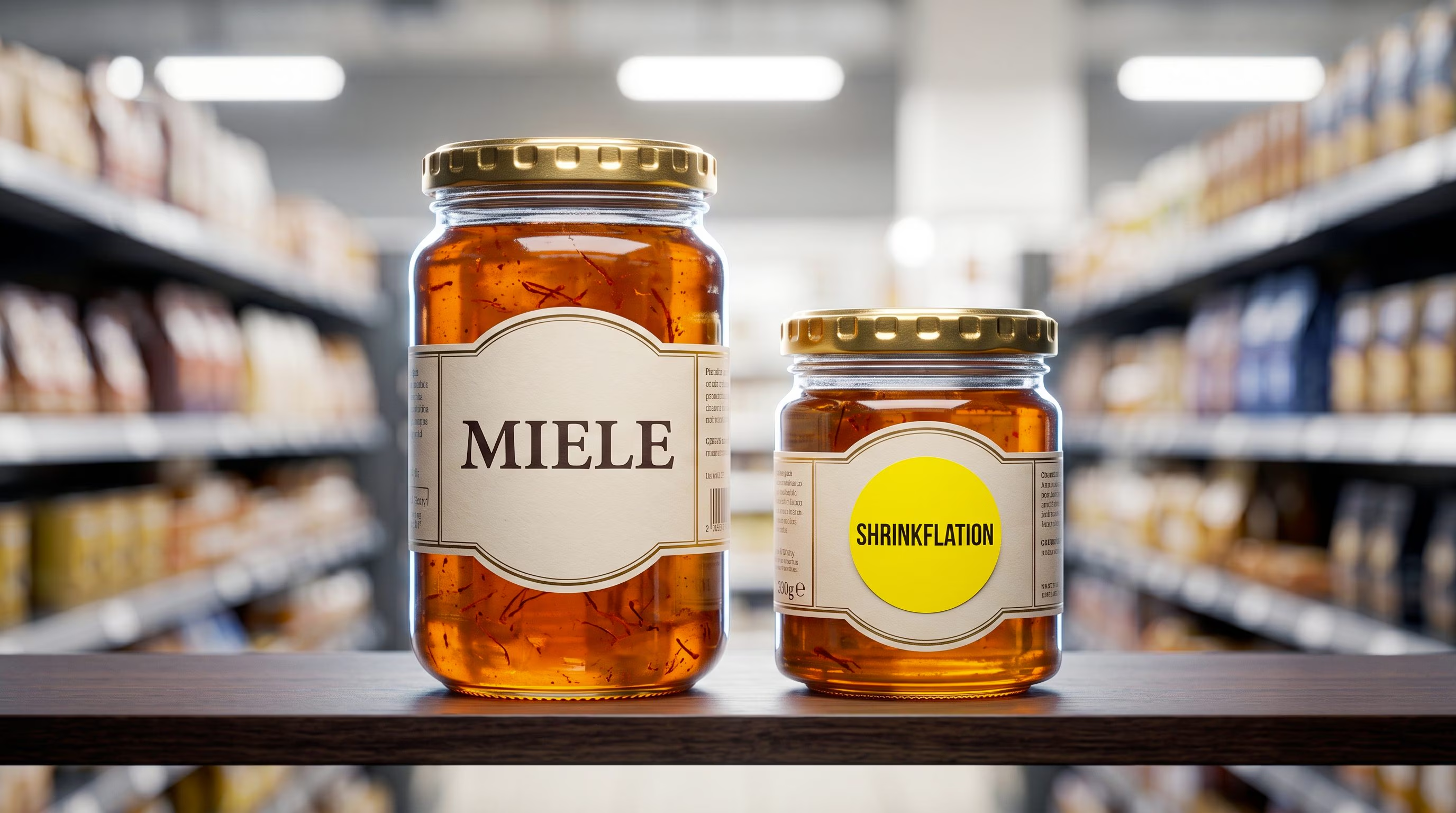
The government’s objective was to better protect consumers in the face of an increasingly widespread dynamic: the packaging is identical, the price is the same (or even increased), but the product inside has decreased. It happens with any product and is called shrinkflation, from English shrink (shrink) e inflation (inflation).
It is a form of invisible price increase, because it does not appear on the receipt: the consumer pays the same amount as before, but takes home less product. The new rules, however, are very different from those originally conceived: in fact, the obligation to insert a label on all products containing smaller quantities than in the past is eliminated, while the duration of the information obligation drops from 6 to 3 months.
What changes for supermarket products from July 15th: the new rules
To understand what changes from today, July 15th, and why we need to take a step back. Already in 2024, with the Competition Bill, the government intervened against shrinkflation by amending the Consumer Code with the introduction of article 15-bis. The rule provided for a rather direct obligation: producers who reduced the quantity of a product, while keeping the packaging unchanged, had to apply a clearly visible label on the packaging itself, with an explicit statement similar to “This package contains a product X smaller than the previous quantity”. The obligation would have lasted six months from the date of placing the re-portioned product on the market.
As emerges from the official TRIS document of the European Commission, Italy had defended this approach by recalling the principle of transparency towards consumers and also citing behavioral sciences: according to the government, information placed directly on the product is more effective than a notice on the shelf, because it reaches the consumer at the exact moment of the purchase choice.
However, in March 2025 the European Union had started an infringement procedure against Italy, contesting that the obligation of a specific label on the packaging could represent an obstacle to the free movement of goods (one of the 4 fundamental freedoms on which the European Union is based) in the single market, imposing additional costs on producers to adapt their products exclusively for the Italian market.
The Commission, while recognizing the legitimacy of consumer protection, had deemed the measure disproportionate to the objective, suggesting less invasive solutions such as notices at points of sale. Result: the government had to review the entire structure of the legislation with a new decree.
With the new legislation in force from 15 July, therefore, the obligation for direct labeling on the packaging disappears. In its place, “a communication system is introduced that develops along the entire commercial chain, involving producers, distributors and retailers both physical and online”.
In concrete terms, when a producer reduces the nominal quantity of a product, the subjects of the supply chain must send sellers a standardized communication containing information on the variation and the percentage increase in the price attributable to the reduction in content. This information must then be made available to consumers at points of sale or through digital channels.
Furthermore, the information obligation has a reduced duration: it goes from the 6 months initially foreseen to 3 months from the date of placing the product on the market in the new quantity. Exceptions are also foreseen: the regulation, in fact, does not apply when the quantitative reduction is accompanied by changes in the formulation of the product which improve its yield or effectiveness of use, maintaining the overall value for the consumer unchanged.
The numbers of shrinkflation: how much it weighs on Italian families
It must be said immediately that Codacons (the association for the protection of the environment and consumer rights) has defined the new rules as “watered down and not very incisive”, precisely because the movement of information from the packaging to the point of sale (or to digital channels) raises doubts about the real perceptibility of the change by the consumer at the moment of purchase.
But how much does shrinkflation actually affect the daily expenses of Italians? The phenomenon concerns the consumer goods market, which in Italy is worth around 120 billion euros a year. According to Codacons estimates, the practice generates hidden price increases ranging on average between +10% and +18%, with peaks reaching +40% in some cases.
Above all, the product categories that we buy most often are affected: among foodstuffs, the most affected are cereals, yogurt, ice cream, snacks, biscuits, biscuits, ready-made sauces, packaged cheeses and soft drinks. But the phenomenon does not stop at food: it also affects household products (detergents, toilet paper) and body care products (shower gel, shampoo, toothpaste).
Data at a European level helps to frame the extent of the phenomenon: according to the Consumer Conditions Scoreboard 2025 of the EU Commission, 74% of European consumers declared that they had noticed, in addition to the general increase in prices, a reduction in the size of packaging and the quality of products, without a corresponding drop in the purchase price.
The problem is that precisely quantifying the overall impact of shrinkflation is not simple, because the phenomenon is not specifically detected by ISTAT in monitoring inflation. However, Codacons tried to make an estimate: assuming even a minimal effect of 0.1% per year on the prices of the entire basket of consumer goods, the bill borne by families in the last 15 years would amount to around 1.8 billion euros.
Then there is a parallel phenomenon that risks further complicating the situation, namely the so-called “skimpflation”: if shrinkflation reduces quantity, skimpflation reduces quality. Producers reduce costs by replacing raw materials with lower quality alternatives (palm oil instead of butter, powdered egg yolks instead of fresh eggs, thickeners and water instead of meat in ready meals) or by cutting the services offered, all without reducing prices downwards. A different practice from shrinkflation, but with the same final effect: the consumer pays the same price for a lower real value.