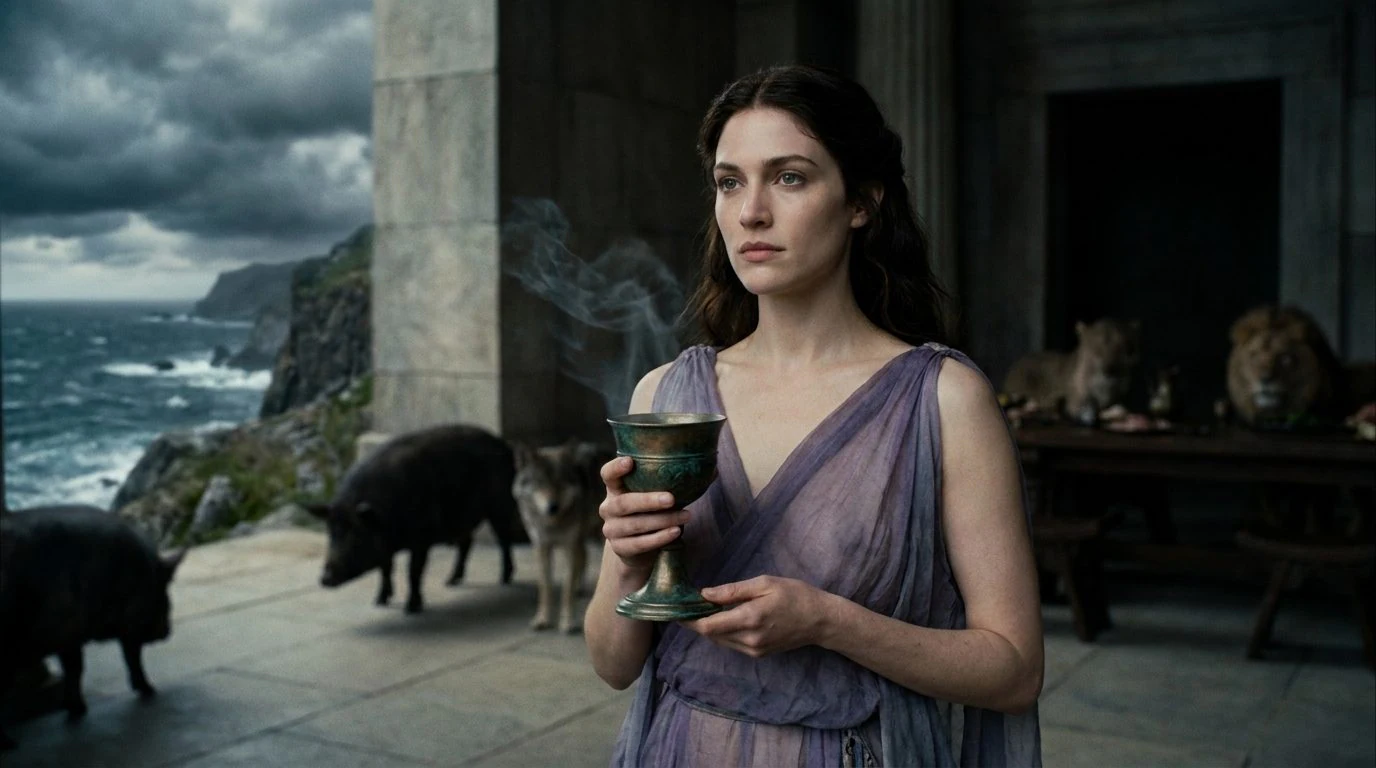
An immortal archetype of power, femininity and sacred danger, the demigoddess Circe has been one of the most magnetic, controversial and misunderstood figures of Western epics for millennia.
Often reduced to the role of a negative character or femme fatale ante litteramthe famous Homeric sorceress who lives on the island of Eea actually embodies a significant psychological complexity: upon closer inspection, in fact, she is nothing more than an independent woman who dominates nature and who does not respond to the laws of men. Indeed: Circe bends those laws, thanks to the magical contents of her glasses.
Today, the extraordinary complexity of his character finds notoriety again thanks to the long-awaited film adaptation of Christopher Nolan’s The Odyssey which will be released in theaters on July 16th. The long-awaited film promises to reinterpret the myth in a psychological and realistic way, turning the spotlight back on a fascinating question: who was Circe really, and what is hidden behind the myth of the woman who transformed men into pigs?
How he transformed men into beasts on the island of Aeaea
Circe is one of the most fascinating figures in Greek mythology, and appears for the first time in the Odyssey.
Described by Homer as a goddess who enchanted men with her voice, she was the daughter of the sun god Helios and the nymph Perseis. He lived on the island of Eea, which is traditionally identified with the Circeo promontory in Lazio.
Skilled in the art of weaving, Circe was endowed with immense powers linked to the knowledge of herbs and magical filters. It is in fact defined by Homer as polypharmakosthat is, an expert in herbs and poisons. The sorceress enchanted travelers who landed on her island by offering them a banquet with glasses containing hallucinogenic substances, which had the power to erase the memory of their identity and the memory of their homeland. Once they lost their memory, the sorceress touched the reckless adventurers with a wand, and completed their metamorphosis by transforming them into beasts depending on their true nature.
Those men who were greedy for riches and who ardently desired power became wolves; those who were dominated by anger, pride and violence were transformed into lions; or they became pigs if they were dominated by their gluttony, laziness or lust. Ulysses’ entire crew was transformed into pigs: this was because his men had pounced on Circe’s banquet without asking too many questions.
What was truly cruel about this spell was that later the men’s minds became clear again, and they realized that they had been imprisoned in an animal body.
The meeting with Ulysses: why he escaped his spell
However, Ulysses managed to escape the sorceress’s deception thanks to the help of the god Hermes, who had given him moly, a magical herb capable of neutralizing the goddess’s poisons.
According to scholars, Moly could correspond to Galanthus nivaliscommonly known as Snowdrop. In fact, this flower would have acted as a real chemical antidote thanks to the galantamine contained within it, a substance that acts as an anti-shock and capable of counteracting the effects of the alkaloids used by Circe. Other scholars instead argue that Moly was a set of herbs, including la Peganum harmala (Syrian rue) or various types of Atriplex (atriple).
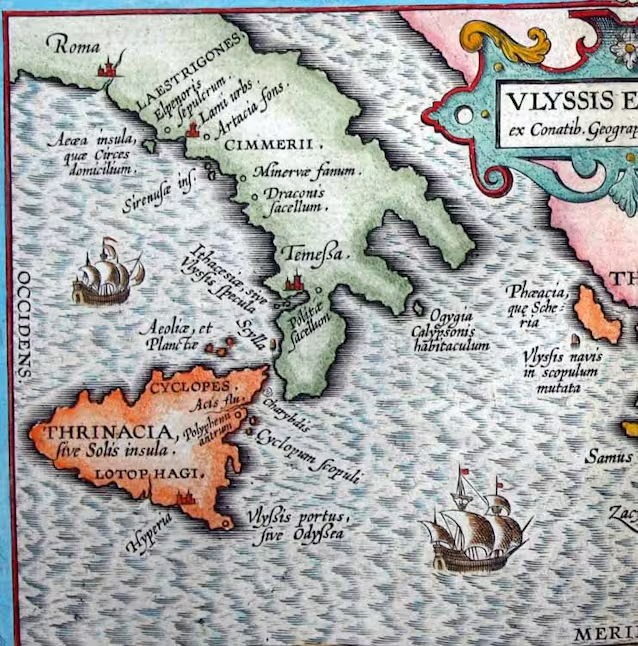
In any case, subdued by the man’s cunning and recognizing in him the hero predicted by the prophecy, Circe made her companions return to humans and fell in love with him, hosting his fleet for an entire year. It was she who showed Ulysses how to go down to the Underworld to consult the soothsayer Tiresias, and who explained to him how to overcome the dangers they would find once they returned to the sea unscathed, such as the song of the Sirens and the monsters Scylla (who she herself had transformed from a nymph to a sea monster) and Charybdis.
Why does Circe Island correspond to the famous Lazio promontory? The geography of myth
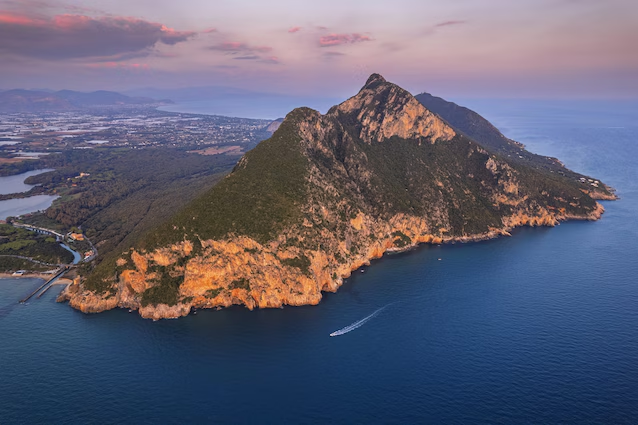
We said that the island of Eea on which the demigoddess Circe lived corresponds to the Lazio promontory that bears her name, the Circeo promontory.
But, in fact, we are talking about a promontory, not an island. This inconsistency can be explained by geology.
It is true that Circeo was an island in the past, but in the distant Pliocene (second geological epoch of the Neogene period, between approximately 5.3 and 2.6 million years ago). The coastal sea caves (such as the famous Grotta delle Capre or the Grotta Guattari) still show very clear signs of marine erosion at heights that are today astounding. Subsequently, the sediments brought by the rivers and the accumulation of sand created a “tombolo” (a strip of land), joining the island to the mainland and transforming it into the current promontory.
In the past, even when the island was now part of the promontory, those arriving from the sea – just like the Greek navigators or Ulysses himself – saw Circeo standing out on the horizon like a clear island. This is because the Pontine Plain behind it was one vast area of impassable swamps, marshes and coastal lakes (think of Sabaudia, Paola or Caprolace), and looking at the coast from a ship, the marshy plain was invisible, while the mountain massif seemed to float alone in the middle of the Tyrrhenian Sea.
Homer himself, moreover, described the area dominated by the sorceress in Canto X of the Odyssey thus:
We climbed onto a rock and saw the island… the sea all around squeezes and garlands it.