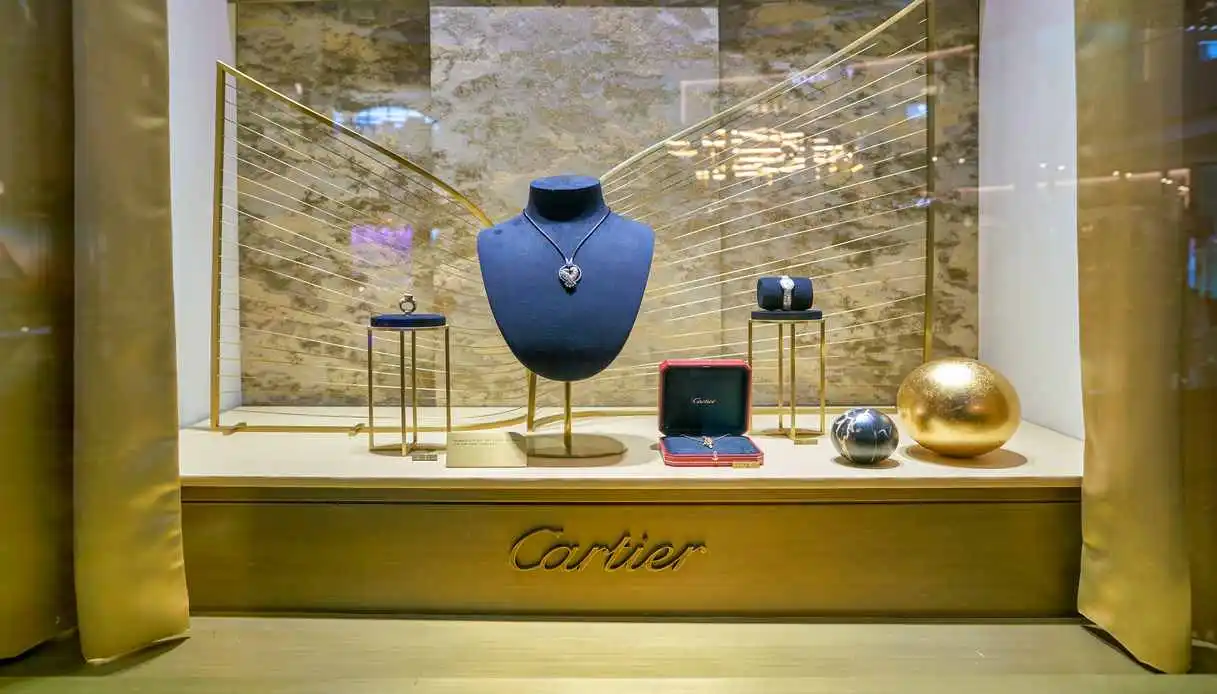
European luxury sends a stronger than expected signal to the market. Richemont, the Swiss group that owns Cartier, Van Cleef & Arpels, Buccellati and Vhernier, closed the quarter with revenues of 6.33 billion euros, above analysts’ expectations, which indicated around 5.90 billion. Growth at constant exchange rates was 20%, a figure that comes in a phase in which the sector remains under special scrutiny due to the combined effect of high rates, selective consumption and less linear Chinese demand.
The main driver is jewellery, which grew by 24%. It is an important step because it confirms the stability of the high-spending customer, less exposed to the compression of purchasing power than the aspirational consumer. In other words, the highest-end luxury continues to defend volumes, prices and desirability even when the macroeconomic context becomes more fragile.
Richemont’s data does not only concern the Swiss group. It is a sentiment indicator for the entire European luxury sector, because it shows where demand remains most solid: jewellery, iconic fashion houses, highly recognizable products and brands capable of maintaining pricing power.
Jewelery and high-end, because data matters
The growth of the jewelry division is the heart of the quarterly report. Cartier and Van Cleef & Arpels do not just represent two prestigious brands, but a luxury segment that in recent years has shown a greater ability to resist economic cycles. High-end jewelery is both a consumer good, a symbol of status and, in some cases, a purchase perceived as more durable than seasonal fashion.
This is why the +24% of the jewelery sector weighs more than the simple revenue figure. He says luxury is not standing still, but is moving selectively. Consumers continue to buy, but favor strong categories, recognized brands and products with high symbolic value. It is a dynamic that can reward groups more positioned on the high end and put pressure on those who depend on more volatile demand.
Watches also show a positive sign, with the specialist watchmakers division growing by 8%. The data is less brilliant than for jewellery, but it helps to strengthen the idea that European luxury is finding support in the most iconic categories less exposed to short-term fads.
Americas and Asia-Pacific push the numbers
The geography of revenues is another element to follow. Sales in the Americas rose 27%, while Asia-Pacific, including China, saw growth of 21%. These are important numbers because they come after months in which the market looked with caution at Chinese demand and the ability of luxury to compensate for any regional slowdowns.
The American data confirms the strength of the high-end US customer. Despite high rates and greater selectivity in consumption, demand for top-level jewelery and fashion houses remains robust. For luxury groups this is a relevant signal, because the United States remains one of the most profitable and important markets for the growth of the sector.
The Asia-Pacific, however, is the most delicate passage. A growth of 21% indicates that demand has not died down, but the market will continue to distinguish between real recovery, favorable statistical comparison and the ability of individual brands to attract local customers. For investors, Asian demand remains the main gauge of European luxury.
The signal for Moncler and Cucinelli
For Piazza Affari the Richemont data counts above all as a preview of the sector climate. Moncler and Brunello Cucinelli will be observed in the next half-yearly reports because they represent two different models of Italian luxury: the first is more linked to technical and premium clothing, the second is more focused on high-end and lifestyle.
The message coming from Cartier is clear: the market rewards brands capable of defending identity, price and margins. For Moncler and Cucinelli the investor question will be the same: how strong does the high-spending customer remain? How much does China weigh? How long can America last? And above all, how much pricing power remains in a phase of more selective consumption?
The comparison is not automatic, because jewelry and fashion respond to different logics, but Richemont offers a useful clue: luxury is not uniformly in difficulty. What makes the difference are positioning, brand quality, geographic exposure and the ability to transform desirability into revenue growth.
Selective luxury, not luxury in crisis
The Richemont quarterly helps to read the sector more precisely. We are not faced with a luxury that is simply in crisis or in general recovery. The picture is more nuanced: demand remains strong where the brand is iconic, the product is recognizable and the customer is less sensitive to the economic cycle.
This explains why jewelery can outperform fashion and why the market continues to look carefully at groups capable of covering the highest segment. For investors, the real question is not whether luxury continues to grow, but which segments are capable of growing without sacrificing margins and reputation.
In this sense Cartier becomes a signal for the entire sector. The strength of Richemont shows that the global luxury customer still exists, but chooses more carefully. For Moncler, Cucinelli and the other European protagonists, the next half-yearly reports will have to demonstrate precisely this: not only sell more, but continue to sell well.