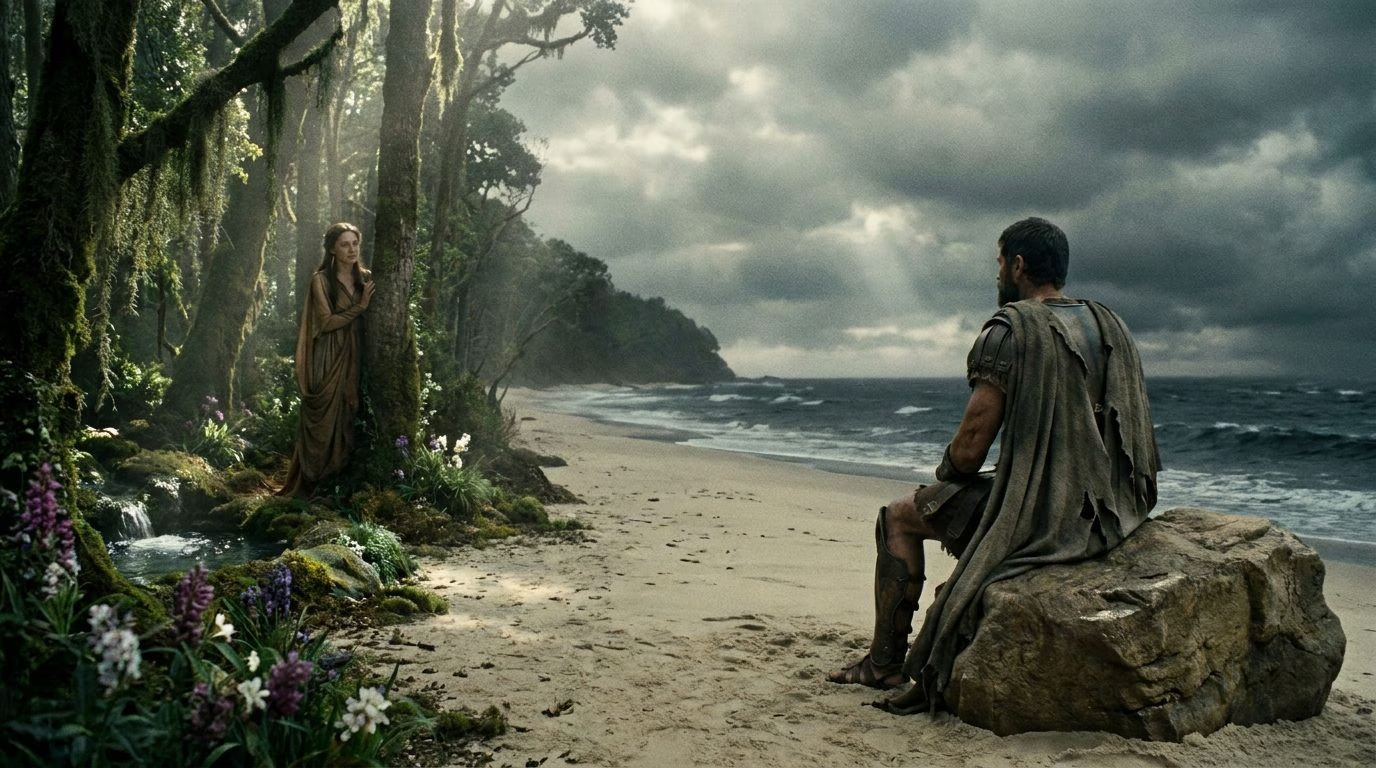
The nymph Calypsoknown for her beauty and for being the one who with her singing enchanted and held Ulysses, shipwrecked on her island, for seven years, has returned to the limelight thanks to Christopher Nolan’s latest highly anticipated film, Odysseywhich brings the famous Homeric story to the big screen.
Calypso, in addition to being a nymph, was also one of the most famous minor goddesses in Greek mythology. But what is the story behind this fascinating and mysterious figure, often associated with love, desire and isolation, so much so that it has become a symbol of beauty and melancholy? To find out it is necessary to go back in time, when the clever nymph dared to seduce and retain the most cunning man in the world created by Homer.
Meaning of the name Calypso and powers of the goddess
In Homer’s Odyssey, Calypso is not a simple nymph of the woods: she has divine and very powerful blood in her veins, and is a goddess in all respects.

Daughter of Atlas – the Titan condemned by Zeus to carry the weight of the entire celestial vault on his shoulders, separating the Earth from the Sky – from his father he inherits the profound connection with the boundaries of the Earth and with the knowledge of the sea depths. It must be said, however, that in Hesiod’s Theogony, Calypso is indicated as the daughter of Ocean and Tethysthe two primordial aquatic divinities from which the universe was born according to the most ancient cosmogonies.
In both cases, the origins of this figure make the idea clear: Calypso embodies the primordial and isolated forces of nature, and this is also why she does not live on Olympus with the other gods, but reigns in absolute and sovereign solitude on her island, Ogygia (‘Ωγυγίη), defined as “the navel of the sea”. Calypso has the power to dominate the elements of this island of hers, and to offer immortality.
But the peculiarity of this character lies in his very name: from the Greek Kalýpso (Καλυψώ), which in turn derives from the Greek verb kalýpto (καλύπτω)with the meaning of “hide”, “conceal”, “envelop” or “submerge”. His is therefore not a name chosen at random, but it takes up what Calypso actually does in the Odyssey towards Ulysses: she hides him from the eyes of the world for seven long years.
Calypso hides Ulysses from the world, from time and from history
Odysseus is shipwrecked on the island of the goddess, Ogygia, following the Trojan War. Calypso helps him and falls in love with him, and keeps him prisoner for seven years, removing him from the geographical map and history. Ulysses no longer exists for the outside world, which now gives him up for dead.
To keep him close, Calypso uses his songs and the offer of immortality. But if initially the promise of eternal youth could be an attractive offer, it soon becomes a paradox: such a power on such a remote island actually means cancel time and freeze life itself in an instant that never passes. Ulysses becomes the ghost of what he had been: he is no longer the hero of Troy, nor even the king of Ithaca.
If time doesn’t pass, you don’t age and you can’t die, no action has any value anymore. And here the meaning of the nymph’s name comes into play: in fact, Calypso hides Ulysses from his destiny. The essence of the Greek hero, in fact, is the nostos (the return journey) and the kleos (the eternal fame given by his exploits). Under Calypso’s protective and suffocating veil, Odysseus cannot fulfill his destiny. This is why the hero, despite living in an earthly paradise made up of sacred groves, clear springs and divine love, spends his days on the beach crying while looking at the sea in front of him.
Eager to return to his wife Penelope and son Telemachus in Ithaca, Ulysses finally manages to invoke the goddess Athena, who intercedes for him with Zeus. The latter sends Hermes to the nymph, forcing her to free the unfortunate traveler. Calypso, who cannot help but obey, gives Zeus a raft and supplies for the journey, and – although reluctantly – lets him go.
What does the myth of the nymph of the Odyssey represent
Beyond her narrative function in the Odyssey, in the literary panorama Calypso is seen as the one who embodies the archetype of suspension, of time that stops when humans distance themselves from their social role and relationships. According to some scholars of comparative mythology, the part of the Odyssey that concerns Calypso refers to the temptation of oblivion (which is also seen in the book in the episode with the sirens and the Lotus Eaters), of the difficulty of choosing between security and growth, between permanence and change.
To use a current term, it almost seems that Ogygia is a “comfort zone”, a perfect place, without risks, without the danger of getting old… but in the long run it becomes a real golden prison, which blocks the personal evolution of those inside it. And so, just like Ulysses, we end up looking at the sea, while drowning in silent unhappiness.