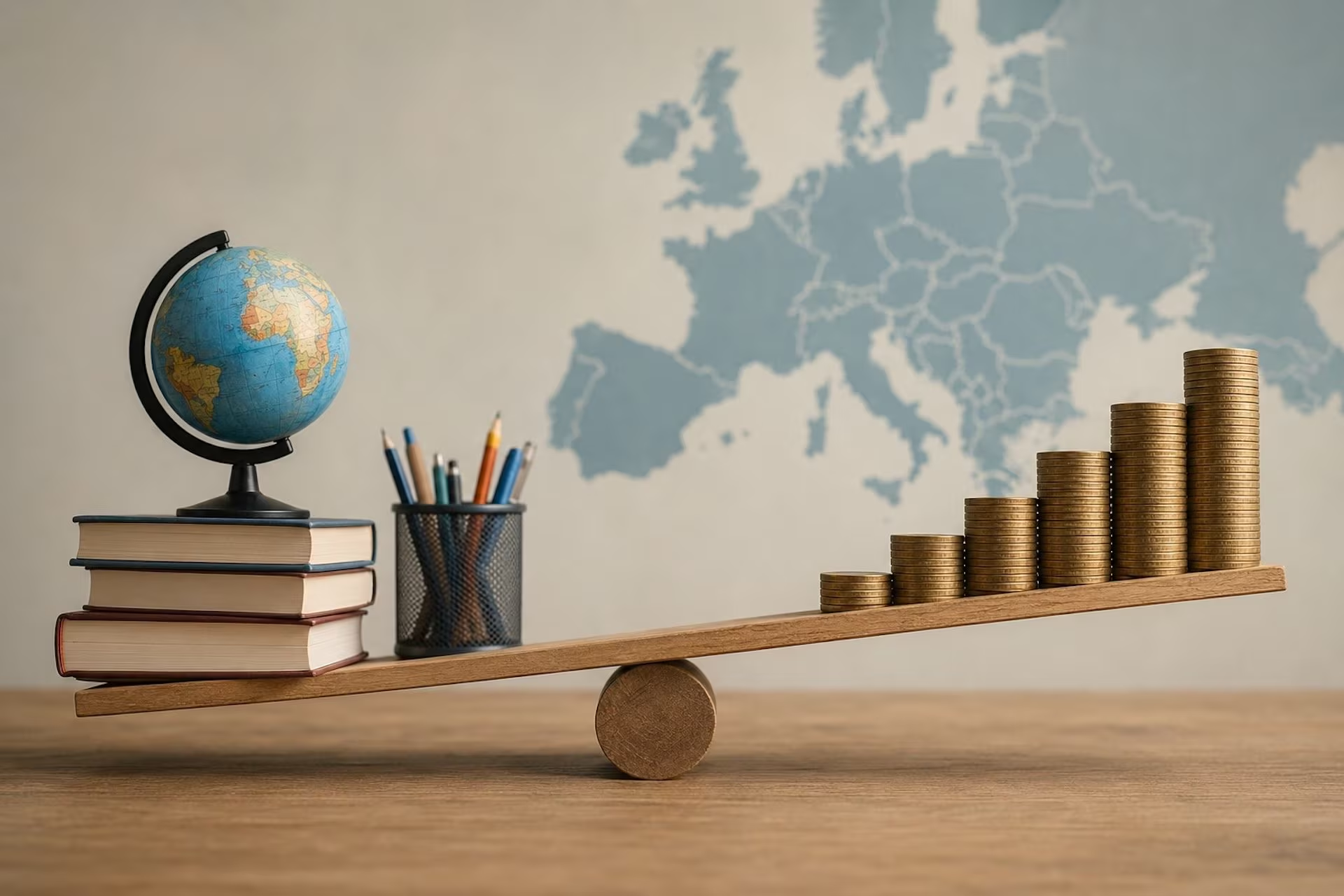
The topic of salaries and salary disparities in Italy is always central to the debate, but in a few sectors like the school sector the salary gap is so marked: for the same qualification and hours in the classroom, a teacher can in fact earn very different amounts depending on the country in which he or she is located. These differences are measured by Eurydice data, the European Commission network that monitors education systems, updated to the 2024/2025 school year. What emerges is a very clear picture that sees the salaries of Italian teachers placed in the lower part of the continental ranking, with around 26,000 euros gross per year at the start of their career, and with the gap with the leading countries not reducing even with the passing of the years of service.
The European ranking: who pays their teachers the most
At the top of the ranking we find Luxembourg, where a teacher at the beginning of his career receives between 52,000 and 62,000 euros; the numbers also change with respect to the reference school level, with a salary that can reach 107,000 euros at the peak of the professional career.
Behind Luxembourg there are Switzerland, Germany, the Netherlands and Spain which are still much higher than Italian levels. The most significant data, in addition to the large factual gap with the entry salary, is above all the difference with career progression. In Italy a teacher goes from the initial 26,000 euros to 37,000 of the maximum table, an increase that accrues slowly over 35 years of service. According to Eurydice, the salary of a teacher in the Netherlands can more than double in just 12 years, while in Denmark and Malta the salary ceiling is reached equally quickly. In Germany you already start above 55,000 euros gross and approach 85,000 at the end of your career.
Teachers’ working hours and unpaid hours
Unfortunately, there is a cliché that has always accompanied the debate on the salaries of Italian teachers, namely that they would work reduced hours and have access to long summer holidays. A rhetoric that is contradicted by European data, which tell another story. In fact, the 18 hours per week of face-to-face lessons in secondary schools and 22 in primary schools, which by contract become 24, with the 2 mandatory hours per week of educational programming provided for by the art. 28 of the CCNL, are perfectly in line with the continental average, and very similar, for example, to the French ones. The difference lies elsewhere, in the activities outside the classroom, therefore preparation of lessons, correction of homework and tests, meetings, interviews with families, which in other school systems are recognized and paid in a structured way.
The contract renewal: a step forward that does not change the ranking
From a salary point of view, something is moving on the Italian front. In fact, with the August 2026 payslip, NoiPA applies the increases provided for by the renewal of the national collective agreement for the “Education and Research” sector for the three-year period 2025-2027, signed at the ARAN on 1 July, which provide on average approximately 143 euros gross per month more for teachers and 107 for ATA staff, with the simultaneous payment of arrears. This is an expected adjustment, which arrives directly on your paycheck without the need for any questions. Looking at the numbers of the continental comparison, it is an increase that brings Italy closer to the European average, without however substantially changing its position in the ranking.
The real issue, as revealed by the Eurydice data itself, is the architecture of the remuneration system, with the increases depending exclusively on seniority: in fact, it takes 35 years to reach the maximum table and the real career paths, those which in many European countries reward responsibility and skills, are effectively absent in Italy. While the OECD data from Education at a Glance 2025 explains how dAs of 2015, the actual average salaries of primary school teachers increased in real terms by 14.6% on average across all OECD countries, while in 2024, they decreased by 4.4% in Italy.and today a primary school teacher earns 33% less than a full-time graduate, compared to an OECD average gap of 17%.
At the same time, the numbers from the OECD TALIS 2024 survey, the largest international survey of teachers and school leaders, explain that only 3% of Italian teachers are under 30, compared to an OECD average of 10%, while almost half, 49%, are over 50. Furthermore, 49% of novice teachers report that teaching was their first professional choice (lower than the OECD average: 58%). Moreover, just 23% of Italian teachers say they are satisfied with their salary, just over half the international average.