THE’Hungarian it is a Finno-Ugric language – part of the Uralic language family, the same of which Estonian and Finnish are part – spoken by 9.8 million people in Europe and around 14 million worldwide. It is the official language of Hungarian People’s Republic.
In the debate regarding which are the most difficult languages in the world, Hungarian is always brought up: in fact, it ranks very high in the rankings of the most complicated languages to learn, competing for first place in Europe with Finnish and Basque.
But is it really the most difficult language in the European Union? It would seem so and there are very specific reasons why it is perceived as such.
Hungarian language and culture
First of all, in a continent dominated by Indo-European languages (specifically Romance, Germanic and Slavic) Hungarian does not belong to this linguistic family. It is, however, part of the Uralic languagesspeak from Siberia to Northern and Central Europe. Although it is related to Finnish and Estonian, it is not mutually intelligible with them; on the other hand, the languages closest to Hungarian are Vogulo and Ostiac (or hianti), two languages in northwestern Siberia.
During the 9th centurythe nomadic tribes of Hungarian Magyars they migrated west, crossed the Eurasian steppes and settled in Carpathian basin around 895 AD Initially known for raids and plundering, the Magari converted to Christianity under King Stephen I, giving rise to the Kingdom of Hungary and integrating into the medieval European world.
Over the centuries, Hungary became an important kingdom in Central Europe, thanks to its role as a physical border between the Christian and Muslim worlds.
Due to its geographical position, it suffered several invasions, such as the Mongol invasion of the 13th century, and was a land of conquest: think of the Ottoman domination between the 16th and 17th centuries. In the eighteenth century it became part of the Habsburg empire, which dissolved at the end of the First World War. After the Second World War, a communist-style regime was established in Hungary, allied with the USSR. Culturally it was very important for the Hungarians uprising of 1956: a failed attempt to overthrow the regime in favor of a more democratic state. Today theHungary is an independent state And member of the European Union with one strong cultural identitylinked to its Magyar origins. It also plays an important role in the EU’s foreign and international policy.
Elements of Hungarian grammar
Modern Hungarian, like many European languages, is written with the Latin alphabet. However, it was not always like this: until the 10th century it was written in Rovasa type of runic alphabet, written from left to right. The transition to the Latin alphabet occurred through assimilation with other European peoples.
From the point of view phonetic Hungarian has 39 phonemes (14 vowels and 25 consonants). The vowels are further distinguished, as also happened in Latin, into long and short. The most “strange” of the Hungarian vowels is (ɒ)/(ɑ), which sounds particularly foreign to other Europeans because it is absent in Indo-European languages. The tonic accent, fortunately, is always on the first syllable.
Graphically, these phonemes are rendered through 40 letters, to which q, w, x, y, present in foreignisms, and diacritics (á, é, í, ó, ö, ő, ú, ü, ű) must be added. There are also 8 digraphs and a trigram (sequences of graphemes that correspond to a specific phoneme), which add further depth to the Hungarian script. The distinction between long and short vowels is rendered graphically through diacritics.
Of note as a phonosyntactic characteristic of Hungarian is vowel harmony, a process of assimilation which in natural languages serves to maintain the coherence of the sound. Vowel harmony consists in the mutation of the vowel based on the vowels present in the root, prefixes, suffixes or endings.
For example, the inexive suffix -ban meaning “in, inside” alternates the vowel depending on the root to which it is added:
ház > house, házban > at home
kert > garden, kertben > in the garden
From a morphological point of view Hungarian is a language agglutinativethat is, it constructs new words by joining multiple morphemes (minimal units with meaning) and adding suffixes; for example:
ház > house, házak > houses, házban > in the house, házakban> in homes)
házamban > in my house
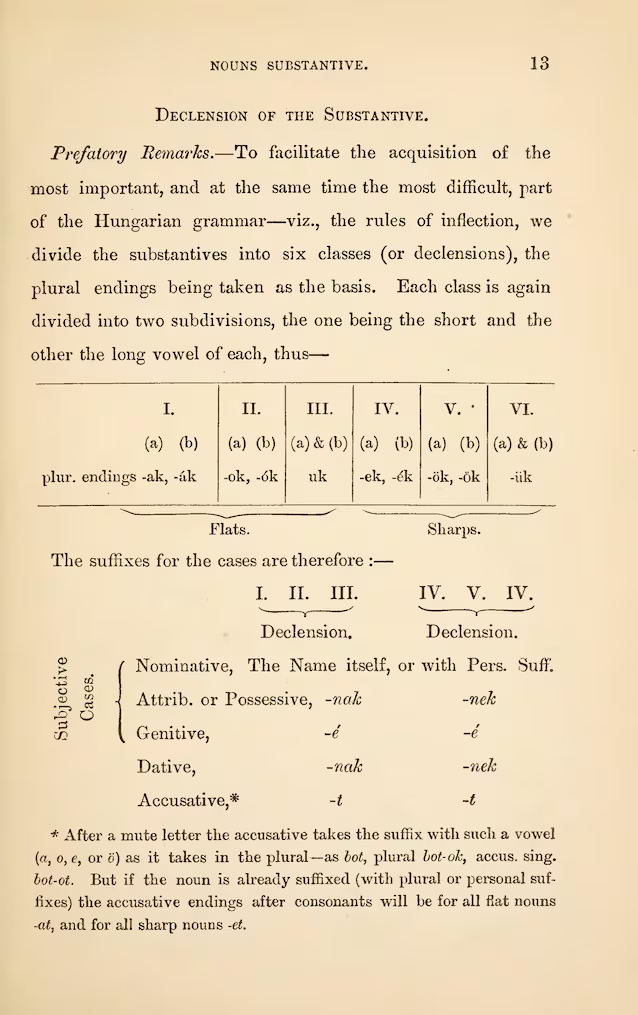
In a single word you can express what other languages would require with an entire sentence made up of multiple components. This aspect is also “facilitated” by the fact that Hungarian presents approximately well 18 grammatical cases (nominative, dative, accusative, instrumental, instrumental-comitative, causative, translational, inessive, superessive, adhesive, delative, illative, elative, allative, ablative, terminative, formative, essive). This means that Hungarian nouns can have dozens, if not hundreds, of different forms!
Taking for example some forms of the word barát > friend:
barát > friend (nominal)
barátot > friend (accusative)
barátnak > to (a) friend (dative)
baráttal > with (an) friend (instrumental)
Hungarian also favors the use of postpositions over prepositions, as well as pre-verbal prefixes that distort the meaning of terms.
THE’word order it is quite flexible within the sentence: while this flexibility offers much more syntactic freedomon the other increases learning difficulty. Usually the sentence follows the pattern Subject-Verb-Object (SVO), although other word orders are permitted and used to emphasize different elements of the sentence (highlighting). Let’s also add the fact that Hungarian favors the use of postpositions with respect to prepositions, as well as pre-verbal prefixes which distort the meaning of the verb and we can easily understand why the complexity increases.
They also exist good newshowever, for those who speak or want to learn this language. Hungarian has only two types of verb conjugation: defined (subjective) e indefinite (objective), based on the presence or absence of a defined object complement. Furthermore, it has a single past timewhose temporal nuances can be expressed thanks to adverbs or periphrases.
As for words, its geographical proximity has enriched the Hungarian vocabulary with terms coming from Latin, German and Slavic languages, as well as from French, English and Italian.
In Hungarian there is no real grammatical genderbecause it has different ways to indicate sex or biological gender of people, animals and entities based mainly on vocabulary and not on internal grammatical variations.
For example, some nouns have different forms to indicate masculine or feminine, exactly like in Italian or other languages:
férfi > man vs. No > woman
apa > father vs. anya mother
fiu > boy vs. lány lass
Specific terms are used for some professions or social roles, for example:
tanar > teacher (male or neutral)
with the addition of the suffix -nő the feminine gender is specified:
tanárnő > teacher (female teacher)
or we use compound words like női tanár.
Finally, the third person singular personal pronoun “or” is used interchangeably for “he” and “she”, a neutrality that is not very rare but still unusual in the European linguistic scenario
Hungarian is a fairly complicated language: conclusions
So, is Hungarian really the most difficult language in the European Union? The most honest answer is “probably yes”, at least for those whose mother tongue is an Indo-European language, as it turns out radically different.
On the other hand, if you overcome the initial fear caused by the difficulty of the Hungarian, you will be surprised at how fascinating it can be. Behind the grammatical complexity and linguistic distance, Hungarian reveals a surprising internal coherence full of rigorous and precise logic.
After all, few languages can give us one of the longest words in the world:
folyamatellenőrzésiügyosztályvezetőhelyettesképesítésvizsgálat
whose meaning is “survey for the qualification of the deputy director of the process control department”.