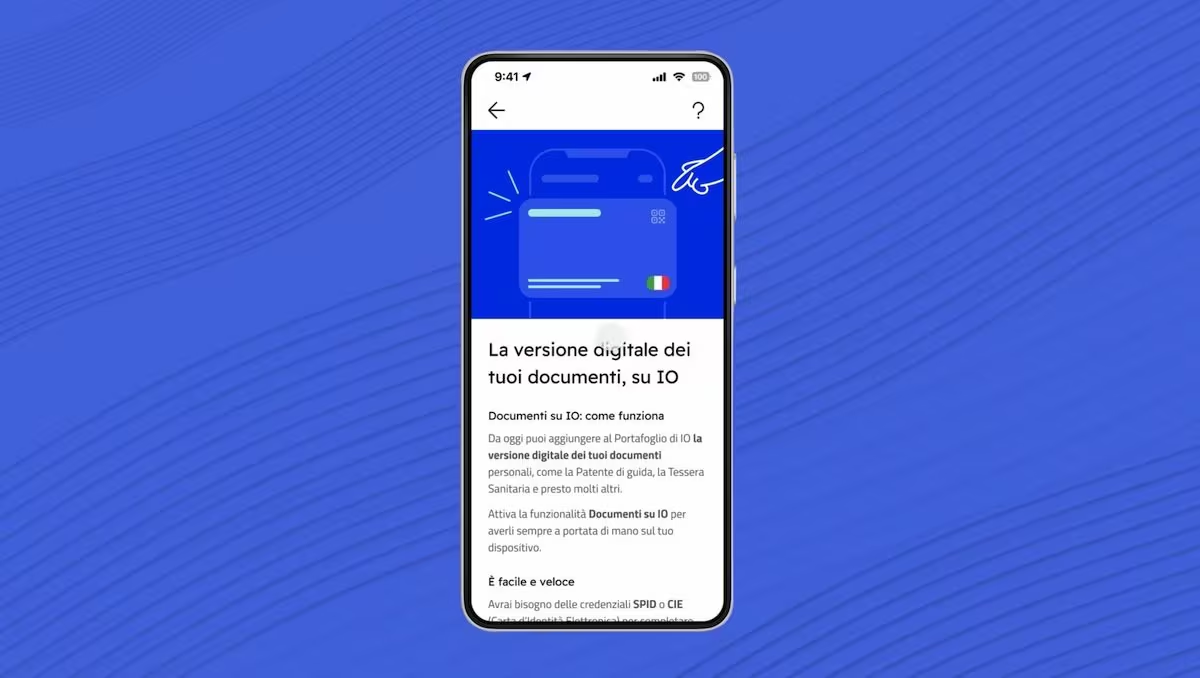
With the publication in the Official Journal of the decree of 19 March 2026, which took place last 3 August, of two implementing decrees concerning IT-Wallet, the system effectively enters a new important operational phase in which bureaucracy will be streamlined and documents will be easily available. In addition to allowing the conservation of the current (few) documents, including driving license and health card, IT-Wallet is preparing to become the infrastructure that will have the task of simplifying the relationship between citizens, companies and Public Administration thanks to the sharing of digital certificates and attestations that will have full legal value. Among these there will be identity documents, residence certificates, ISEE and qualifications. These innovations aim to streamline the much-hated bureaucracy.
The timing for the release of new documents
Let’s start with what is probably the most significant innovation, the one that concerns electronic certificates. These digital documents serve to certify a given piece of information, such as residence, a qualification or the ISEE, i.e. the Equivalent Economic Situation Indicator used to establish access to numerous public benefits. When this data is available within IT-Wallet, it will no longer be necessary to download certificates, print them and attach a copy when sending a request to an institution. This is because the organization that receives the request will be able to directly verify its authenticity via the IT-Wallet system.
Of course, the transformation towards such a system will be gradual and is still relatively far from working at full capacity. Also because each document will appear in the IO app only when the body that officially holds that data is connected to the infrastructure. The driving license, health card and European Disability Card are already available. The residence certificate and qualifications should also arrive between September and October 2026. Then it should be the turn of the photographic identity documents, the academic qualifications, the aforementioned ISEE, the registration on the electoral lists, the attestation of age of majority and the registered proxies. For the latter there are no very precise release times, as everything will depend on the integration of public databases.
The concept of authentic source
To understand how the system works you must also know the concept of authentic sourcewhich was introduced by the decree. The authentic source is essentially the person who owns the original and certified data. An entity belonging to the Public Administration, but also a manager of public services or a publicly controlled company, can be considered an authentic source. It is this subject who makes information available in the form of an electronic certificate. If, for example, a Municipality becomes the authentic source of the residence certificate, the latter will directly have to provide the verified data to the infrastructure. In this way another body or an authorized company will be able to retrieve it via IT-Wallet without having to go through citizens, who will thus not have the task of having to retrieve the certificate and send a copy.
The result, at least on paper, should be a significant reduction in the bureaucratic delays that have always been criticized in our country.
The decree also clarifies who will have to participate in the new digital ecosystem. Public administrations, managers of public services and unlisted publicly controlled companies will have the obligation to become authentic sources by 3 August 2027. As regards private companies, however, they will not be obliged to do so, but will be able to join on a voluntary basis to provide their own electronic certificates or, more simply, to accept IT-Wallet as an identification or access system to their online services.
From 3 February 2028 documents issued even without CieID
In all of this, the State Printing and Mint Institute together with PagoPA will continue to have a leading role in managing the technical and organizational infrastructure of the IT-Wallet system. Regarding this, it is interesting to note that from 3 February 2028, personal identification certificates can be issued by the Polygraphic Institute even when users use only the physical CIE, without going through authentication via CieID (which is the highest level of security provided at the moment).