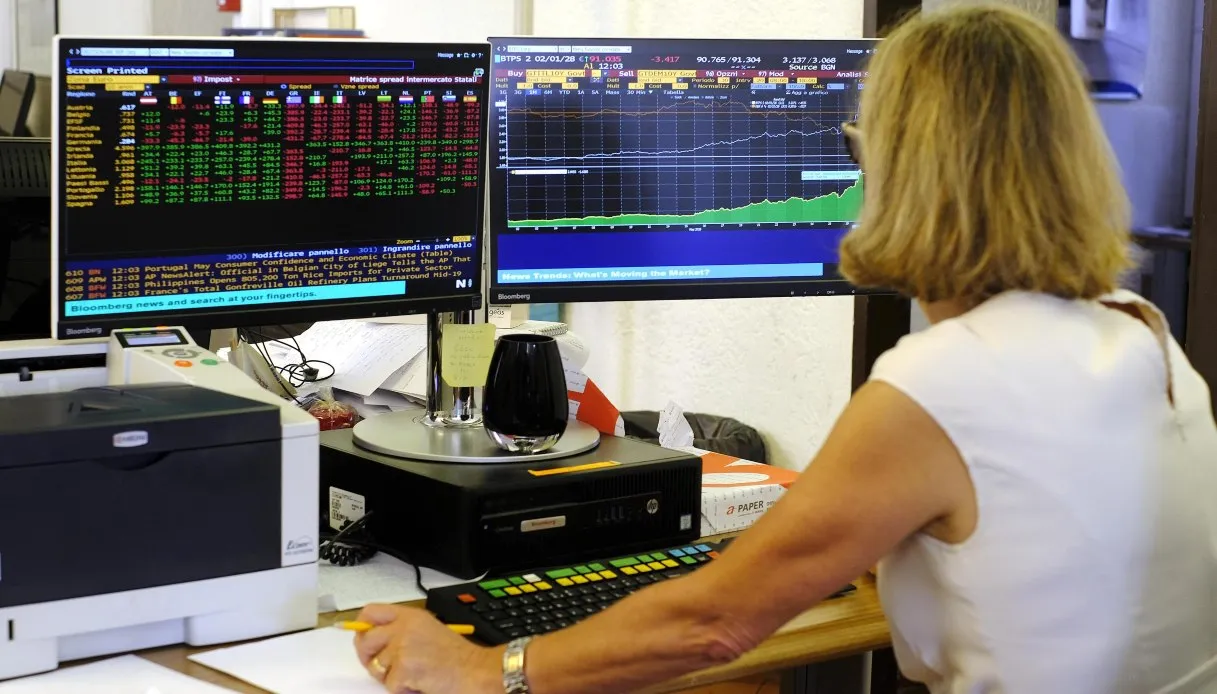
The opening of the financial markets marked a new slight decrease in the spread between Italian BTPs and German Bunds, which returned below 80 basis points. Instead, European government bond yields continue to increase slightly with Spanish Bonos at 44 points and French OATs at 82 points.
On August 11th, Brent returned to the $90 per barrel area, bringing a new wave of insecurity. The clash between Iran and the United States is once again dictating the pace. According to the markets, central banks are moving towards a further rate increase in September.
The opening of the spread between BTP and Bund on August 12th
The spread between Italian BTPs and German Bunds at the opening of August 12th fell to 78.9 points. It opens lower than on August 11th, when it reached 80 points.
At the opening, the Italian annual yield dropped 0.3 points to 3.94%, the German one rose by 0.2 points to 3.16% and the French one remained unchanged at 3.98%.
Spreads in the rest of Europe
Yields and spreads instead increased in the other large European countries.
In Spain, the Bonos reached interest of 3.60%, with a spread of 44 basis points.
| Government bonds | Returns | Spreads |
|---|---|---|
| German Bunds | 3.16% | – |
| Italian BTPs | 3.96% | 80 |
| French Oats | 3.99% | 82 |
| Spanish bonos | 3.60% | 44 |
The French Oat, however, underwent a change of +0.76%. A benchmark Paris stock yields 3.99%, with a spread of 82 basis points.
August government bond auctions
As anticipated, the MEF confirmed the issuance of an annual BOT with ISIN code IT0005729220, first tranche, for a total amount of 8 billion euros.
The security will have a duration of 364 days, with an issue date set at 14 August 2026 and expiry on 13 August 2027.
Attention: we remind you that bookings by the public are no longer possible.
Other dates on the calendar:
- August 12, Bot auction;
- CANCELED August 26, Short Term BTP and BTP€i auction;
- August 27, Bot auction;
- August 28, auction of medium and long-term bonds.
Rate increase in September
The international situation, however, is characterized by uncertainty. After the recent events between Iran and the United States, most analysts expect a 0.25 percentage point increase in interest rates.
The announcement could come at the ECB meeting on 10 September. It may not even be the last increase of the year. As already estimated, the ECB could order a further increase by the end of the year. The impact on mortgages is already being felt.
A rate cut will have to wait until 2027, in the best case scenario. In fact, at the moment the continuation of the conflict in the Middle East and the consequent increase in the price of oil and natural gas are fueling inflation. On 23 July, ECB President Christine Lagarde confirmed the uncertainty, which “remains high and the overall inflationary impact of the energy shock has yet to fully manifest itself”.