At the European Athletics Championships taking place in Birmingham from 10 to 16 August 2026, each start from the blocks is measured by a hidden sensor that calculates how much time passes between the shot and the push of each sprinter. If that time is less than a tenth of a second, the athlete is disqualified even if he left the blocks after the starting signal. This is not an error in the rules but a precise choice, because it is believed that no one can really react that quickly and that those who manage to do so are starting by intuition. In short, it is not the judge’s eye that decides, and the limit that the sensor applies arises from an experiment conducted over seventy years ago.
What counts as a false start
The World Athletics technical regulations provide for two different infringements that lead to the same outcome. The first is early departure in the literal sense, and the regulations define it as “loss of contact”. In the start from the blocks the athlete commits a false start when one of the feet leaves the platform or when one of the hands leaves the ground before the shot. A sprinter who, for example, raises his pelvis and lowers it again while keeping his hands and feet in place is not disqualified, although he may receive a disciplinary warning for incorrect conduct.
The second infraction is the one that generates the most discussion, because it concerns athletes who left after the shot. If the electronic system records a reaction time of less than 100 thousandths of a second, the race is stopped and the person responsible is disqualified. The reasoning is that a tenth of a second is the minimum time necessary for a sound to reach the ear, be processed by the brain and translate into a muscle contraction, so whoever moves first did not hear the shot but predicted it.
The decision is communicated with colored cards: red and black divided diagonally means disqualification, green communicates to everyone that no one made a mistake and that the race starts again, while yellow and black remains in use only in multiple events, where decathlon and heptathlon athletes are still entitled to one error before exclusion.
Where does the limit of 100 thousandths of a second come from in athletics
The number wasn’t derived by measuring a sprinter’s brain, but the pressure in his feet. In 1947 the American Henry Franklin studied how an athlete’s push on the blocks changes during the start and drew the corresponding curve. The thrust does not reach its maximum instantly, but grows progressively until it exceeds 50 kg, and Franklin noticed that around 25 kg the growth became regular. That point was chosen as the conventional moment in which the departure begins and was linked to reaction times, reaching the limit of 100 thousandths.
The consequence is that the reaction time that we read in the results is not the instant in which the sprinter heard the shot, but the moment in which his push exceeded a certain force. They are two different concepts, and the difference also depends on how quickly an athlete is able to develop strength with his legs.
How blocks are made
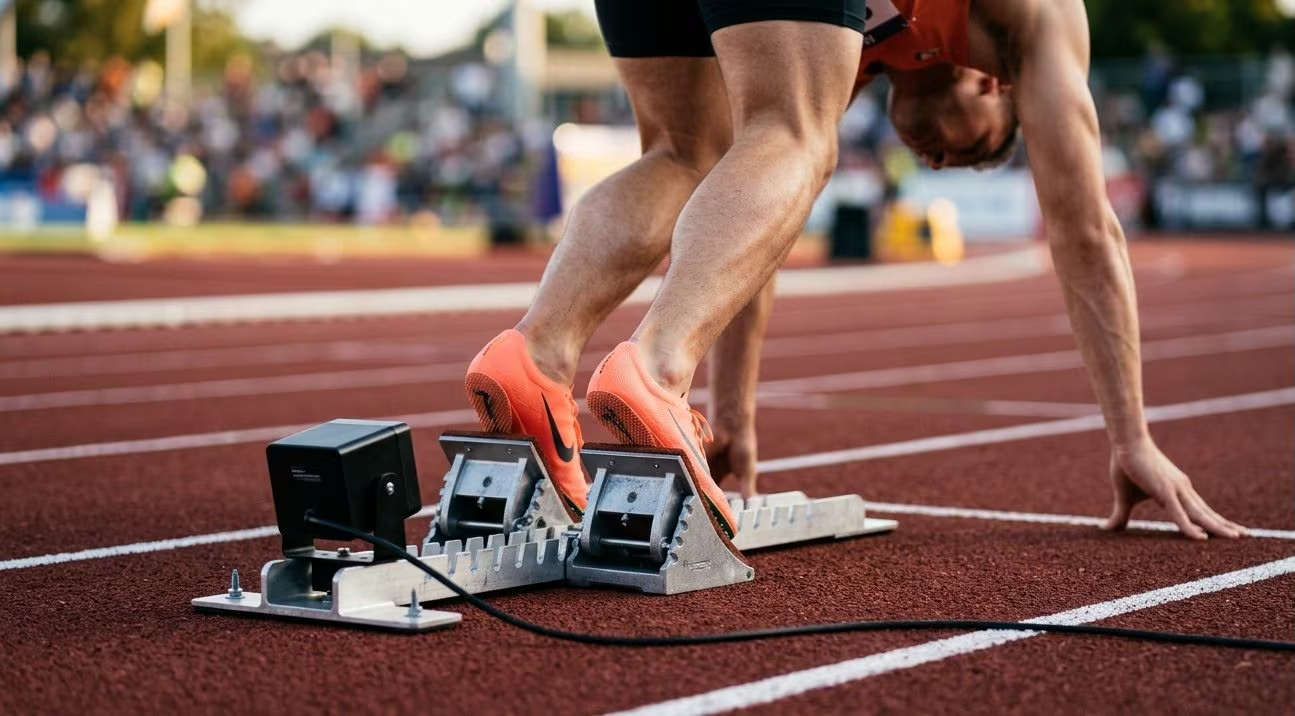
The regulation imposes blocks in all races up to and including the 400 meters, including the first leg of the relays, and prohibits them in all others. A 19th century runner therefore starts standing, while a 14th century runner is forced to start from the blocks. The structure is simple: two platforms, against which the athlete presses his feet, are mounted on a rigid frame that must not move during the push.
The footpegs tilt and slide back and forth in relation to each other, so that each sprinter can find their position, and their surface is made to accommodate shoe nails. The chassis is anchored to the track with tips that damage the synthetic surface as little as possible, and no part of it can overlap the starting line, even if the tail can protrude into the external lane, a useful concession for those who start on a curve and want to orient the push towards the most direct trajectory.
The tool was born well before electronics. The first recognized patent dates back to 1927 and bears the name of the American George Bresnahan, who proposed an adjustable wooden support to replace the holes that sprinters dug in the ash track with a shovel. At the Olympic Games the blocks appeared for the first time in London in 1948.
The sensors and speakers
Each footplate contains a sensor that records the force exerted by the foot thousands of times per second, enough to reconstruct the entire thrust curve and pinpoint the exact moment it exceeded the threshold. When the system detects a reaction below 100 thousandths it sends an acoustic signal into the headphones of the starting judge, who must immediately stop the race and recall the athletes.
However, the sensor alone does not distinguish a real push from a simple settling of the foot against the platform, which also causes the pressure to vary. For this reason, the systems filter the signal, looking for the type of variation typical of a start and ignoring the small previous movements.
A speaker is also housed in the frame of the blocks, and the reason has to do with the speed of sound. The lanes are 1.22 meters wide, so there is 8.54 meters between the center of the first lane and the center of the eighth lane, a distance that the sound travels in approximately 25 thousandths of a second. With the starter positioned to the side, each lane of additional distance therefore entailed a delay of approximately 3.6 thousandths, and the sprinter in the eighth lane felt the shot with a delay compared to that of the first equal to a quarter of the very threshold that distinguishes a regular start from a disqualification.
The electronic gun used since 2010 eliminates the disparity because it does not produce any shots and transmits the signal simultaneously to the speakers located behind each athlete, also starting the stopwatch at the same time.
How the rules have changed over the years: how many false starts can be made
Over the last 25 years the regulation relating to false starts has changed several times, always trying to improve and adapt to the needs of the athletes. Until 2002 every athlete had the right to a personal false start, and was disqualified only on the second one committed by him. The system lengthened the races a lot, because in a battery of 8 sprinters 8 errors could accumulate without anyone being disqualified, and it rewarded those who it burned on purpose the first start to make the opponents nervous.
From 1 January 2003 the false start allowed became only one for the entire battery. The first mistake, whoever committed it, was valid as a warning for everyone, and the second led to the disqualification of whoever committed it, even if he was not responsible for the first. It is a rule that punishes those who arrive later, and its most sensational case was not long in coming. At the 2003 World Championships in Paris, in the second heat of the 100 meters quarterfinals, the Jamaican Dwight Thomas recorded 0.087 and made the only false start allowed to everyone.
On the repetition the system reported the American Jon Drummond with 0.052 and the Jamaican Asafa Powell with 0.086, and both were disqualified despite having made their first personal error. Drummond, convinced that he had not moved, lay down in his lane and refused to come out and the race remained blocked for a long time, while the Stade de France crowd took his side. The replays broadcast on the giant screen, in fact, did not show any obvious movement before the signal, because what triggered the disqualification was not an advance visible to the naked eye but a change in pressure on the platform, recorded by the sensor in too short a time to be considered a reaction. The international federation then judged the athlete’s behavior to be detrimental to the image of the sport and excluded him from the rest of the event.
Finally, from 1 January 2010, the current rule came into force, i.e. immediate disqualification at the first mistake, without any warning, to reduce downtime and remove space for tactics. The most famous sprinter in history was the first to pay the price, because at the 2011 World Championships in Daegu Usain Bolt was disqualified from the 100 meters final, two years after running the world record of 9″58 in Berlin. At the 2022 World Championships in Eugene, American Devon Allen was excluded from the 110 hurdles final due to a reaction time of 0.099, one thousandth under the limit.
Because that limit is contested
That a tenth of a second is the right limit has been questioned several times, and not by the fans but by the laboratories. Research conducted with instrumented blocks and electromyography, directly measuring the activation of the muscles instead of just the push, recorded reactions 85 thousandths faster in some sprinters, with the muscles coming into action even earlier. A study commissioned by the International Federation and published in 2009 in its own scientific journal reached the same conclusion, which observed reactions even below 80 thousandths and recommended lowering the limit to 80 or 85, as well as studying a high-speed camera system capable of judging the first visible movement instead of just the force on the platforms.
Then there is a problem of equity between men and women: an analysis of the reaction times of all 425 sprinters present at the 2008 Beijing Games found that female athletes were on average slower than male male athletes, and attributed the difference not to physiology but to the identical strength threshold for both. Because a sprinter develops momentum more slowly, it takes her longer to reach the value that triggers the stopwatch, and the result is that her reaction time appears higher than it really is.