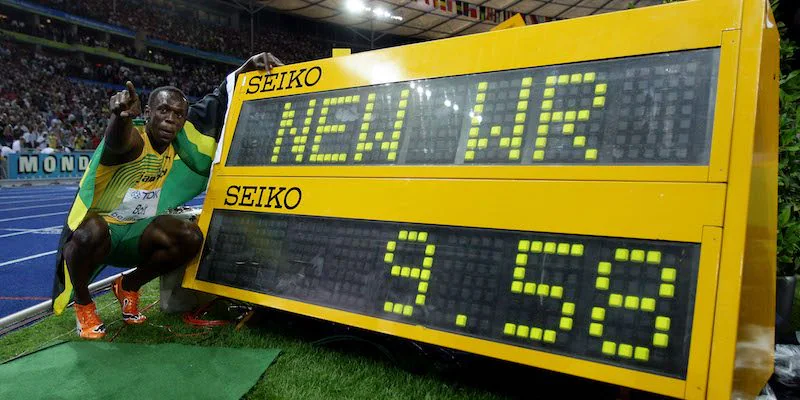
For 17 years now, athletics has rewritten almost all track records, from 400 to 5000 metres, from 3000 steeplechases to 110 hurdles. One of the few records that no one on the track has ever come close to is the 9″58 with which Usain Bolt ran the 100 meters at the Olympiastadion in Berlin at the 2009 World Championships, 11 hundredths better than the second regulation performance ever, the 9″69 of Tyson Gay and Yohan Blake.
The reason why that record still stands today has to do with the physiology of the sprint rather than with the exceptionality of a single athlete, because the 100 meters are among the races in which technology has the least impact. The so-called super shoes have also arrived in speed, i.e. spikes with carbon fiber plates and high elastic return foams, but the advantage they offer sprinters is a fraction of what they guarantee in longer races. In fact, the benefit of those shoes arises above all from the energy saving that accumulates over several minutes of running, while in a test that lasts less than ten seconds, fatigue is not the limiting factor, and what really counts is the force that the foot manages to discharge to the ground in less than a tenth of a second.
What happened at the World Cup in Berlin on August 16, 2009
The final started at 9.35pm, with a favorable wind of +0.9 m/s (the regulatory limit for validating records is +2.0 m/s). The data from that race are among the best documented in the history of athletics: the German federation and the IAAF (International Association of Athletics Federations, now World Athletics) measured the run with eight cameras and three laser systems, and the results were published in an official biomechanical analysis.
The first surprising fact concerns the start: Bolt’s reaction time was 0.146 seconds, the third slowest of the 8 finalists. Despite this, after 20 meters he was already in the lead. The partials collected every 10 meters best describe the race: five consecutive fractions between 0.81 and 0.82 seconds, at an average speed of more than 12 meters per second. In the stretch between 60 and 80 meters Bolt averaged 44.72 km/h, the fastest segment of the entire final. The even more indicative data, however, concerns the point at which it reached its maximum, which the laser systems place around the 68th meter, while Tyson Gay and Asafa Powell (2nd and 3rd at the finish line) reached their peak around the 55th meter before starting to slow down.
To cover the 100 meters he needed just under 41 steps, compared to the 44 and 46 of the other two medalists, with an average stride width that in the last 20 meters reached 2.85 meters. Tyson Gay finished in 9″71, at the time the third fastest ever, and finished over a meter behind. Finally, the improvement of 11 hundredths on the previous record (9″69 in Beijing 2008) is the largest ever recorded in the history of the 100 meters record.
Because the “super shoes” didn’t make a dent in the 100 meter dash record
Footwear with a carbon plate and high elastic return foams have changed the world of running in recent years, particularly over medium and long distances, but have had little impact on distances under 400 metres. The largest study on the topic, analyzing the 100 best annual performances from 2010 to 2022, quantified the gain: from 5000 meters to the marathon, men’s times improved by 0.7-1.4% and women’s by 2.2-3.5%; in fast races (from 100 to 400 hurdles) the gain drops to 0.4-0.7% for men and 0.6-1.1% for women.
There are two main reasons. The first is regulatory: World Athletics rules set the maximum thickness of the sole at 20 mm for track races, compared to the 40 mm allowed on the road. Much less foam means much less springback to exploit. The second reason is biomechanical: the advantage of super shoes arises above all from the energy savings accumulated over tens of minutes of running, an almost irrelevant factor in a race that lasts less than ten seconds and in which the limit is not fatigue.
Where the limit really lies: the contact time with the ground
At maximum speed (around 45 km/h) a sprinter’s foot remains on the ground for less than a tenth of a second, and in that instant the leg must discharge a force equal to several times the body weight. For years it was thought that the limit was right there: in the maximum force that the muscles can express. The most recent studies, however, have highlighted how the limit is not on the force that the legs can produce, but on the minimum time necessary to apply it: it is the speed of contraction of the muscle fibers that puts the roof on. Consequently, if muscles could generate forces close to maximum in that very short window, humans could run theoretical speeds in excess of 60 km/h. The record limit in the 100 meters is therefore biological, and to overcome it you need an athlete who combines long levers, explosive strength and very short supports. Exactly the combination that has only been seen once in the history of athletics, with Usain Bolt.
How long can Usain Bolt’s 9″58 last?
The post-Bolt generation of sprinters has come very close to that time, but not close enough. Kishane Thompson ran 9.75 at the 2025 Jamaican championships, the fastest time in a decade. Compatriot Oblique Seville won the Tokyo 2025 world title in 9″77, the American Noah Lyles won the Paris 2024 Olympic gold in 9″79. Amazing times but almost two tenths of the time recorded by Bolt on 16 August 2009. Before Bolt, the 100 meter record fell in small steps, often by one or two hundredths at a time. To beat 9″58 today we would need a leap in size that, in the last fifty years, only Bolt himself has achieved.