During archaeological investigations preliminary to the construction of the new Albaufstieg, the section of the A8 destined to cross Swabia in southern Germany, archaeologists brought to light a portion of an ancient Roman road. The discovery occurred along the route of an important modern infrastructure, but in the same place, about 2,000 years ago, one of the main communication routes of south-western Germany passed.
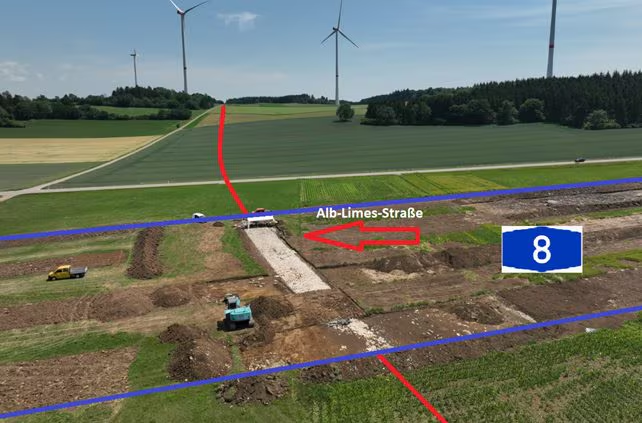
The stretch highlighted by German archaeologists measures 90 meters in length, and is made of locally sourced white limestone. The street belonged to the so-called Alblimes-Straße, a road network that served the part of limes Danube in what is now southern Germany. The discovery is particularly significant because it allows us to directly study a portion of the ancient road in the area affected by future road works. The archaeological investigation was part of the preventive archeology activities carried out in view of the construction of the new motorway connection. Before modern infrastructures definitively modify the territory, archaeologists are therefore verifying the presence of any evidence of the past.
The discovery also demonstrates how great contemporary works can offer precious opportunities for archaeological research. In fact, preventive excavations allow us to document structures that otherwise could remain buried or be destroyed by the works. The preventive archeology intervention has in fact made it possible to discover new sites near the new motorway, even much older than the Roman road, and dating back to the Bronze Age.
In this case, as often happens, the coincidence between the route of the modern highway and that of the ancient Roman road creates a curious comparison between two transport systems separated by about two millennia: the road built by the Roman Empire and the infrastructure intended to support the traffic of contemporary Germany.