Summer 2026 will cost the European Union around 180 billion euros, 1% of GDP. That’s almost exactly the growth the European Commission had forecast for this year, 1.1%. The estimate comes from Hot Summer Economics, the report published on August 8 by Triodos Bank economists Hans Stegeman, Joeri de Wilde and Ernst Hobma, who measured the impact of the heat on four fronts: agriculture, energy, transport and labor productivity. A clarification is needed immediately: the estimate only considers the direct effects of the first round, with the summer still underway. By the authors’ own admission it is probably prudent.
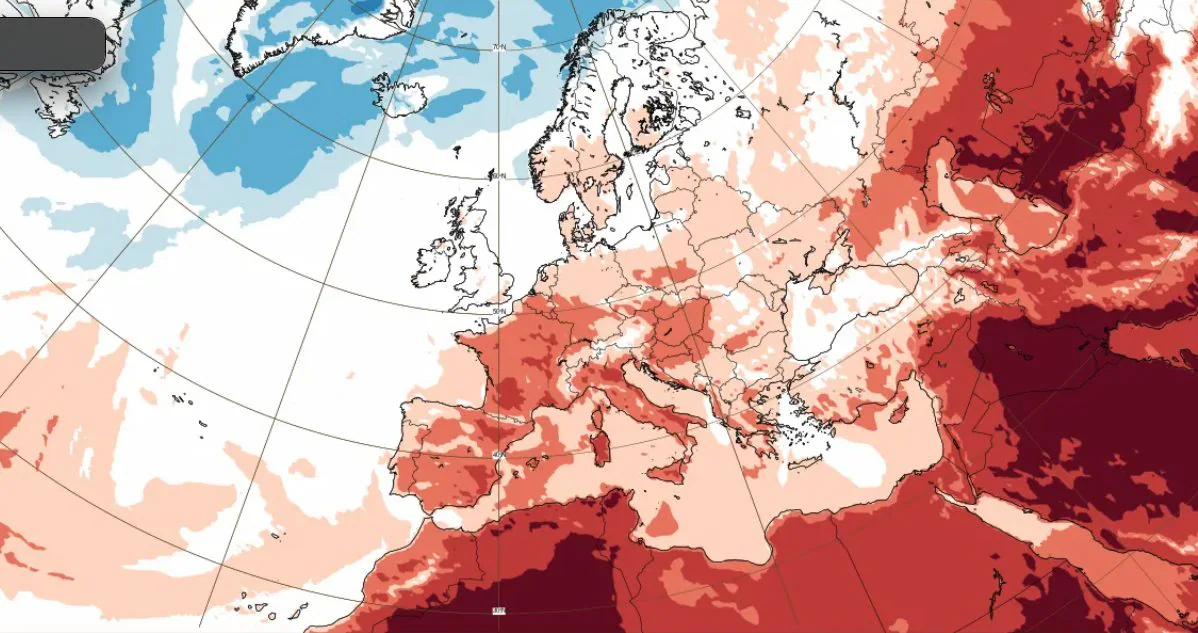
This year our country has accumulated 47 days above 30 degrees above its historical average: the highest value among the seven economies analysed, almost double the European average, which stands at 24. It is this difference, and not the absolute temperature, that determines the economic damage. And this is the reason why Italy is the second most affected country in the Union, immediately behind France and ahead of Spain and Belgium. With a paradox that we will get to: it happens despite being, on paper, the best equipped country of the group.
How hot summer 2026 really was
The starting point is physical data, and it is unambiguous. According to the Copernicus Climate Change Service, June 2026 was the warmest June ever recorded in Western Europe, more than three degrees above the 1991-2020 average: a record that belonged to the year before. Since then, two more heat waves have arrived. Three in six weeks.
There is a precise measurement of the origin of that heat. The research group World Weather Attribution calculated that the June wave was made about a hundred times more likely by global warming than it was two decades ago, and that 45% of more than 800 European cities surveyed had broken their heat stress record. The individual national meteorological services recorded records never seen before: France five consecutive days above 40 degrees and 72 departments on red alert at the same time, Germany eleven days above 35.
For Italy, however, a national number does not exist. Our country does not have a body that keeps this accounting like the German DWD or the Dutch KNMI do, and the available data remains local: in Florence six consecutive days above 36 degrees, a record for seventy years. It’s a gap we’ll return to.
How extreme heat turns into lost GDP: the 4 channels
The report analyzes the components of lost GDP distinguishing them by sector. Three of these together weigh just under half a point. The fourth alone is worth more than the other three combined.
- Agriculture accounts for approximately 0.15 points. The MARS bulletin of the Joint Research Center of the European Commission describes precisely what happened: the repeated waves shortened the maturation phase of autumn-winter cereals and brought forward the harvest, while for corn and sunflower the yield forecasts were cut by 6-7%. The French corn harvest, according to the findings cited in the report, is expected to be the lowest in fifty years. In Italy, in the Parmigiano Reggiano area, heat stress has reduced milk production by up to 10%. However, the sector weighs just 1.2% of European GDP: a serious agricultural shock is never translated one by one into a macroeconomic number.
- Energy is worth another 0.12-0.15 points, and here the heat acts in two opposite directions at the same time: it increases the demand for air conditioning while reducing the supply. Scarce, hot water has cut hydroelectric power, but the clearest image comes from French nuclear power: in July 6.3 gigawatts of capacity, about a tenth of the installed capacity, remained at a standstill at times because the cooling water exceeded legal limits. On prices, Ember data shows the European day-ahead average rising at the end of June to the highest levels since the 2022 crisis, with the Italian market, dependent on gas, returning to winter 2025 values.
- Transportation adds approximately 0.15 points. The drought has lowered navigable rivers to the point that some barges on the Rhine were traveling with a fifth of their normal load, with knock-on effects on German industrial supplies: economists estimate up to 0.2 points of GDP less for Germany if the situation persists. On the railways, the heat expands the tracks and imposes speed limits in half of Europe.
- The heaviest channel, however, is the least visible: labor productivity, alone 0.6 points. Above 30 degrees, hourly production collapses — about 3% for every degree higher according to Allianz Research, with more conservative estimates in the OECD analysis. It doesn’t just affect those who work outdoors: in controlled experiments at 30 degrees, performance on office tasks dropped by around 9%, and the heat at night worsens the quality of sleep, with effects that accumulate in the following days.
Because Italy is among the most affected countries despite being the best equipped
This is where the analysis produces the least obvious result. To distribute the losses between countries, the authors construct a heat sensitivity index based on four elements: how much the exposed professions weigh, how many air conditioning systems are installed, how much a population is historically accustomed to high temperatures and how much time they spend commuting between home and work.
On this scale, Italy is the least sensitive country in the sample. It has a lot of air conditioning, many hot days behind it and therefore a good degree of acclimatization of the citizens and shorter home-work journeys. At the other extreme is Poland, which suffers an estimated 3.4 times more damage for every single hot day.
Yet Italy still ends up among the most damaged economies, because the ability to adapt has not stood up to the intensity: being equipped is useful until the threshold shifts, and this year it has shifted. France, less acclimatised and with little air conditioning, loses around 1.4 points of growth. Italy follows it with around 1.2 points, and since it started from a growth forecast of just half a point, the result is the same: two of the major European economies close 2026 in contraction, both around -0.7%. Belgium and Germany also go below zero, while the Netherlands stops at the zero line. Poland, which had very few extra hot days, still grew by almost 3%.
What the ECB says: heat enters monetary policy
That summer has become a macroeconomic variable is no longer just a partisan thesis. In its August Economic Bulletin, the European Central Bank lists extreme weather events — “as illustrated by ongoing heat waves” — among the upside risks to food prices. It is the most explicit language that a central bank uses on a phenomenon that is not yet concluded.
The measure of that risk comes from the ECB’s own research. A 2024 study by Maximilian Kotz, Friderike Kuik, Eliza Lis and Christiane Nickel, published in Communications Earth & Environment, calculated that the European heat in 2022 pushed food inflation up by 0.93 percentage points in the following twelve months. This is precisely the parameter that Triodos uses to project the effect of 2026. A second ECB working paper, Beat the heat, released this year, estimates that in a scenario of heat and drought similar to that of 2022, the added value per capita will drop by 4.5 points in agriculture and by 0.75 in industry.
The practical consequence is that the bill for families will not arrive this summer, but in 2027, when failed harvests will be passed on to supermarket prices.
What is left out of the 180 billion
One final caveat about the number, and it’s the most important. GDP measures production, not well-being: fires and victims do not enter into it. Indeed, the expense of putting out a fire or treating a sick person technically increases it, despite being a net loss for the country. The authors write it openly and give up on monetizing these effects.
On fires, the European data from EFFIS, the monitoring system of the Joint Research Centre, describe one of the worst seasons ever recorded: in mid-August the burned area in the Union exceeded 490 thousand hectares, against a twenty-year average of around 197 thousand, with France at an all-time high. None of these figures have so far been translated into euros.
A count of victims exists only where national health agencies publish it, and this year there are few countries that already have data. France certified 5,764 excess deaths between June 17 and July 2, a more intense episode than August 2003, with more than half of the deaths concentrated on just three days out of sixteen. In Germany the Robert Koch Institute has so far counted around 5,120. Belgium stopped at 1,747 between 18 June and 1 July, 48% above the seasonal average: its deadliest wave since records have existed, i.e. since 2000. The Netherlands counted around 1,323 deaths in three weeks, with a tail that continued after the drop in temperatures. In England and Wales, the Met Office, UKHSA and Imperial College together estimated more than 2,700 fatalities for the May and June waves.
Here too Italy is missing. It does not have a timely national count comparable to that of France or Germany, just as it does not have a timely official statistic on extreme heat days. The country that this year recorded the largest temperature gap in Europe is also the one that measures it the worst and could be a problem.