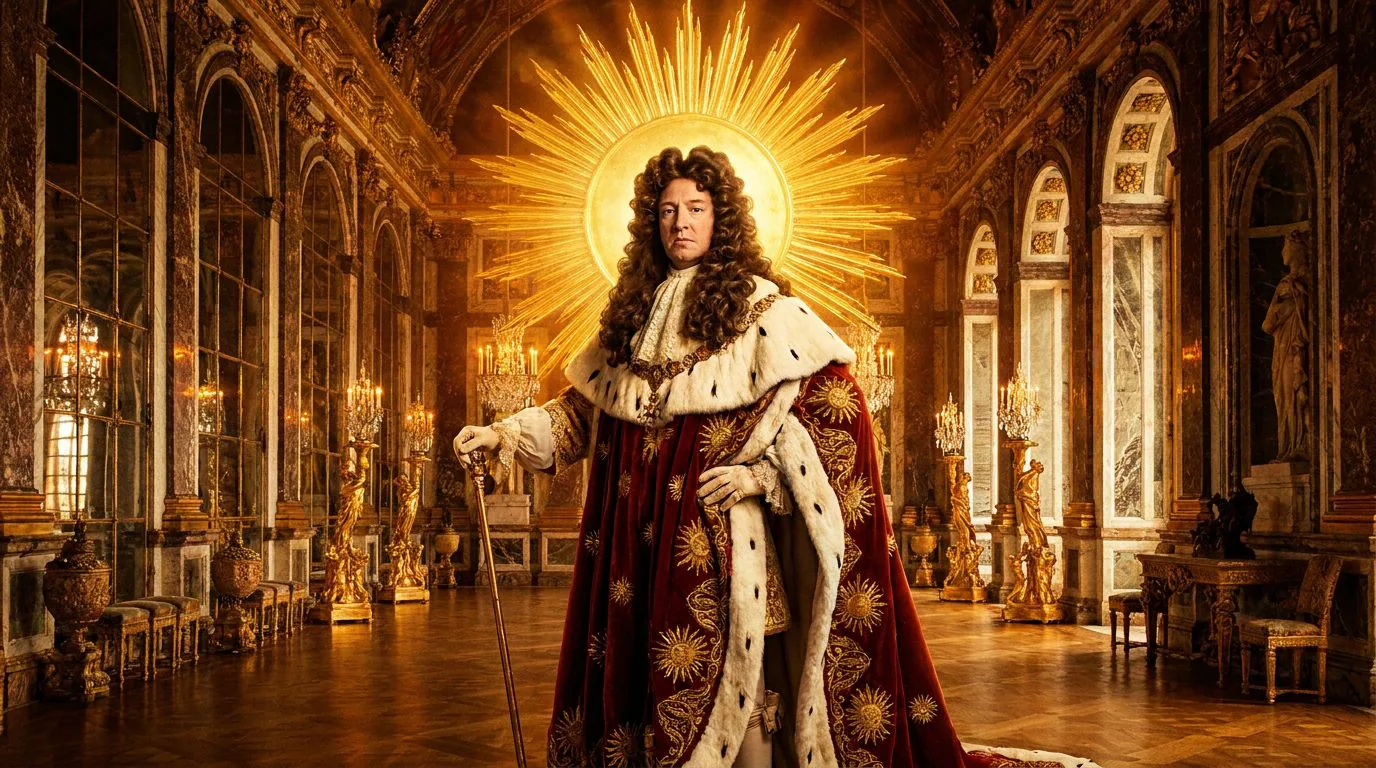
Louis the planets rotate around the Sun. Louis, in fact, stood out for the centralization of power, summarized in the phrase L’Etat c’est moi«I am the State», which according to some sources he uttered. His reign, 72 years and 110 days long, was the longest of all time and represented an important moment not only for France, but for all of Western civilization.
Brief biography of the longest-serving ruler in history: absolutism in France
Louis Born on 5 September 1638 in Saint-Germain-en Laye, he was the eldest son of King Louis XIII and Anne of Austria. In 1643, when his father died, he took his place as sovereign but, being still a child, he did not personally assume power, which was administered by the cardinal minister Giulio Mazzarino until 1661, the year of his death.
After the death of Mazarin, Louis XIV personally took over the government of France and highlighted himself as a model of absolutism: he centralized all power in his hands, significantly reducing the political weight of the aristocracies and high officials. His way of governing represented the conclusion of an epochal change. In the Middle Ages, in fact, power was extremely fragmented and the great feudal lords effectively acted as kings of their territories, while the sovereigns and the emperor had only nominal control. As the centuries passed, central power strengthened (at different times and in different ways depending on the country), which allowed the birth of the state in its modern form. Louis XIV represented the culmination of this process.
His reign was characterized by important reforms. In the economic field, through minister Colbert he promoted a mercantilist policy, aimed at increasing state revenues as much as possible. In matters of religion, he tried to impose the monarchy’s control over the clergy, thus coming into conflict with the papacy, but he denied freedom of worship to the Protestants, revoking the Edict of Nantes issued by Henry IV in 1598.
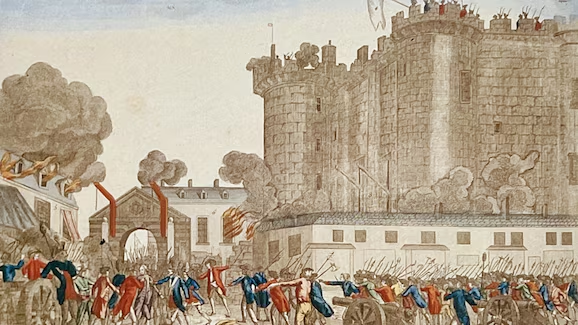
To pursue his political objectives, in 1682 Louis XIV moved the court to the palace of Versailles, which he himself had built. The idea of moving the court away from Paris responded to the need to better control the nobles, who were forced to move with him, as well as to avoid the risk of popular revolts by the Parisians.
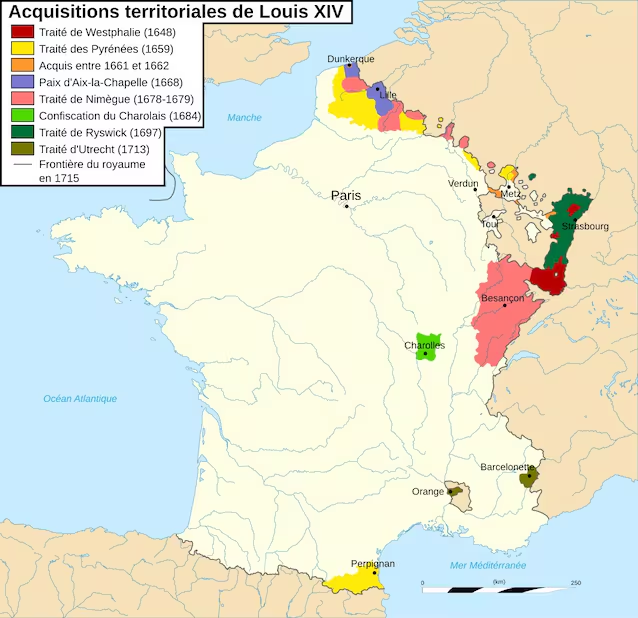
Louis XIV also sought to assert France’s power in Europe. He led several wars, including the War of Devolution in 1667-1668, the War of Holland in the period 1672-1678, gaining control of Franche-Comté and Flanders, and the Nine Years’ War between 1688 and 1697. The last conflict in which he participated was the War of the Spanish Succession, which lasted from 1701 to 1714 and ended with a compromise. Overall, Louis XIV was only partially successful in realizing his foreign policy goals. He died at Versailles in 1715.
Louis XIV becomes the Sun King: the order of the name
The sovereign knew that, to govern absolutely, he had to flaunt his power and magnificence. One of the first occasions on which he did so was the Grand Carousel, the grandiose show organized by the sovereign at the Tuileries on 5 and 6 June 1662 to celebrate the birth of his firstborn. Later, he used the sun emblem on coins and various artifacts, often along with the motto Nec Pluribus Imparwhich literally means “Not inferior to most”. The meaning was that the king, like the Sun, was above everyone.
Moreover, the expression “l’Etat c’est moi”“I am the State”, which perfectly explains his concept of absolute power (although it is not certain that the king ever uttered it). The French sovereign died on 1 September 1715 in Versailles, a few days before his 77th birthday, after a reign of 72 years, the longest in the history of Europe. In the last days of his life he suffered a lot, received the last sacraments and left precise instructions for the succession.
Two curiosities:
1. He was not considered beautiful in the classic sense of the term (the name Sun King, as we have seen, did not derive from his external appearance) but he had a regal bearing and great charisma, which came from his power.
2. As a man of his time, he paid little attention to hygiene (which in the seventeenth century was very different from today, also because the methods of transmission of diseases were not known). Tradition has it that in his entire long life he only bathed twice.