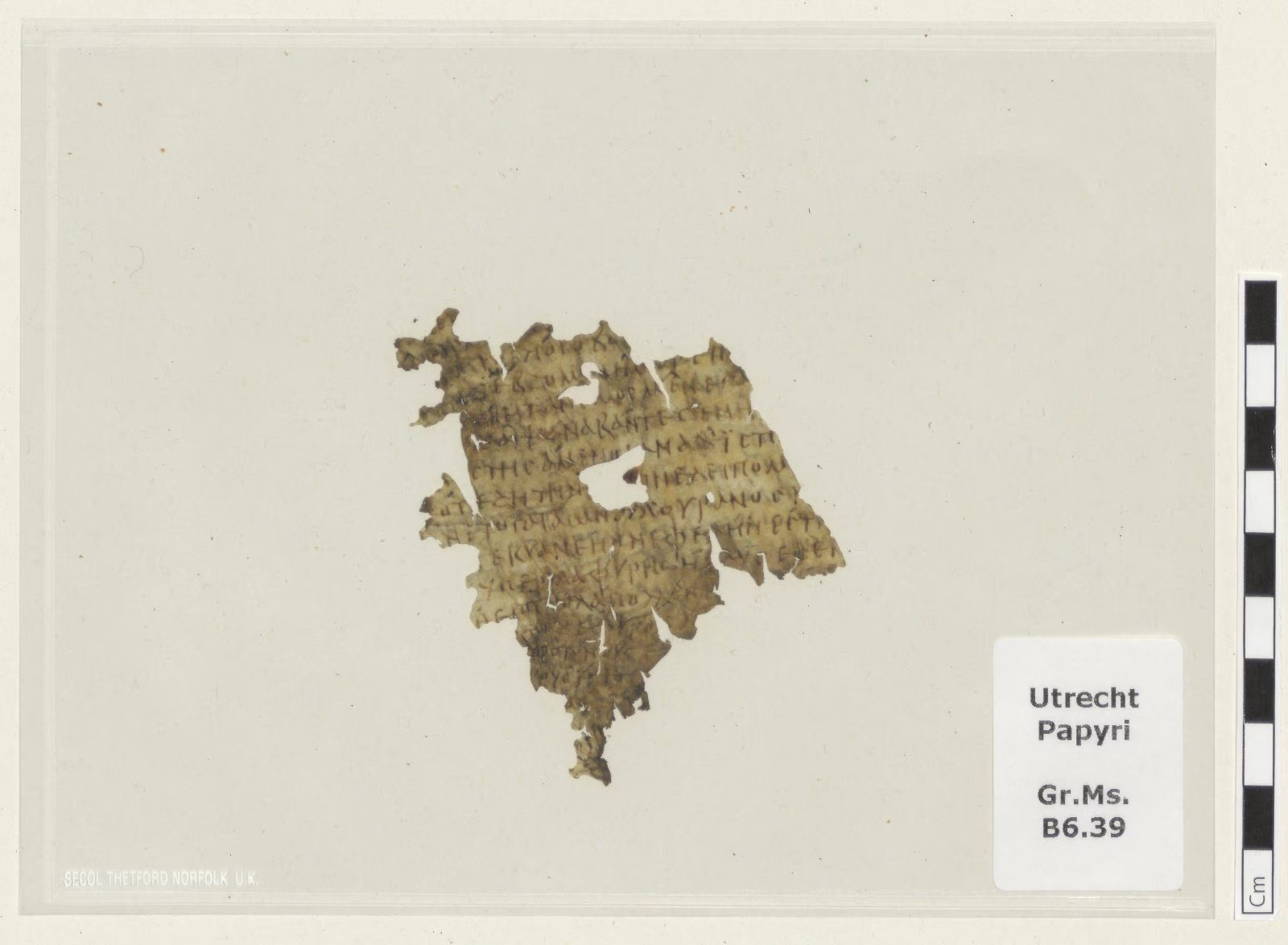
A fragment of Homer’s Odyssey, dating back to 300 AD, identified as Utrecht Gr. Ms. B6.39a, has just been found: it is a very rare fact, there are only about thirty similar ones in the whole world. This portion of the manuscript emerged by chance in the Library of the University of Utrecht, in the Netherlands: Dr. Mark de Kreij found a small fragment of a parchment codex dating back to the 3rd or 4th century AD. On this piece of parchment some verses from Book XII of the Odyssey are transcribed, in particular the episode in which the sun god Helios, or Helios, discovers that Ulysses’ fleet has eaten his sacred oxen, committing a sacrilege.
The success of Christopher Nolan’s The Odyssey, the IMAX cinematic epic released during the summer, has brought Homer’s masterpiece back to global attention, one of the oldest literary works in the world that have come down to us, which narrates the daring return of the Greek king to the island of Ithaca. The interest in this great literary work, however, is not new: like the Iliad, the Odyssey has always been highly appreciated: it is considered a masterpiece of the Western Canon, and the ancients already considered it precious and replicated it in manuscript to preserve it.
Like the Iliad, the Odyssey is divided into 24 books. The twelfth is the last of Ulysses’ internal narrative, that is, the one that immediately precedes his actual return to Ithaca. The hero’s narrative begins in the sixth book, when he arrives on the island of Scheria, in the land of the Phaeacians, after a storm destroyed his ship and caused the death of his companions. Once he arrives, in books from the ninth to the twelfth Ulysses tells his guests about the journey that led him there, thus explaining the encounters with the Lotus Eaters, the Cyclops Polyphemus, Circe and Calypso, concluding with the loss of his ship. This in turn was caused by the fact that his companions had eaten the oxen of the Sun god, Helios, unleashing a terrible storm upon themselves.
The verses present in the Utrecht Gr. Ms. B6.39a manuscript describe the very moment in which Helios discovers what Ulysses’ companions have committed. This event marks the most critical point of the now decade-long journey home, as well as the beginning of the king of Ithaca’s mission of revenge against the men who attempt to seize the throne by marrying his wife Penelope. It is a real turning point in the Odyssey, not surprisingly placed in the middle of the twenty-four books that make up the work.
Since the mid-twentieth century, Utrecht University has assembled a collection of early Christian manuscripts from the heirs of the German scholar Carl Schmidt. Most of these texts were written on parchment in the Coptic language – Egyptian written using the Greek alphabet -, but the collection also included some Egyptian and Greek papyri. It is precisely among these materials that a discolored and damaged fragment was found, initially considered a fragment of little interest, characterized by tiny and tidy writing. De Kreij found it and immediately recognized some typical words from the Homeric epic: new research confirmed that those verses really belonged to the Odyssey. “It is really remarkable that such a fragment simply happened to be somewhere in Utrecht, without anyone knowing about it,” De Kreij told RTV Utrecht.
But which edition of the Odyssey? The page, written on both sides, was part of a pocket edition of the complete Odyssey measuring approximately 15 x 10 centimeters (more or less like a current e-reader of books), which probably belonged to a Homer enthusiast residing in the Fayyum oasis (i.e. in the Libyan-Nubian desert, in Egypt) around 300 AD
However, this is not the oldest fragment of the Odyssey that has come down to us: the Metropolitan Museum of Art in New York has a fragment of Egyptian papyrus dating back to the period between 285 and 250 BC that contains verses from the twentieth book, including three that do not appear in the standard text (which shows that different versions of the Odyssey circulated in ancient times). Donated to the museum in 1909 by the Egypt Exploration Fund, the fragment is now on display at the Met not far from six other objects related to the Odyssey, including a cup and a fresco.