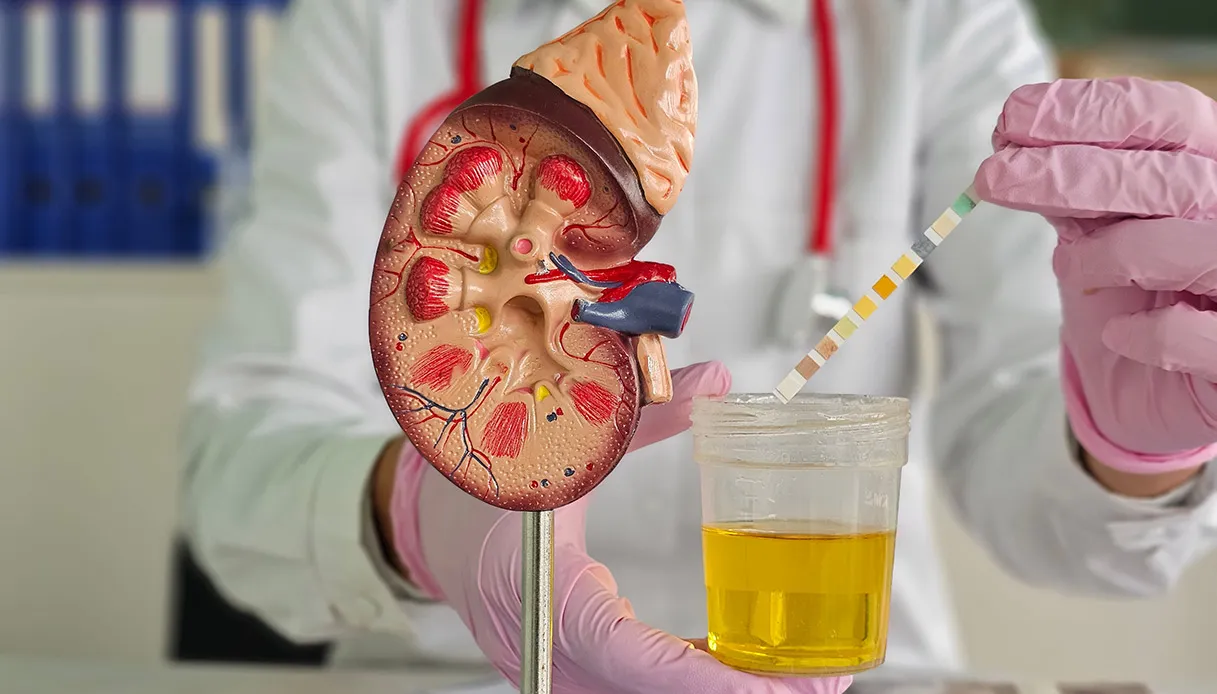
The first EU Screening Week is underway, the European week dedicated to screening and early diagnosis, promoted from 28 September to 4 October by the European Commission in the framework of the Safe Hearts Plan. In this logic, in addition to knowing the blood sugar, blood pressure and cholesterol values, experts recall the importance of the kidney-heart axis and the possibility of understanding with a urine test who runs the greatest risks. It is called uACR and calculates the ratio of albumin to creatinine in urine.
Every year in Europe, cardiovascular diseases cause 1.7 million deaths and represent the leading cause of death and disability. An impact that affects a significant part of the European population: one in seven adults lives with a cardiovascular disease. Yet, around 80% of these pathologies would be preventable thanks to early diagnosis, and this is what we are aiming for with a test worth a few euros, with correct lifestyles.
A simple check
An IQVIA investigation shows that we are faced with a clinically recognized test, technically simple and already substantially available, but not yet included in a uniform and systematic way in Italian care pathways and with a strong territorial heterogeneity. Organizational, operational and cultural barriers limit the systematic use of uACR. The uACR is poorly integrated into care pathways (PDTA) and this limits the possibility of intercepting a risk condition that may still be silent very early. From the nephrologist’s point of view, the presence of albumin in the urine is an important signal: The uACR expresses organ damage, it is the first signal that the renal filter, i.e. the glomerulus, is unable to retain albumin, which should normally never be present in the urine.
“When this happens it means that the renal filtering capacity is compromised, so there is a problem that needs to be investigated. The KDIGO Guidelines have recommended the use of the uACR test for at least ten years and nephrologists follow these indications, and recommend associating the eGFR with the uACR, which allows for even more precise stratification of both renal damage and cardiovascular risk”
explains Giuseppe Grandaliano, Full Professor of Nephrology at the Catholic University of the Sacred Heart of Rome, Director of the Complex Operational Unit of Nephrology, Fondazione Policlinico Universitario A. Gemelli IRCCS of Rome.
Why screening is important
Knowing that you have a kidney condition when symptoms are not yet showing makes a difference in two aspects: the management of the patient with kidney disease is different in the use of many drugs, starting with a banal antipyretic or a painkiller, but also an antiplatelet or an oncology drug. Not only that: as underlined by Massimo Morosetti, President of the Italian Kidney Foundation FIR ETS and Head Emeritus of Nephrology and Dialysis ASL Roma 3
“Until a few years ago we had no therapies to treat kidney failure, apart from diet and antihypertensives, now the situation has completely changed, we have drugs capable of greatly slowing down the progression of kidney disease, or stopping it if it is intervened at a very early stage. For this reason, periodically carrying out investigations capable of highlighting kidney disease at a very early stage is of fundamental importance and the uACR is one of these tests, extremely sensitive and precise”.
Sebastiano Sciarretta, Professor of Cardiology at the Sapienza University of Rome, Director of the Complex Operational Unit of Cardiology at the Marco Pasquali University Institute ICOT Polo Pontino (Latina), President of the SIC Lazio section, underlines:
“The uACR contributes to making an integrated vision of cardio-renal risk concrete, highlighting the strong link between cardiovascular health and renal health: the same risk factors that impact the development of atherosclerosis also influence the development of chronic kidney disease. In this scenario, it is essential to start from preventive medicine, it is a question of intervening according to an integrated multi-specialist approach which, among other things, favors a sharing on the interpretation of the results of tests and therapeutic choices. The urinary albumin/creatinine ratio is very important as it is a marker of very early renal damage in often asymptomatic patients who may also have an initial cardiovascular problem”