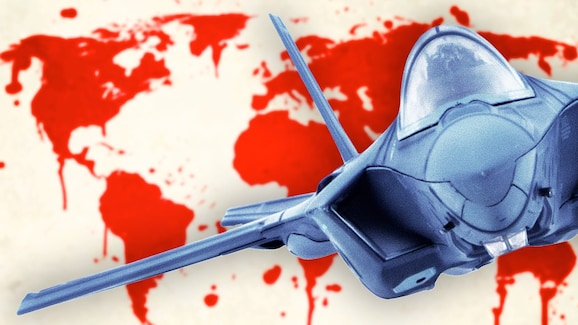
He made a recent interview with the Daily Mail British General Richard Shiroff, a high officer of the Armed Forces of His British Majesty and former deputy supreme ally in Europe (the second most important charge within the NATO military structures), according to which there is the risk of an “extreme, but not impossible scenario” in which, in the face of a surprise attack on the vast scale of Russia against Europe, the oriental defenses of NATO can give in just 100 hours. The “apocalyptic” scenario also made hypotheses of “third world war up”. But is it really the case?
This is not a new thesis by Shirreff: already in 2016 with his book 2017: War with Russia: an urgent warning from senior military commands to spare the military world as much as that of politics regarding that The General warned that NATO is found in a state of complete unpreparedness that would make it unable to organize a sufficient defense in the event that the worst scenario in the east of NATO concretized. That the evaluations expressed by Shireff over the years are realistic or not is the subject of debate: what we can say is that at the moment there are no credible signals of a surprise Russian offensive in preparation.
Because at the moment a surprise attack by Russia is unlikely
The main reason why it appears unlikely that at the moment Moscow is preparing for a large -scale surprise offensive along the east of NATO east is the absence of preparations by the Russian Navy. This asset holds a position of fundamental importance in the military strategies of the Kremlin, as widely confirmed during the Russian intervention in the Syrian civil war and during the Russian-Ukraine war. Before the start of hostilities, between October 2021 and February 2022, there is in fact an abnormal concentration of Russian naval forces in the waters of the Black Sea (some from the North fleet or even from that of the Pacific), in particular landing ships to support the amphibious operations along the Ukrainian coasts.
The large -scale mobilization of the Navy was an unequivocal signal of the fact that the Kremlin was preparing for an attack. To date, however, no similar preparation has been noticed that would hypothesize that the Russia Navy is close to going out into the sea by mass in war set -up. This is a very significant clue, because a hypothetical surprise attack against NATO could in no way be regardless of the use of the Navy, on whose shoulders the responsibility of attacking the NATO sides and affecting strategic goals located in depth with a shower of conventional or even nuclear head -head missiles would fall.
The absence of any “suspicious movement” by the “vessels with the cross of Sant’Andrea” is enough to dispel the most foschi scenarios: Russia is not one step away from attaching to us.
The growing Russian tensions and born
The lack of signals that lead us to affirm that the outbreak of the “third full -time world war” is not around the corner, however, must not make us think that “everything is going well”. In the last decade, the relationships between Russia and NATO have gradually worsened until they leave the field to an open hostility and, consequently, the high commands and the Think Tanks of the opposite factions have wondered several times regarding the hypothetical war scenarios.
The increase in the voltage has resulted in recent border accidents that are growing in number in a worrying way, from the alleged cases of GPS JAMAMING to the alleged incursions of drones in the air spaces of Eastern Europe. From this point of view it is legitimate to ask whether the two contenders are actually preparing for a large-scale war, even if it is not easy to distinguish between reality and rhetoric, especially when the contenders resort to declarations of incendiary nature such as those who have been accustomed to the former Russian-coating Dmitry Medvedev for years.
Without a doubt, Russia, in an attempt to bring the Russian-Ukraine war to a victorious solution for her, has invested very large resources in the expansion of her armed forces and in the reconstruction of the military-industrial complex necessary to support them, even in a perspective of comparison-clash with the western western. The NATO, for its part, has openly sided in favor of Ukraine and is almost unanimously supported Kiev in its fight against Moscow, but the general rearm program of the alliance has now produced contrasting results.
Although at the moment it does not seem imminent a direct confrontation, there is the question at all secondary of the update of the contending doctrines. While Russia is literally reforming the operational concepts of its armed forces also in the light of the real experiences learned on the battlefields of the First Conventional War on a large scale of the 21st century (massive use of drones, use of electronic disorder systems and so on), NATO seems to date back to embrace the revolution in the military field that this war is bringing.