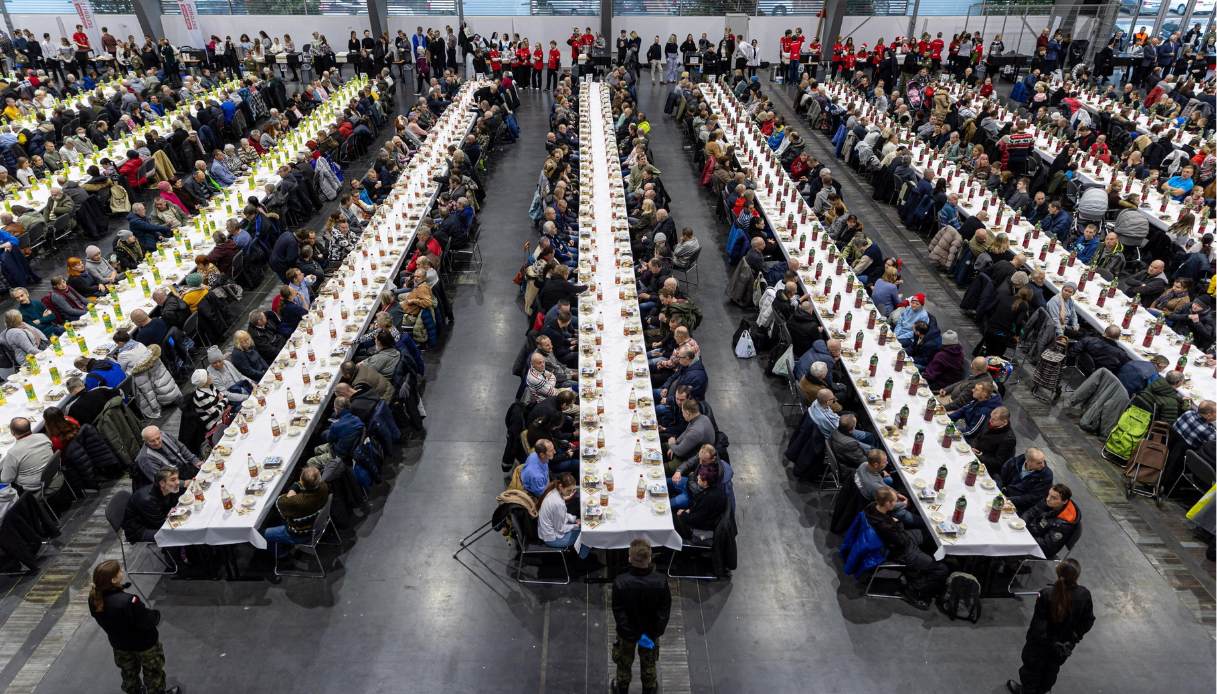
Italy is an increasingly poorer country. This is the photograph taken by Caritas, the CEI’s charity, in the report on poverty and social exclusion, recording an increase of over 43% in poor families in the last 10 years.
From the processing of Istat data, there are currently over 5.7 million poor people, equal to 9.8% of the resident population in Italy.
The growth of absolute poverty
Caritas presented the 29th edition of its report on Italy, entitled “Off the field. The gaze of proximity”, on the occasion of the World Day of the Poor on Sunday 16 November.
The report highlights a consolidated phenomenon which has seen significant growth in the last decade, particularly affecting minors and precarious workers with insufficient wages.
An increase calculated in a +43.3% of families in absolute poverty, which currently number 2.2 million in Italy, equal to 8.4% of households.
Of these, in 2024 the Caritas centers offered support to 277,775 families, equal to 12% of the total, an increase of 3% on 2023, recording a +62.6% compared to 2014.
Furthermore, there are at least 10 million people in our country with less than 2 thousand euros in liquid savings, who would therefore have major problems coping with serious unexpected events, such as the loss of a job or the discovery of a serious illness.
The Caritas report on poverty in Italy
The study focused not only on economic and housing difficulties, but also on the social fragility caused by unemployment, low education, legal irregularity, isolation and family burdens.
Poverty increasingly manifests itself as a multidimensional node of intertwined fragilities, which cannot be reduced to a lack of income alone
From this survey, a synthetic index of individual vulnerability was obtained, according to which 67% of people with multiple problems, in at least three of the areas examined, fall into a medium-high or high vulnerability range.
In this context, the Caritas report also highlighted the increase in inequalities in Italy, where the 10% of the wealthiest families own 60% of the total wealth.
Disparities which, according to the analysis, have repercussions between one generation and another, fueling a vicious circle destined to block social mobility, crystallizing privileges on one side and exclusions on the other.
While since the 1990s the average wealth of the 50 thousand richest Italians has more than doubled, the 25 million poorest people have seen their assets reduced by more than three times, to an average wealth of around 7 thousand euros per capita.
The targets are above all women and young people between 16 and 34 years old residing in the South, as well as workers with part-time contracts in general.
A condition also effect of the decrease in salaries: Italy is last in the ranking for change in average real salaries in OECD countries in the period between 1990 and 2020 and the only country with a negative value (-2.9%).









