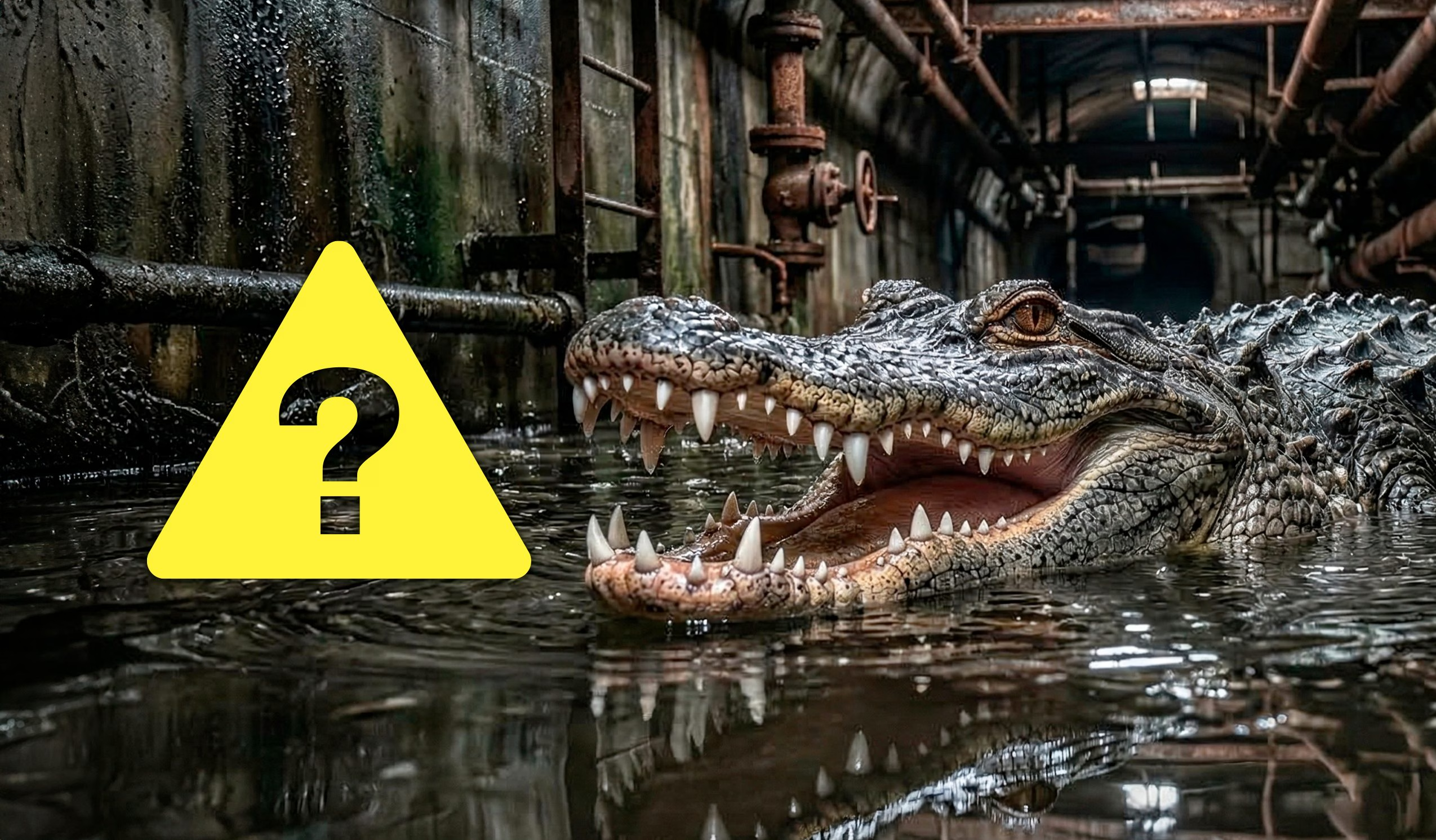
The presence of alligators in the sewers of New York is one of the most famous urban legends not only in the USA but, perhaps, in the world. And although science has never found any type of supporting evidence, still today thousands of people are convinced that entire colonies of these reptiles actually live underground.
But how exactly did this myth arise? And what do we know about it? Let’s clarify.
The origin of the legend
Like any self-respecting legend, that of the New York alligators also has its roots in a historical fact. At the beginning of the twentieth century, tourists who went to Florida could buy baby alligators for a few dollars: it was a common practice that was also advertised in newspapers and flyers. In short, an “exotic” puppy to then bring to the Big Apple – when it was still legal to do so.
As it is easy to imagine, managing an alligator is anything but trivial and therefore often these animals when they became a little too big were thrown down the toilet or into the manholes. These are the words of Michael Miscione, former historian of the Manhattan borough, to the NY Times:
It was a time when all these alligators were brought to New York and ended up escaping on their own or were released by disgruntled parents.
Precisely from here a popular belief was born that saw these alligators grow, reproduce and proliferate in the city sewer system. The newspapers, clearly, wallowed in this type of news: anything involving an alligator was reported in all the city newspapers, starting to lay the foundations for the birth of the myth. In many of these cases, the origin of the alligators found in the city or along the coasts was often not investigated and – by default – was assumed to be in the sewers.
The “definitive proof” was placed inside a book, World Beneath The Citywritten by Robert Daley in 1959. This work mentions Teddy May, the city’s sewer superintendent until 1955. He confirmed that he had seen alligators with his own eyes and that he had hunted them to try to reduce their numbers – although his stories remain stories without any kind of concrete evidence to support them. Regardless, the book became a best seller, providing narrative material for films, comics, TV series, novels, etc.
But how much truth is there in this whole story?
What science says about alligators in sewers
To date, there is no evidence that alligators live in New York’s sewers, and the scientific explanation behind this statement is far from trivial.
First of all we must keep in mind that the immune system of alligators is very resistant and, consequently, the bacteria present inside the sewers may not be such a big obstacle to their development. The main reason why they would not be able to live here is instead to be found in their thermoregulation: being reptiles, their body heat comes from their exposure to the Sun but this is impossible in the sewers. It is true that alligators can enter a state of brumation (a sort of hibernation) and tolerate temperatures up to around 4°C, drastically slowing down their metabolism… however these are survival techniques that can only be adopted for small intervals of time and certainly not for an entire lifetime.
Furthermore, the cold could cause problems with their nutrition, given that the digestive system of alligators requires heat to function: otherwise the food cannot decompose properly, with potentially lethal consequences.
But even if we ignore all this, we don’t have any kind of concrete evidence regarding their presence in the sewers. In fact, in recent decades the sewerage system operators have never reported even a single sighting. As former service manager John T. Flaherty ironically commented, the most concrete proof of the absence of alligators is that no union representative has ever cited the infestation as a reason for asking for a wage increase for sewer workers.
In conclusion we can therefore say that yes, it is possible that in the past alligators may have lived in sewers for very limited periods of time… but it is highly unlikely – indeed, impossible – that stable and long-lasting colonies will be able to develop here.