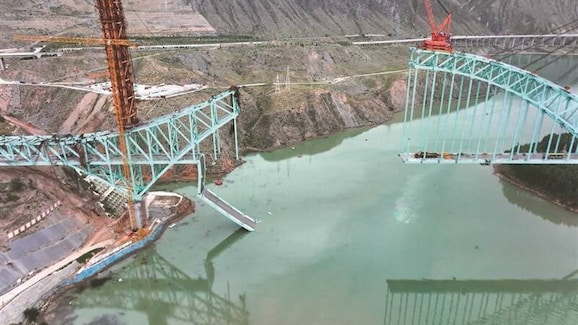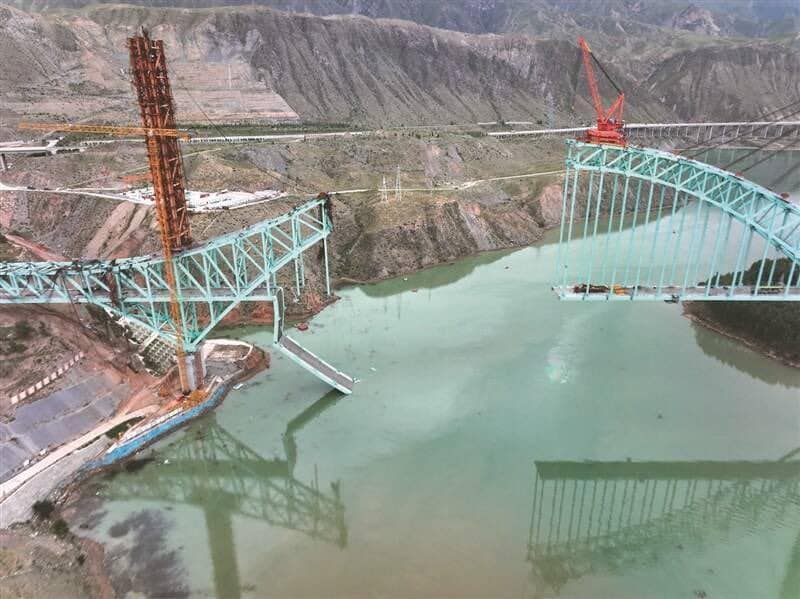
In the north-western province of Qinghai, in China, an arched bridge has collapsed during the construction phase: the accident caused the death of 12 workers, while 4 are still missing. The infrastructure should have been completed by the end of August, becoming the largest double -track continuous railway bridge in the world, as well as the first bridge of this type to cross the yellow river.
The structural engineer Gaetano Cantisani provided us with a technical analysis of the accident, explaining the functions of the cable and the different factors that could have caused the release, causing a waterfall reaction that determined the collapse of the central part of the structure.
What was the cable for and why was it so important for the construction of the bridge?
“First of all, it must be specified that the support cable performed a temporary and provisional function: as can also be seen from the images, in addition to the aquamarine arch, the infrastructure is also composed of two brown pylons positioned in the support area, from which the ropes that maintain the structure, which is made up.
It is a technique often used for arch bridges which, until they are complete, do not work as they should because the arch is not yet able to transfer the actions that are provided to it by the structure that hangs underneath. Probably during this phase he is not even able to hold his own weight.
As it is built, in fact, the arch becomes increasingly heavy and therefore needs a support that is provided to it by these cables, fixed on the pylon that has a counter -down on the other side. Consequently, the horizontal action is discharged on the counterpart (fixed to the pylon), while the vertical action is downloaded on the pylon itself.
In other words, the arc bridge is unable to support its weight until the suture with suture is mounted, i.e. that element that unites the two arc stunts which, once completed, will constitute the arch.
The infrastructure, therefore, had been designed to be maintained provisionally by these cables: only in cases where the arched bridges are smaller in size (as in the case of some railway bridges built in Italy along the high -speed line) it is possible to build the entire structure of the bridge without the use of cables, and then place it directly on the spot. Otherwise, the presence of these additional structures is always necessary, precisely because not all the components of the bridge are performing their function. “
What were the consequences of the release of this cable?
“The moment the temporary cable gives way is generated a cascade reaction: the cable that has given up brings all the other following, because the whole part that was to hold the broken cable is now kept by the next cable, which in turn gives because the weight is excessive, until the structure gives everything completely.
Among other things, from the video of the collapse it is possible to notice the “scie” around the cables: in all likelihood it is dust, which could be raised at the time of the breakage of the cable or anchoring on the arch. The cable, in fact, is in tension and when it comes out suddenly it generates a sort of whip effect. “
What could have caused the release of the cable?
«Behind the collapse of the bridge there may be different causes: from the published images, it seems that all the councils had been positioned, but probably the last one was not yet definitively attacked. The most delicate phase of the whole construction was therefore taking place, because all the cables were at the time of maximum stress. The failure may have triggered due to an assembly defect of the arch, but it could also be linked to a previous damage to the cable (which, being a provisional element, is often reused).
At the same time it should be considered an additional important aspect: during the construction of a bridge of this type there is a precise alignment between the two pieces of bow, especially if you are in the final phase, as in this case. That’s why the workers were working at night, to try to limit the thermal changes and the consequent dilations of the structure due to the temperature variations between day and night. At this stage, the altitude adjustments between the two sides can also be carried out by varying the tension in the cables, which adds to the possible contributing factors of the failure.
To consider, then, there is the question of the sizing of the cable (i.e. what is the diameter that the cable must have to be able to hold a certain weight), even if unlikely since they are very controlled objects and that require relatively simple project calculations, as well as security margins usually high for their crucial role.
Finally, the hypothesis of human error remains: it must be emphasized that in a constructive phase as delicate as the final one the attention is maximum, but clearly this possibility cannot be completely excluded.
In summary, behind the assignment of the cable there may be a series of contributing factors, also linked to environmental conditions, which may have caused the release and triggering the cascade reaction finished with the collapse of the central structure. “
How common are accidents of this type?
“In reality, accidents of this type occur mainly during the construction phase (and this is true in general when it comes to bridges), when the arc bridge is not yet able to support its weight and needs an external support: once the collapse of a bridge of this kind is completed, it is rather rare and, if it happens, is mainly linked to the age of the infrastructure and the lack of maintenance over the years.
In addition to the factors mentioned above, it must also be considered that it is a record bridge: being among the first large arch bridges, what happens during the construction can be more difficult to predict.
Today, however, these collapses are less frequent also thanks to new real -time monitoring technologies that allow you to control the cables with tools that record their instant shooting. “