Since its first military use, during the Italian-Turkish War of 1911, the air fleet has demonstrated extreme flexibility during all the wars of the twentieth and twenty-first centuries, undoubtedly establishing itself as one of the decisive elements in modern conflicts.
It is therefore no coincidence that the United States, Russia, China and India, the main world powers, are also the countries that can boast the most numerous and powerful air forces in the world. However, it is necessary to highlight the fact that, in light of the parallel experiences of the war between Russia and Ukraine and the war between the United States and Iran, the doctrines of air power – understood as the strategies and tactics employed – are going through a rapid transformation, and it is not certain that the current global hierarchies in the field of flight will remain such for much longer.
Before proceeding, however, it is necessary to introduce a necessary premise: the data we will present are estimates and, moreover, there is no unanimity of consensus behind the numbers, for several reasons:
- first of all, for obvious national security reasons, countries generally do not openly declare the number of aircraft they possess;
- secondly, a distinction must be made between aircraft in service with the actual air forces and those used by other military services of a given country. In fact, outside the United States, where the various air forces are used to operating in synergy and for this reason there is a tendency to consider the union of all the air assets owned by the Stars and Stripes country, elsewhere (for example in Russia, China and India) there is a clear separation between the aircraft in service with the “air forces” and those in service, for example, with the “navy air forces” or others, and these assets are usually not counted in the analysis documents;
- finally, there is the problem of aircraft no longer in service, but kept in reserve and potentially reactivated in the event of conflict, but this is yet another story entirely.
The ranking of countries
- 11. The United States: a dominion tested
- 22. Russia, between reform and expansion
- 33. China: the unknown of experience
- 44. India and production dependence
- 5The new trends that are advancing
1. The United States, a dominion tested
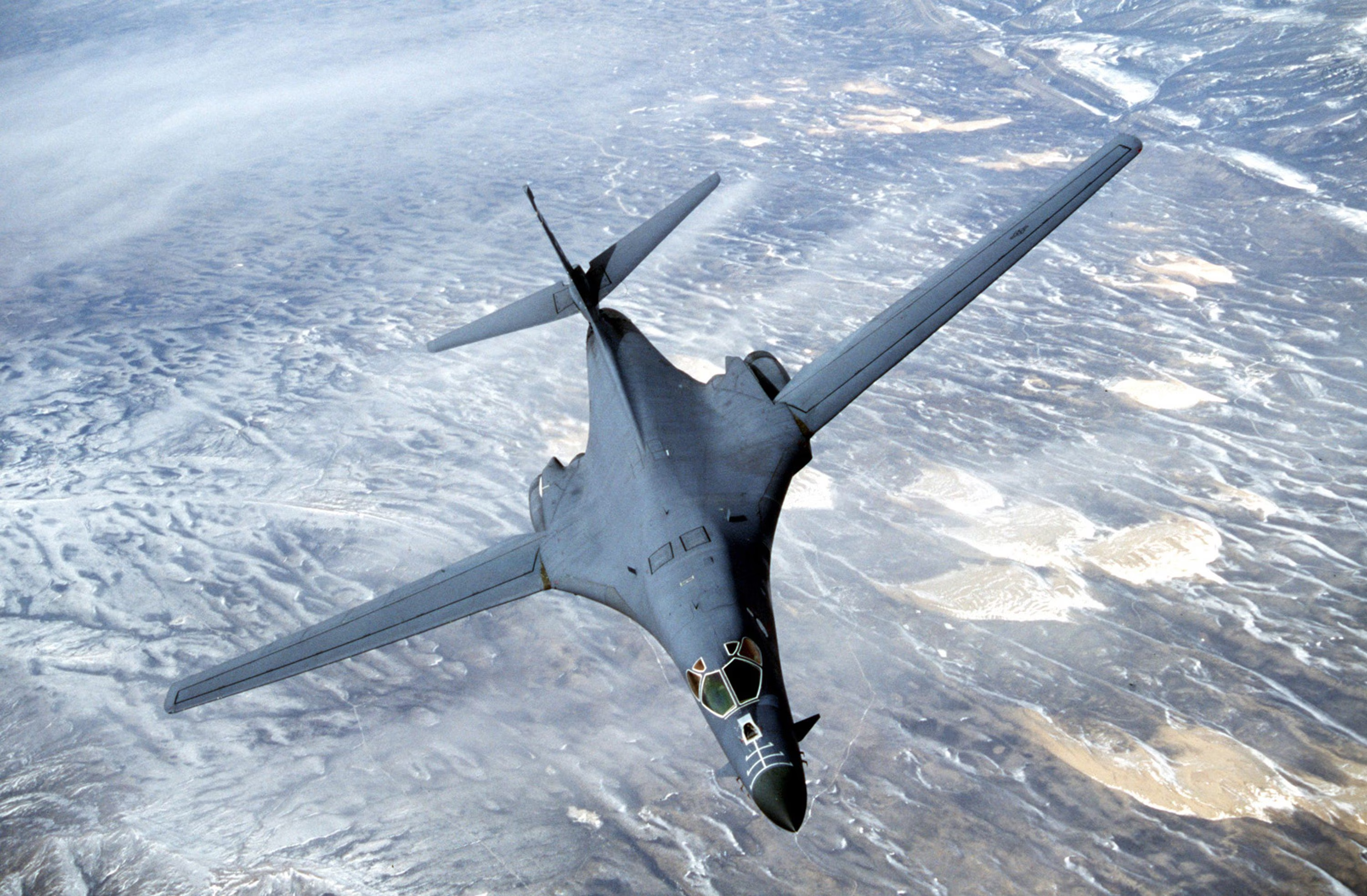
On paper, the United States of America, which became a great aeronautical power during the Second World War, is still at the top of the ranking today. Considering the assets in service with the USAF, and those in service with the other American air forces (air forces of the US Navy, the Marine Corps and the US Army), they alone possess a higher number of aircraft (at least 13,000, more according to other sources) than the other 3 great powers mentioned above combined.
The power of an air force, however, is not only given by numbers, but also by the ability of pilots and technicians to maintain the vehicles and get the best out of them from an operational point of view. Here too the Americans excel, given that in terms of training, planning and military logistics to support operations they have no rivals, with the only partial exception being Israel – which however has a numerically much smaller air force and is therefore out of the ranking.
Yet, despite these undoubted advantages, in recent decades the American air forces have encountered gradually increasing obstacles in the conduct of air operations against enemies who have adopted increasingly innovative tactics (from the massive use of swarms of low-cost drones or the development of area interdiction systems), capable of dampening, if not completely canceling, the excessive air power of the Stars and Stripes.
If the overwhelming victory obtained in 1991 during the Gulf War had imposed a sort of “international standard for the conduct of air operations” in American style, the catastrophic performance demonstrated to date during the current conflict with Iran is already advancing the scenario that the days of American air dominance are coming to an end.
Despite everything, by virtue of the numerical and technological aspects mentioned above, the USA still ranks at the top of the ranking.
2. Russia, between reform and expansion
Like the USA, Russia also became a major air power during the Second World War (then it was the USSR), but on a comparative analysis, Russian air power doctrines are completely different from those of the Americans. It would therefore be a very serious mistake to consider, as many do, the Russian Aerospace Forces (VKS) as if they were a sort of “USAF of the East”. This clarification is important because, precisely by virtue of the different doctrinal framework within which it moves, the VKS adopts aircraft with different technological characteristics compared to American or European ones and its pilots are trained according to a curricular plan that is not comparable with that of their Western counterparts.
Nonetheless, with approximately 4,500 aircraft, the VKS is the second largest air force in the world and can also be reinforced if necessary by the assets made available by other armed services of the Russian Federation, such as the Navy and the Rosgvardiya. Furthermore, the heavy involvement, starting from 24 February 2022, in the war with Ukraine is having as direct consequences both a numerical expansion and a radical reform of the use of aircraft, with a strong emphasis placed on the use of long-range weapons such as the infamous “glide bombs” (the so-called glide bombs in English).
Russia is also introducing new types of drones of all categories into service, in impressive numbers (if we also consider the tiny FPV drones, we are now talking about hundreds of thousands) which are literally changing the face of the “war of the future”. Therefore, weighing all these aspects, Russia stands firmly in second position.
3. China, the unknown of experience
Numerous publications, over the last few years, have dedicated ample emphasis to both the numerical and technological growth that has affected the Air Force of the People’s Republic of China (PLAAF) from the end of the 1980s to the present day.
Even if from a purely numerical point of view (around 3,900 aircraft) the Chinese are third compared to the Americans and Russians, the pace at which they are producing and putting into service on an annual basis new types of new generation aircraft has exceeded even the seeded ones. The PLAAF has also profoundly reformed its operational doctrines and the training of its pilots with the declared aim of being able to “beat the West at its own game”.
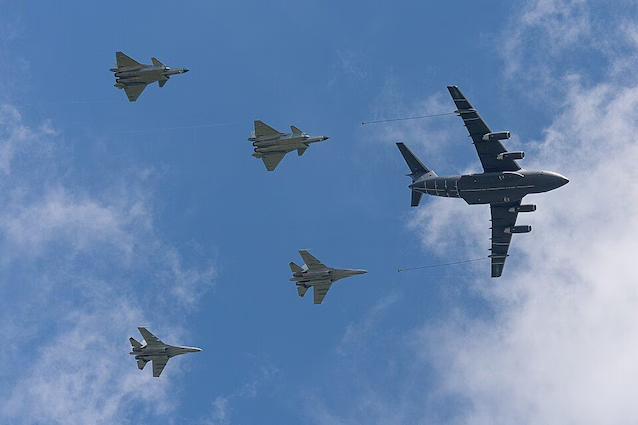
Despite all this, however, it is necessary to point out that any theoretical plan and training, however realistic, cannot make up for the lack of direct operational experience. In fact, the PLAAF, just like the rest of the Chinese Armed Forces, suffers from the fact that it has no longer fought a large-scale war (with less than exciting results) since 1979. So in this case too, as every time when we talk about Chinese military issues, the doubt remains regarding how the Chinese soldiers and their military assets would perform in the event of involvement in a real war. For these reasons we place China in third position.
4. India and production dependence
The Indian Air Force (IAF) traces its origins to the British colonial period and then took a completely autonomous path after the independence of the subcontinent. Since then, Indians have been influenced from a doctrinal point of view by both the West and the former Soviet Union, gradually coming to forge their own autonomous thinking relating to the use of air power which was repeatedly put to the test during the wars fought by New Delhi against Pakistan.
Nowadays the IAF can count on very solid operational experience and a cadre of pilots trained according to the most modern standards; however, it remains significantly smaller than the US, Russian and Chinese air forces, with around 1500 aircraft. Furthermore, unlike the other 3 countries mentioned above, India is the only one not to be completely independent from the point of view of aeronautical production, still having to import a large part of the components of the highest quality and technological content, if not entire aircraft, from foreign countries: this automatically places it at a serious disadvantage in a hypothetical scenario of involvement in a large, long-lasting conventional war. For these reasons, India does not go beyond the fourth position.
The new trends that advance
Before concluding our narrative it is necessary to highlight how the events of the conflicts that have bloodied the world in recent years: in particular, the Second Nagorno-Karabakh war, the Russian-Ukrainian war and the conflict in Iran are bringing out a whole series of new trends in the use of air power, first of all the generalized use of drones at all levels, which seem to lay the foundations for a greater “democratization” of the use of flying assets in the various theaters of war. In fact, if until a decade ago only countries that could launch very expensive investment plans had the possibility of equipping themselves with numerous and balanced air forces, today, with the overwhelming rise of “unmanned machines” characterized by purchase and operating costs far lower than those of a modern fighter-bomber, even smaller geopolitical actors can aspire to compete in the crowded skies of 21st century wars, from where they were previously excluded.