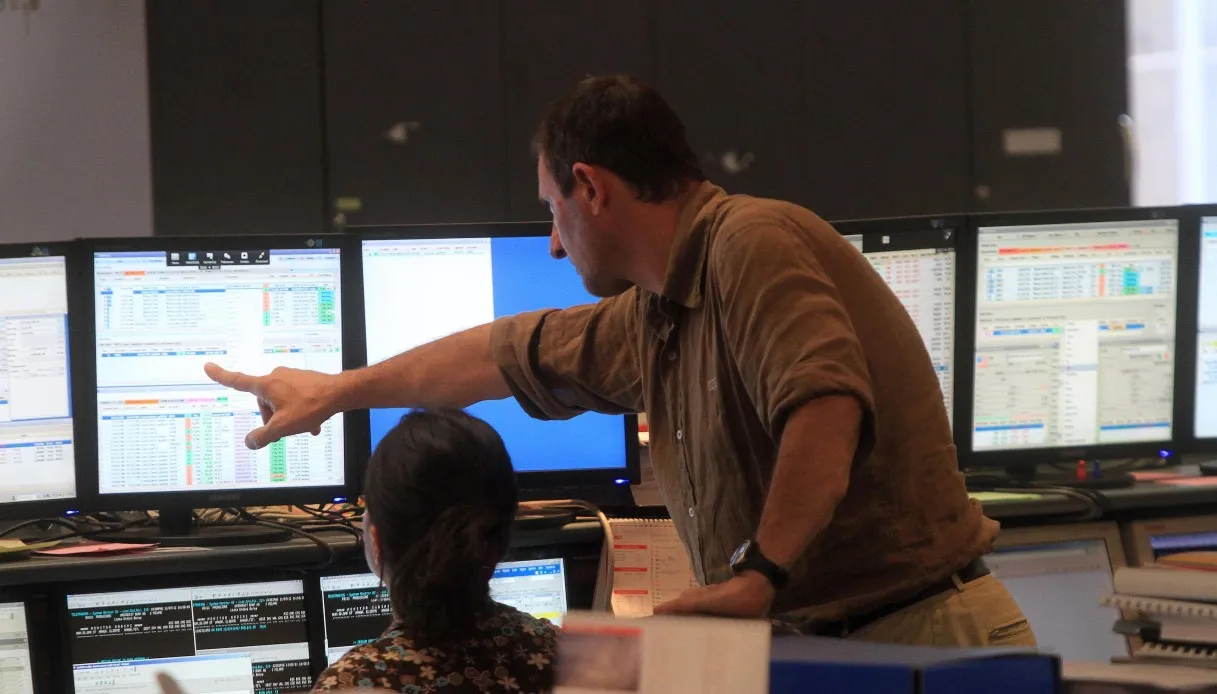
Opening slightly lower for the spread between BTP and Bund in the session of Wednesday 26 August 2026. At the beginning of the day the yield differential between the reference 10-year BTP and the corresponding German Bund stood at 80 basis points, one less than yesterday’s closing. The yield on the 10-year BTP also fell, falling below the psychological threshold of 4%, with a first trading at 3.99%, compared to 4.01% at the previous close.
The decline in spread and yield comes after a week of tension in European bond markets, with widespread selling pushing eurozone government bond yields to recent highs.
What does an 80 basis point spread mean
The BTP-Bund spread measures the distance between the yield required by the market to purchase a 10-year Italian government bond and that required for the corresponding German bond. With a spread of 80 basis points, the difference is 0.80 percentage points. In other words, if the 10-year Bund yields around 3.19–3.20%, the market asks the Italian BTP for a higher yield of around 0.80 percentage points.
This data does not directly represent how much the saver will earn by purchasing a BTP. The spread is in fact above all an indicator of the different perception of the risk associated with the two issuers and of the conditions of the bond market. For the small investor, when evaluating a new purchase, the yield of the individual BTP, the price at which the security is purchased and its maturity are therefore more important.
Anyone who has purchased BTPs in recent months or years should not react to small daily fluctuations in the spread. In fact, the mere movement of the spread does not in itself represent a sufficient reason to sell securities already in the portfolio.
For those who have liquidity in the account and want to buy BTPs today, a gross return of around 4% on an annual basis for a ten-year horizon represents an interesting level compared to expected inflation and the returns offered by normal current accounts. In yesterday’s session, Tuesday 25 August, the spread closed at 81 points and the 10-year BTP at 4.01%.
Italy, France and Spain: who pays the most on the markets
The other large Eurozone countries also remain under observation, with different dynamics between the various markets. This is the reference framework with the other large issuers in the euro area (opening data of 26 August):
- Italian 10-year BTP – yield approximately 3.99–4.00%, spread 80 points;
- French Oat 10 years – yield around 4.04–4.10%, spread 84–87 points;
- 10-year Spanish Bonos – yield around 3.71%, spread 45 points;
- 10 year German Bund – yield around 3.19–3.20%.
The markets today recognize Italian securities as having greater relative stability than that of the transalpine issuer. However, Spain remains the most advantaged country in Southern Europe, with a spread of 45 points and a rate of 3.71%.
Short Term BTP auction, the characteristics
Meanwhile, today the auction of a Short Term BTP with the following characteristics will be held:
- ISIN code: to be assigned;
- issue date: August 28, 2026;
- expiration date: October 30, 2028;
- annual coupon: 3%;
- minimum amount offered: 2.3 billion euros;
- maximum amount offered: 3 billion euros;
- placement commission: 0.075%;
- % Additional auction amount: 30%;
The auction will take place with the marginal auction mechanism. The Treasury will discretionally establish both the award price and the quantity actually issued, within the emission intervals already indicated.
The minimum subscription is set at 1,000 euros. If the requests at the marginal price exceed the available quantity, the offers at that price will be distributed in proportion (pro-quota), applying the appropriate rounding.