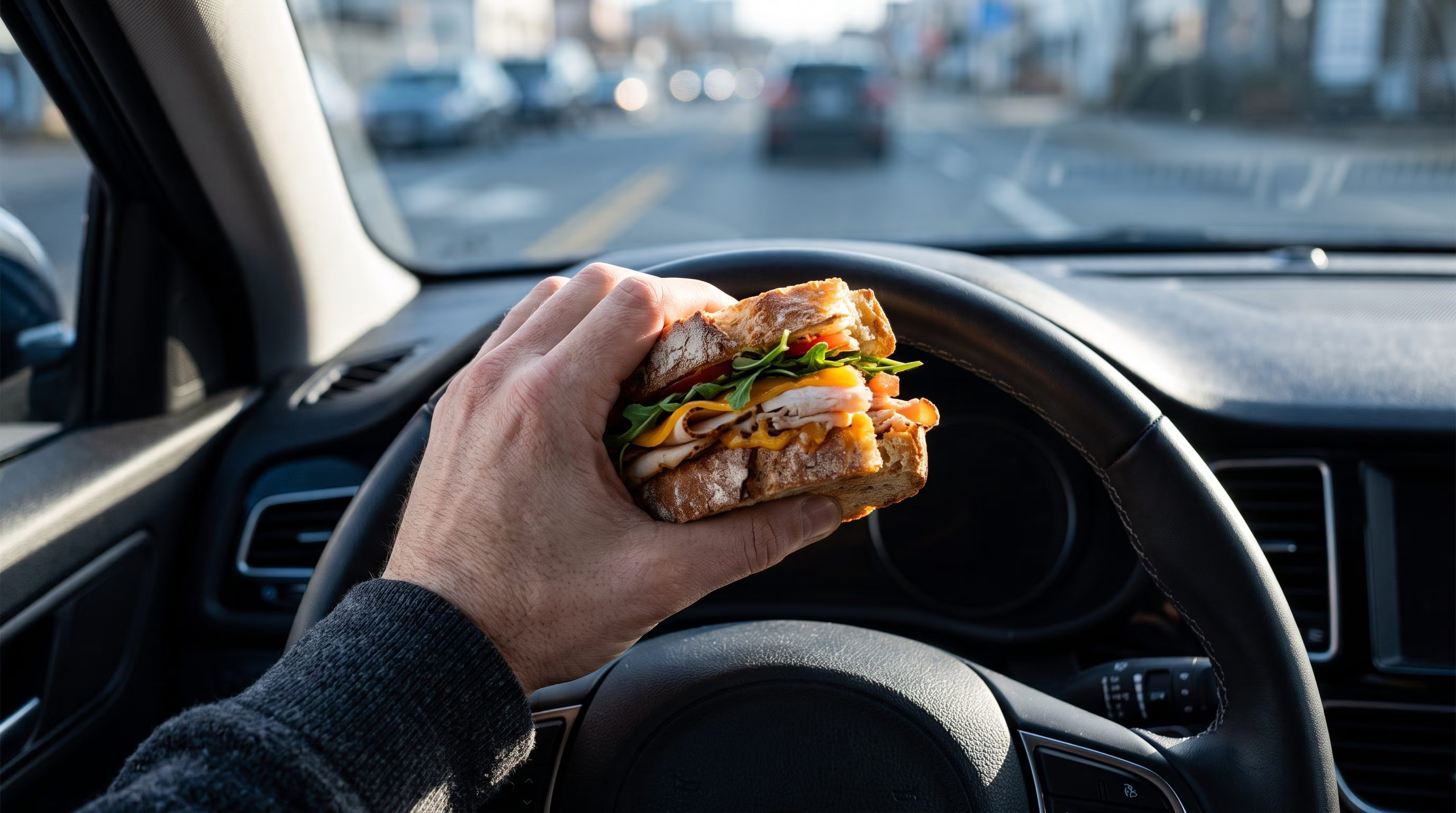
It will have happened to everyone at least once in their life to eat or drink something while driving, from a sip of coffee in the morning to a bite of a sandwich while we are standing in line. And in cases like these it is natural to ask ourselves a question: is it allowed? The short answer is that in the Highway Code there is no article that explicitly prohibits eating or drinking while driving, clearly when talking about soft drinks or water.
The fact that it is not expressly prohibited, however, does not mean “without consequences”. As in the case of flip-flops, if our driving behavior does not allow us to maintain full control of the car at all times, there is the risk of incurring sanctions, based on articles 141 and 169 of the Highway Code.
The reason why the law does not clearly prohibit the consumption of food and drink while driving is quite logical: listing every single potentially dangerous gesture would be almost impossible. This is why the Highway Code establishes some general principles of behavior that are always valid, for which drivers can be sanctioned, with fines ranging from 42 to 344 euros.
Is it legal to eat or drink while driving? Articles 140, 141 and 169 of the Highway Code
As mentioned, eating or drinking while driving is potentially punishable if this behavior does not allow full control of the car. In this case, there are three articles of the Highway Code that can be taken as reference:
The first is article 140, which contains what is called the “circulation guiding principle”. The text establishes that road users must behave in such a way as not to constitute a danger or obstacle to traffic and so that road safety is in any case safeguarded. It is a sort of mother rule: it comes before speed limits, precedence and everything else and establishes a sort of basic duty that applies to anyone traveling on the road.
The second is article 141, dedicated to vehicle control. In particular, paragraph 2 provides that the driver must always maintain control of his vehicle and be able to carry out all necessary maneuvers in safe conditions, in particular the timely stopping of the vehicle within the limits of its field of vision and in front of any foreseeable obstacle. Clearly, if one hand is occupied with food or drink, this margin becomes thinner.
The last is article 169, which in the first paragraph establishes that in all vehicles the driver must have the greatest freedom of movement to carry out the maneuvers necessary for driving. The meaning is the same: the driver must have free hands and movements to manage the vehicle.
None of these articles, therefore, expressly mentions the ban on eating or drinking (soft drinks), but all three impose the same obligation: to maintain control of the vehicle at all times, have full freedom of movement and not constitute an obstacle to traffic.
Possible fines and distraction, the leading cause of accidents in Italy
Consequently, if the police were to verify the imprudence of a driver while he was eating or drinking while driving, there is the risk of sanctions: article 141 provides for an administrative fine of 42 to 173 euros, while a violation of the provisions of article 169 implies sanctions of 87 to 344 euros.
And here we come to the heart of the problem: the issue of distraction. According to the latest ISTAT report on road accidents in 2025, distracted driving or indecisive driving are the first cause of accidents among incorrect driving behaviours, with 35,667 cases, equal to 15.1% of the total.
To give an order of magnitude to these percentages, in 2025 in Italy there were 177,207 road accidents with injuries, which caused 2,868 victims and 237,822 injuries. Together with failure to yield the right of way, excessive speed and erratic maneuvering, distraction contributes to 43.1% of all causes of accidents.
It must be said that among the sources of distraction inside the passenger compartment there is above all the use of the mobile phone, but in general all gestures that move the gaze and hands away from driving are potentially dangerous.