Claude’s Fable 5 model, the artificial intelligence developed by Anthropic, has found an example that refutes the Jacobian conjecturea mathematical problem that has remained open since 1939. It was announced Levent AlpögeTurkish-American mathematician. While the world was watching the World Cup final, Alpöge used Fable 5 to explore the problem and identify an example capable of disprove the conjecture, what in “mathematics” is called “counterexampleShortly afterwards he shared the result on X, also publishing the counterexample found, so that anyone could verify it.
The discovery is part of a series of results in mathematics and theoretical physics obtained recently with the help of AI. Among these are the closure of the theoretical representation of “jamming” and the proof of Erdős’ problem 1196. Unlike previous results, however, no details have yet been released on how Alpöge guided the AI model in generating the counterexample and how long it took the AI to solve it. The model used, Fable 5, is the most advanced model commercially released by Anthropic to date. According to the company, it outperforms previous models in most AI benchmarks, from software engineering to scientific analysis, from computer vision to complex reasoning on documents.
What is the Jacobian conjecture
A conjecture is a mathematical idea that appears to be true, but that no one has yet been able to prove or disprove. The Jacobian, in particular, concerns the invertibility of functions and is extremely relevant in many different fields of mathematics, physics and engineering.
A function is a map that connects two sets and relates their elements. To understand why the invertibility of a function is important, let’s take an example starting from cryptography, the branch of mathematics that studies how to protect information. Let’s imagine that there is a function that connects the set of unencrypted messages with that of encrypted messages and that transforms the message “Hi, how are you?” in the sequence “Dlbm, dpnf tubh!”.
If we deliver our encrypted message to the recipient, to understand what we have written, he will need a function that transforms “Dlbm, dpnf tubh!” again in “Hi, how are you?”. This function connects the set of encrypted messages with that of unencrypted messages and is the inverse of our starting function. Without it, our message would remain incomprehensible.
Not all functions, however, are invertible and this is where the Jacobian conjecture comes in.
The Jacobian conjecture tells us that, if some conditions are respected, the polynomial functions (i.e. those written like this: f(x) = x3 or so f(x) = 2x+1) are invertible and are still polynomial functions. For example, the function that takes any number (for example, 2) and associates it with its cube (in this case, 8), is invertible and has as its inverse the function that takes any number and associates it with its cube root.
This conjecture has been considered plausible for decades and many mathematicians have tried to find a proof. It was considered so important that in 1998 the mathematician Stephen Smale, winner of the Fields Medal, included it among the mathematical problems of the new century.
The counterexample found by Fable 5
After nearly ninety years of trying to prove it, Fable 5 has found a feature that complies with all the required conditions by conjecture, but it is not invertible. This function connects two three-dimensional spaces together and is the example that disproves the conjecture in spaces with three or more dimensions.
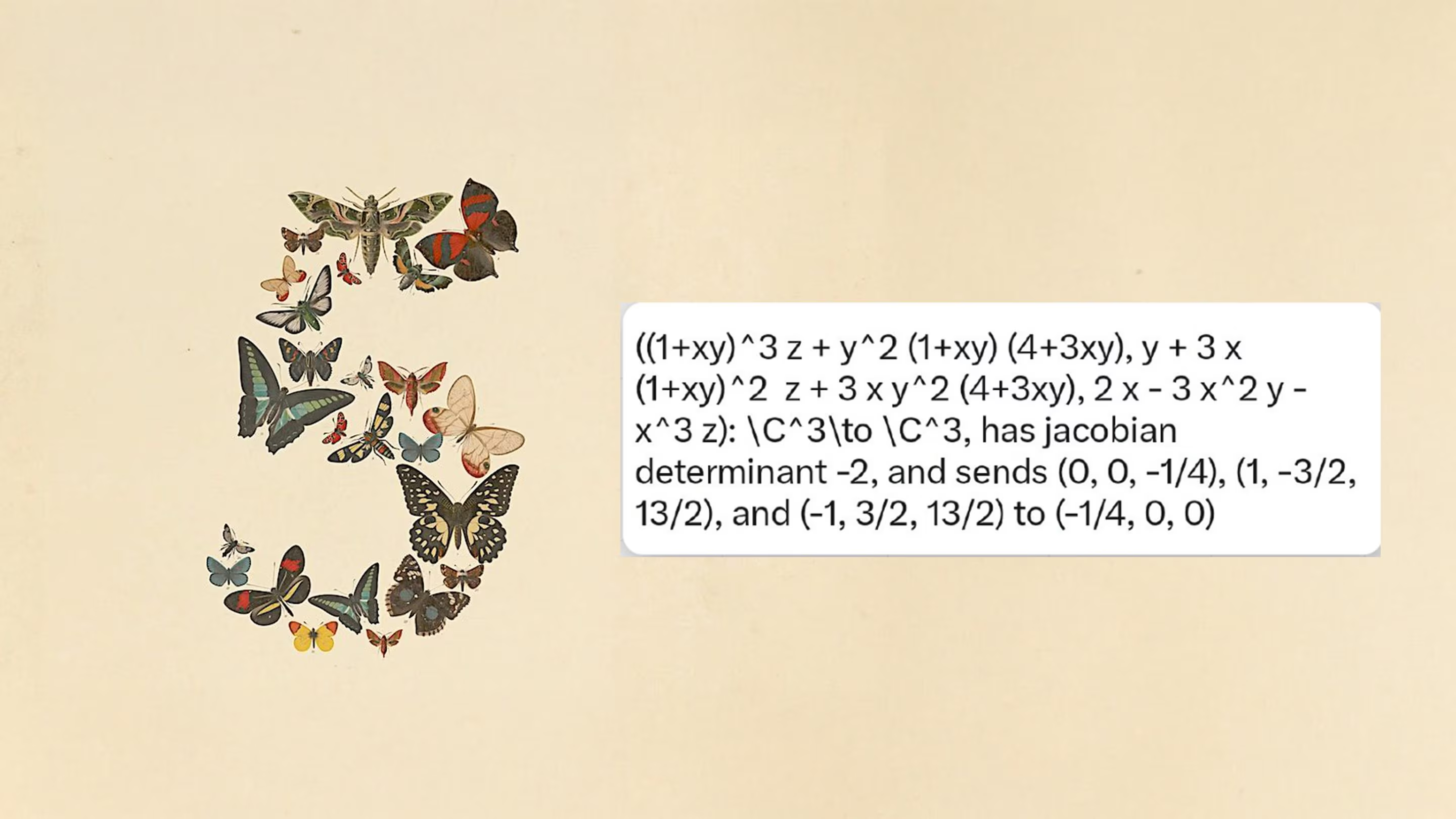
The function, written in Alpöge’s tweet, is as follows:
This function takes a triple of values, indicated by (x, y, z), and transforms it into another triple obtained through three expressions, indicated in the image by the colored boxes. For example, if we take x=0, y=0 and z= -¼ and substitute their values into the formula above, with a little math we get:
F(0, 0, -¼) = ( (1 + 0)3 *(-¼) + 0*(1+0)*(4+3*0), 0 +3*0*(1 + 0)2 * (-¼) + 3*0*(4+3*0), 2*0 – 3*0 – 0* (-¼) ) = (-¼, 0, 0).
This function, therefore, associates the triple (0,0,-¼) with the triple (-¼, 0, 0).
To prove that this function is not invertible, Fable used a fundamental condition: for a function to be invertible, at every element of the set of departure must match one and only one element of the set of I arrive. Returning to the previous example, whether it is “Hi, how are you?” that “What’s the weather like today” were encrypted in the sequence “Dlbm, dpnf tubh!”, whoever receives the encrypted message would not be able to obtain the original message. If multiple different elements are transformed into the same element, there is no unique way to go back and therefore the function is not invertible.
To demonstrate that the function found is not invertible, therefore, it is sufficient to find more elements of the starting set that are connected to the same element of the arrival set. In this case, Fable 5 has found it three distinct elementsthe triples (0, 0, -¼), (1, −3/2, 13/2) and (−1, 3/2, 13/2), which are all associated to the same element: (-¼, 0, 0). This is enough to demonstrate that the function it is not invertible and therefore constitutes a counterexample to the Jacobian conjecture in spaces with three or more dimensions.
At the moment, the details of how Alpöge posed the problem to Fable 5 nor the process followed by the model to arrive at the solution have not been made public. However, this achievement is different than other recent AI successes in mathematics. In this case, the real difficulty was not to construct a long and complex proof, but to effectively explore an enormous space of possible polynomial functions until identifying one with the desired properties.
This suggests a new potential use of AI in research: it could prove valuable not only to help build proofs, but to effectively search for counterexamples to conjectures that have been open for decades.