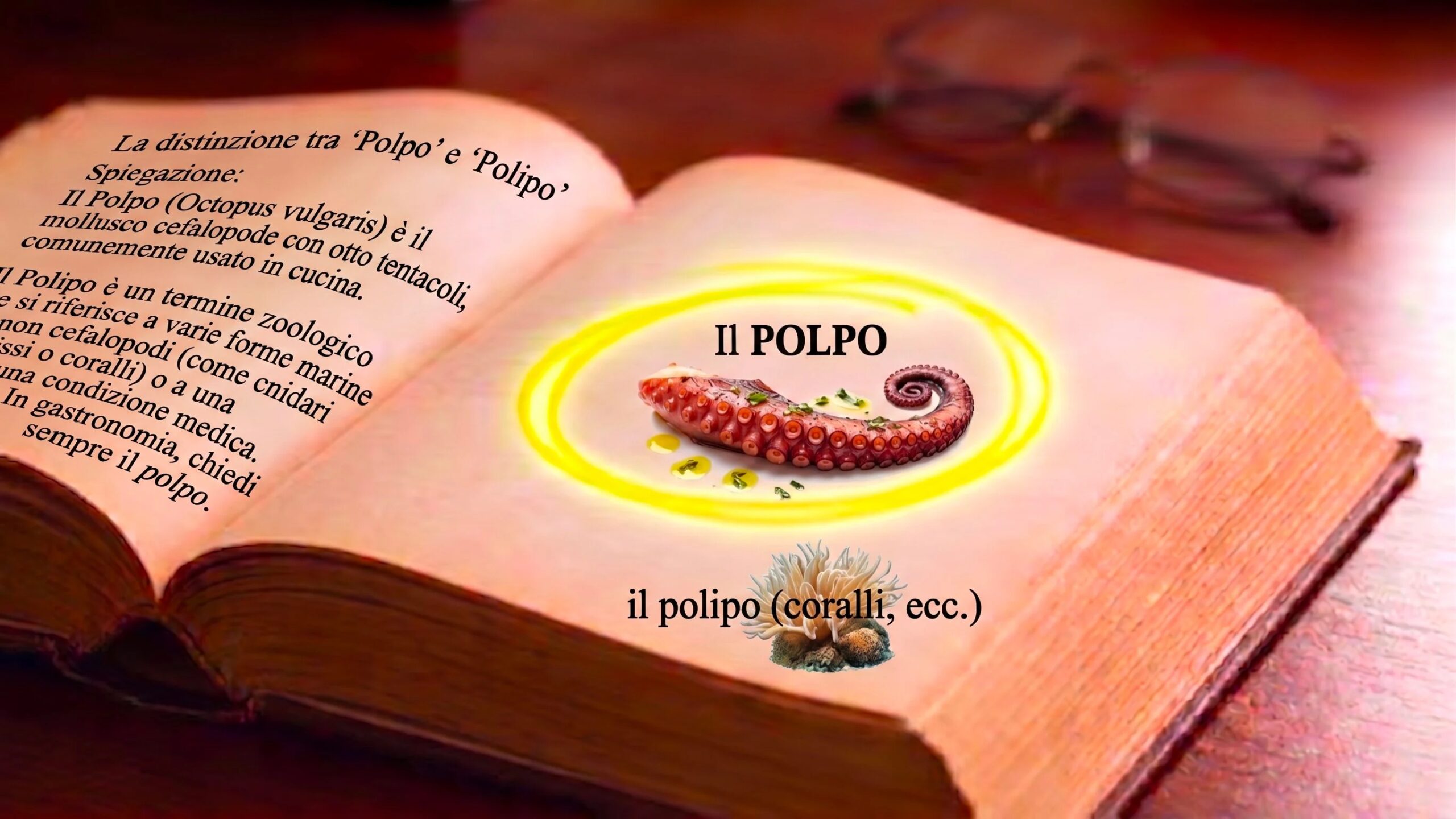
At the restaurant do you order the “octopo alla luciana” or the “octopo alla luciana”? At the supermarket, at the fish counter, do you ask for octopus or octopus? And is the octopus the same thing? If you’ve ever had any doubts about the correct way to say it, you’re definitely not alone: polpo (pronounced with a closed O) and polipo are two of the Italian words that generate the most uncertainty. The reason is that both exist in Italian, but over time they have developed distinct uses, becoming less interchangeable than one might think.
Where do the words “octopus” and “octopus” come from
It all begins in Greece, about 2,500 years ago. In ancient Greek this animal with tentacles was called polýpous (πολύπους), a word composed of polý- (“many”) and poûs (“foot, leg”), which we can literally translate as “many-footed”. A descriptive and precise name, as often happened in the Greek nomenclature of animals.
From Greek, the word passed to Latin as polypus (or piscis polypus for many Latin authors), from which both Italian forms then derived, one passing into the literary Italian and the other into the technical-scientific one. There are two of them allotropes: polipo has maintained a form closer to the original one passing through the cultured and technical-scientific language, while in popular Italian polypus it gave rise, through a phonetic evolution and the dropping of the vowel, to the form octopus.
When to use one or the other: the difference according to the Accademia della Crusca
Italian dictionaries record both forms, but the position of the Accademia della Crusca, the main body for the protection and study of the Italian language, is clear. In his linguistic consultancy, he concludes that octopus (whose scientific name is Octopus vulgaris) is the entry «continuously supported by the lexicographic tradition, by constant use in literature» and is the choice recommended and used by fisheries workers, in the marketing of the product and in legislation. When you go to the fish market or read a menu or recipe book, octopus it should be the correct choice.
Polyphowever, in zoology indicates organisms belonging to a group other than cephalopod molluscs: polyps are the fixed vital stages of animals belonging to the phylum of Cnidarians, such as jellyfish, corals and sea anemones.
In medicine, it also indicates benign growths on the mucous membranes (intestinal polyps, nasal polyps and so on). Using the word octopus to indicate the mollusc with eight arms is therefore a widespread form in common use, but improper from a scientific point of view.
The “octopus”: a giant octopus that comes from France
It’s not exactly the same thing: octopus is a word that in Italian originally indicates the giant octopus, the creature that in ancient legends terrified sailors. In common use, however, it has become a synonym for octopus, widespread in Italy, especially in the North, even in the gastronomic field (“octopus salad” is often even more frequent than “octopus salad”).
The etymology of octopus has a precise history: it comes from French pieuvrea Norman dialect form also deriving from Latin polypus. Its diffusion in Italian is also linked to the success of the novel by the French writer Victor Hugo, Les Travailleurs de la mer (The workers of the sea1866), which helped make it popular in Europe. Written during his exile on the island of Guernesey, off the coast of Normandy, it recounts the protagonist’s struggle with a gigantic tentacled creature, using the Norman term pieuvre.
The dialects and the richness of regional variations
Throughout Italy, as often happens with many words, octopus is called differently depending on the dialect. Piovra is the most used variant in Milan, Genoa, Turin. In Sicily the dialect is used purpu (or vurpu in some variants), while in some areas of Campania it is said purpo. In Venetian and in some Venetian varieties it is said folpowith a transformation of the initial p into f (a phonetic phenomenon specific to some Venetian varieties). Each regional variant, as always, is a testimony to how words adapt to the sounds, rhythms and phonological habits of those who use them.









