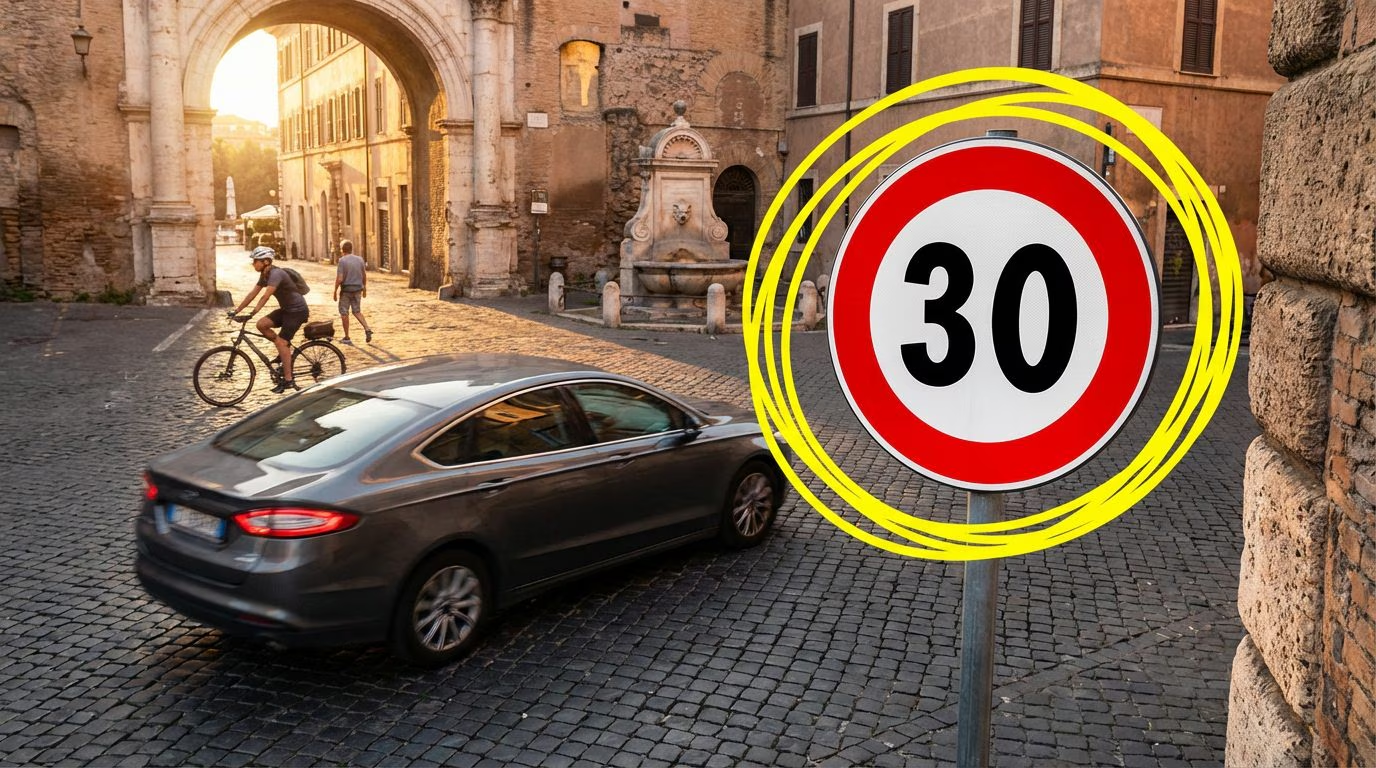
In Rome, a speed limit of 30 km/h has been introduced in the historic center of the city: the capital is thus following the example of other Italian cities, such as Bologna and Milan, which in recent years have adopted this initiative to improve road safety and try to reduce road accidents and air pollution. But does introducing this speed limit really work? According to the EU Council report on transport safety (ETSC), 30 km/h represents the maximum threshold within which the coexistence between cars and vulnerable users (pedestrians and cyclists) is considered acceptable: in fact, accidents, noise pollution and particulate emissions decrease, although not eliminating the risks, but the measure is truly effective when supported by urban strategies on a larger scale. So let’s see what the official numbers say.
Road safety data with the speed limit of 30 km/h
The ETSC report highlights how driving speed is a determining factor for the severity of injuries in the event of an accident: in fact, the more the speed increases, the greater the probability of serious trauma. Precisely for this reason, the Transport Safety Council has recommended that EU countries introduce the 30 km/h limit in residential areas and near schools and playgrounds.
But, therefore, are there actually results in terms of road safety? According to a survey conducted by Ramboll, in the 40 European cities that have implemented 30 zones, an average reduction in accidents of 23% and serious injuries of 38% has been observed. This is because the reduced speed of cars increases drivers’ reaction time and reduces the necessary braking distance, reducing the risk of high-impact collisions. the probability of avoiding collisions.
However, it must be specified that this limit does not eliminate the risks, especially for the elderly. As reported by ETSC data, in the event of a collision with a vehicle traveling at a maximum speed of 30 km/h, a pedestrian over the age of 65 has a 15.4% probability of suffering serious injuries: under 65, the probability is 9.4%.
Data on traffic and pollution
From a traffic perspective, 30 km/h zones contribute to a significant reduction in traffic noise, up to 3-5 decibels in urban areas, according to average data recorded in the 40 European cities taken into consideration in the survey. Cities such as Brussels and Paris, in fact, have achieved a noise reduction of up to 50% in some secondary streets.
At the same time, the 30 km/h limit means less sudden acceleration and braking, reducing tire and brake wear which, according to Ramboll’s study, can be responsible for over 75% of particulate emissions in urban contexts.
In short, by going slower, violent braking and sudden maneuvers are reduced and, consequently, PM10 concentrations can also drop, which is also affected by the wear of brakes and tires.
The effect on emissions, however, strongly depends on driving style: since it is not certain that the 30 km/h limit is respected by all drivers, it is not certain that the impact on emissions is effective and tangible.
The 30 km/h limit alone is not enough
However, another interesting fact emerges from the ETSC report: the 30 km/h limit alone is not enough. The initiative, in fact, really works if supported by a “traffic calming” strategy, with the aim of making compliance with this limit easier and discouraging higher speeds. All this translates into the introduction of barriers such as roundabouts, speed bumps or roadway narrowings, which actually physically slow down traffic.
To this must be added effective controls – especially in the first period after the introduction of the 30 km/h limit -, which in turn can incentivize speed reduction if the previous measures are not sufficient.
In short, according to the European agency’s analysis, the 30 km/h limit in urban centers can only bring concrete results thanks to a combination of traffic calming measures (roundabouts, speed bumps, etc.) and road controls.









