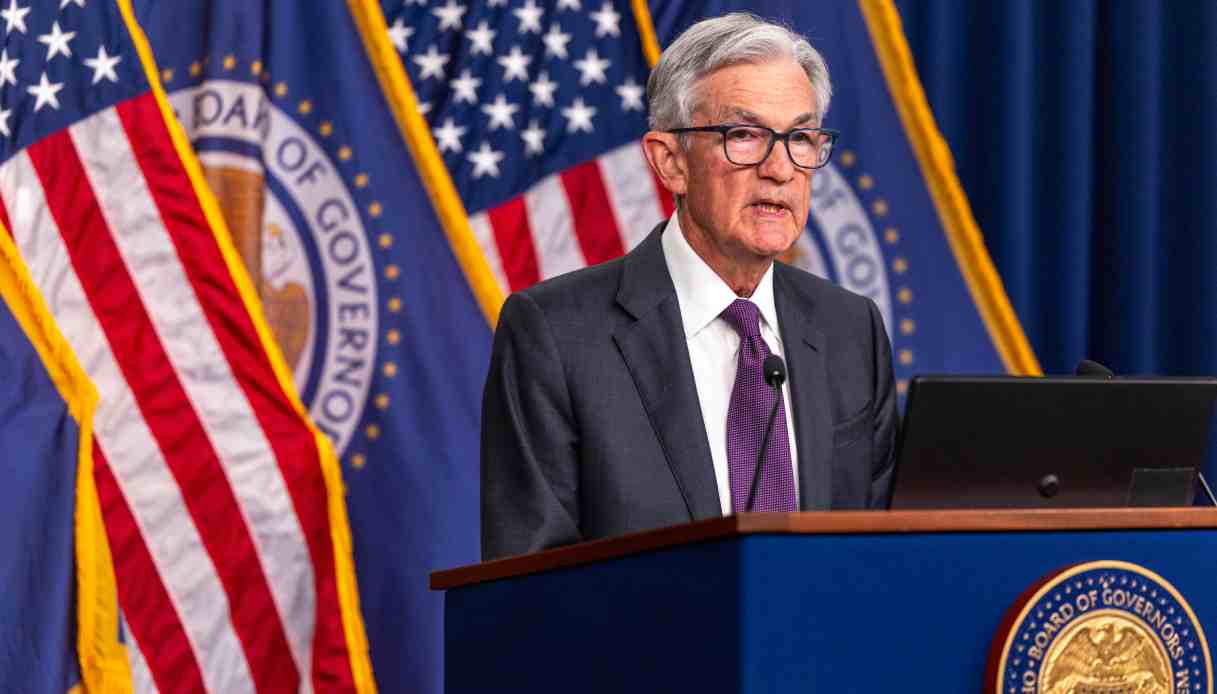
The Federal Reserve is preparing to cut the interest rates of 25 basis points this week, giving in to the pressures of the American president Donald Trump, but above all responding to a deterioration of the wider work market than expected. A decision that may not be the beginning of a new cycle and find yourself isolated, in front of a more serious risk such as that of stagflation. The American central bank will not be the only one to decide this week, but from Bank of England and the Bank of Japan there are no relevant announcements, at least on the rates front.
The labor market and duties
The Fed is comparing itself with a series of disappointing data, which feeds the fears of a more serious slowdown in the labor market, which would also condition the expense of consumers and, in cascade, economic growth. The mei occupation twelve months in March 2025 was revised on the downward of 1 million units, not to mention the disappointing August data, which saw the creation of just 22 thousand jobs.
As for inflation, although stable, it is still well above the 2% objective of the Fed and risks undergoing rise to the rise from the policy of Trump’s duties. Although the impact of the duties on prices has now been limited by business policies, which have managed to absorb its impact, Powell recognized that the impact could prove to be short -lived, but he warned that it is necessary to be careful of the opposite possibility.
FOMC split?
In this context, the risk of stagflation is high, which also breaks the FOMC, the Fed’s monetary policy committee, making cautious bankers about future decisions and compared to moving too quickly. Therefore, if usually an initial intervention such as that scheduled for next Wednesday marks the beginning of a new cycle of cuts, this time the start of a new trend is not at all obvious.
According to Bloomberg, the divisions between the Fed officials on what to do later could give rise to multiple dissensions, with some in favor of any cutting of the rates and others who ask for a more incisive intervention. It could be the first Fed meeting since 2019 with three dissensions, or even the first since 1990 with four.
Bank of England ready to slow down the QT
The bank of England, on the other hand, could announce this week a slowdown in the quantitative tightening, or the reverse tool for quantitative Easing, with which the central bank reduces government bonds in its wallet. Currently the QT has a rhythm of 100 billion pounds per year, but the increase in volatility on the bond market and the consequent increase in the refinancing costs of the British government could advise bankers a slowdown in this tool around seventy billions.
A nothing done, however, is expected on the interest of interest rates, which were cut last month for the fifth time in just over a year. With an inflation at 3.8% in July, the highest of the advanced economies of the G7, and with the probability that it raises 4% this month, no economist foresees a cut of the rates in the meeting on Thursday 18 September.
Bank of Japan towards confirmation of rates
The Bank of Japan (Boj), which will announce its decisions on Friday 19 September, closing a crucial week for central banks, is preparing to confirm the current level of interest rates at 0.5%.
A cautious optimism is expected from the Japanese central bank on the prospects of the Japanese economy which preludes further increases in the cost of money by the end of the year, beyond the pause expected for this month.