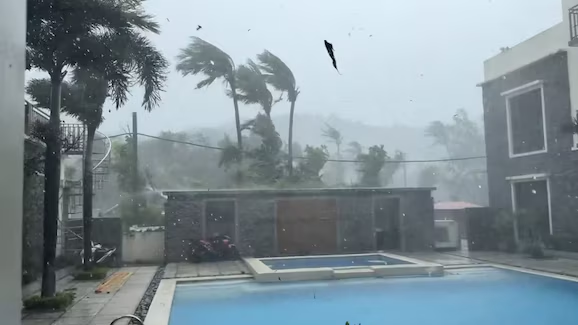
South-East Asia has been hit by violent floods which have caused over 1,300 deaths, although the death toll continues to rise: among the most affected countries are Sri Lanka, Indonesia and Thailand, although floods have also been recorded in Malaysia and parts of Vietnam. These heavy floods, among the largest disasters in history in Asia, were caused by two tropical cyclones, which combined with the heavy monsoon rains of this season, dumping in a single day the amount of rain that is normally recorded throughout the month of November.
The floods have devastated the Indonesian island of Sumatra in particular: overall, almost 1 million people have been evacuated to emergency shelters, while the floods have isolated entire villages, destroying bridges and filling roads with mud and debris.
Why the floods were so severe
As highlighted by experts, the floods in Asia were caused by the convergence of three meteorological phenomena: the monsoon rains, typical of this period, the tropical cyclone Senyar, which formed in the Strait of Malacca (which separates the Indonesian island of Sumatra from Malaysia), and the tropical cyclone Ditwah. The combination of these three phenomena caused strong winds, rains and floods, devastating entire areas of Sri Lanka, Indonesia, Thailand and parts of Malaysia and Vietnam.
In particular, Cyclone Ditwah hit Sri Lanka, moving very slowly and dumping almost 500 mm of rain on some locations in just a few days. Cyclone Senyar, however, intensified after interacting with typhoon Koto – which affected the Philippines in the last days of November – and then hit Indonesia. In reality, as highlighted by the Indonesia Meteorological Agency (BMKG), Indonesia is generally not particularly prone to cyclones, as it is located very close to the equator. This is because what causes the air masses to rotate in cyclonic systems is an apparent force called the Coriolis force, due to the rotation of the Earth. This apparent force is not the same everywhere on the planet: it is maximum at the Poles, but zero at the equator. In other words, cyclones should not have the strength to develop at the equator. In this case, however, Cyclone Senyar managed to form, an event that has been called “a rare atmospheric anomaly.”
As mentioned, these two cyclones joined an already particularly intense monsoon rain season: according to data from Thai Meteorological Departmentlast November 21, 372 mm of rain fell in southern Thailand in just 24 hours, an impressive figure considering that the average rainfall for the entire month of November is 317 mm.
Behind the intensification of these atmospheric phenomena are the increasingly higher temperatures of the ocean: the higher the temperatures of the surface waters, the more rapid and intense the evaporation process will be, which releases large quantities of water vapor into the atmosphere which will then be discharged later.
One of the largest disasters in Asian history: death toll and damage
The overall death toll has exceeded the tragic figure of over a thousand deathswith theIndonesia which is the most affected country, with over 600 deaths and around 500 missing. Even in Sri Lanka the death toll is at least 390, with flooding also in the capital Colombo, in Thailand 176 deaths were recorded and in Vietnam another 90.
THE damage to property and infrastructure were extensive and severe: beyond 28,000 homes were compromised from floods and also from landslides, which have devastated entire villages.
The violence of the floods, in fact, caused the destruction of bridges, with mud and debris covering the roads, which made entire areas inaccessible for relief efforts, effectively isolating communities. The water, which some residents described as a current so strong that it “could kill an elephant”, overwhelmed and submerged the houses: according to estimates, approximately 1.5 million people would have been affected from the disaster.
According to local newspapers, nearly 1 million people have been evacuated to emergency shelters, while India and Pakistan have sent rescuers to help the local population.