Europe could receive more liquefied natural gas thanks to the Asian demand crisis. Asia’s LNG imports are expected to fall to their lowest level for this month in eight years in September, as prices have become so high that several buyers have been forced to reduce orders.
Unpurchased cargoes from China, India and other countries can be diverted to European terminals, offering help in replenishing inventories. For Italian families, however, this does not mean that bills will immediately decrease. Available gas remains expensive and the balance will depend on winter temperatures, American supplies and the evolution of tensions in the Middle East.
Why Asia is buying less gas
Asian LNG imports are estimated to be approximately in September 20.09 million tonnes, the lowest level for the month since 2018. The decline mainly affects the most price-sensitive markets.
China should stop at approx 4.32 million tonnes, down both compared to August and on an annual basis. India, Pakistan and Bangladesh have also had to scale back spot purchases or replace some gas with coal, domestic generation and other sources.
The reason is the price. Prices for cargoes destined for North Asia have reached approx $26 per million Btu, an increase of close to 150% from February. At these levels, gas may become too expensive for some industries and for the energy systems of emerging countries.
| Indicator | September date | What it signals |
|---|---|---|
| Asian LNG imports | 20.09 million tons | Eight year low for September |
| Imports of China | 4.32 million tons | Demand slowing sharply |
| Spot price in Asia | About $26 per mmBtu | Increase of approximately 150% since February |
| Expected European imports | 7.98 million tons | More cargo headed to Europe |
| European Ttf price | Area 78 euros per MWh | Market still under strong pressure |
Because less Asian demand helps Europe
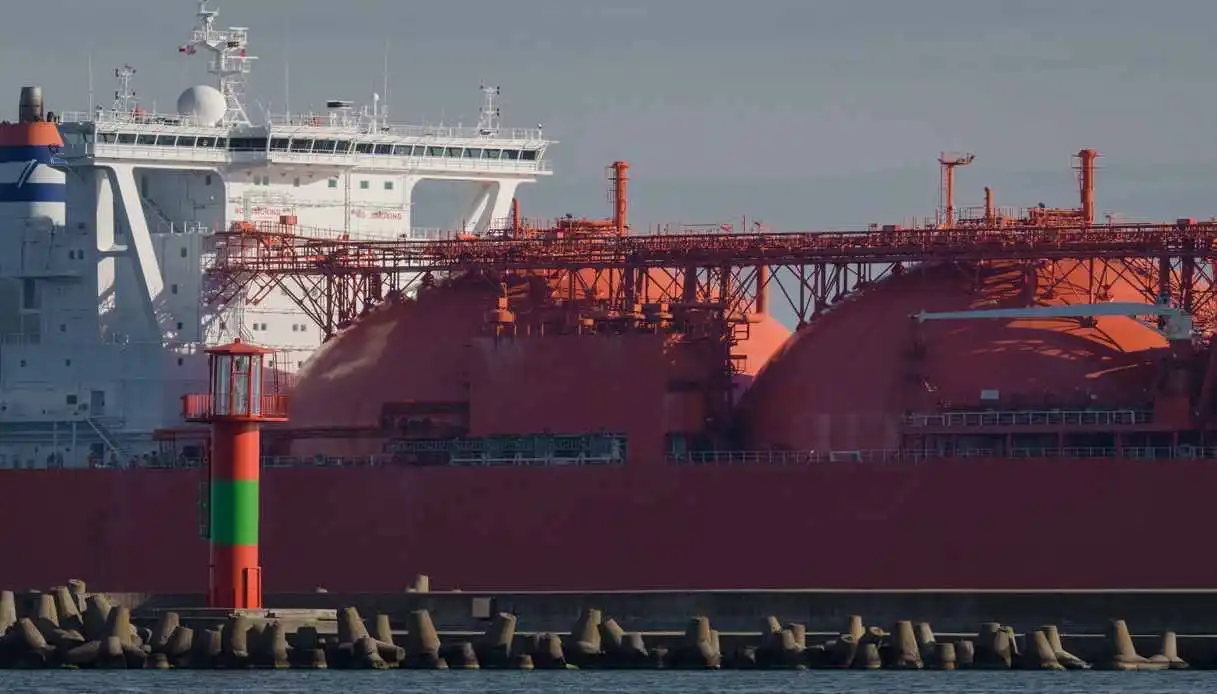
LNG travels on methane tankers and can be sold on the market that offers the most convenient conditions. Unlike gas transported through a pipeline, its destination can, therefore, change even during the journey.
When China, Japan, South Korea and India buy a lot, Europe has to compete by offering higher prices. If Asian demand decreases, some of the cargoes may reach European regasifiers.
The European Commission explains that liquefied natural gas allows for the diversification of supplies because it does not depend on a single gas pipeline network. This flexibility has become essential after the sharp reduction in Russian supplies.
European imports could catch up in September 7.98 million tons and exceed 10 million in the following months. It is an improvement, but it arises from the economic difficulty of Asian buyers, not from a structural increase in global supply.
More LNG does not immediately mean lower bills
The wholesale price represents only a portion of the bill. Marketing, transport, distribution, charges and taxes also impact the final expense. Additionally, many contracts are updated at different times.
A decrease in the TTF can therefore be transferred to invoices gradually, while a fixed price contract does not change until the signed conditions expire.
On the European market the TTF remains close to 78 euros per megawatt hour, a level that continues to incorporate a strong premium for geopolitical risk. The arrival of more methane tankers can prevent new increases, but it is not sufficient, on its own, to bring prices back to pre-crisis levels.
The problem of European stocks
Europe enters the final part of the filling season with deposits lower than the average of recent years. Daily data can be verified on the platform Agsi of Gas Infrastructure Europe, which collects the storage levels of the various countries.
European reserves are around 67% of capacity. Italy has approx 172.5 terawatt hours stored, but safety does not depend only on the quantity present in the deposits. The speed of withdrawals, industrial consumption, temperatures and the possibility of quickly replacing missing supplies count.
Inventories do not alone determine the price: they serve, above all, as insurance against demand peaks and interruptions. The lower they are, the more sensitive the market is to weather forecasts and geopolitical news.
What can happen to your bills during the winter
| Scenario | Effect on the market | Possible consequence |
|---|---|---|
| Mild winter | Low consumption and withdrawals | More stable or decreasing prices |
| Average winter | Sufficient supplies but under pressure | Bills still high and volatile |
| Very cold winter | Strong competition between Europe and Asia | New increases in gas and electricity |
| Resumption of supplies from the Gulf | Greater availability of LNG | Reduction of the geopolitical premium |
| New interruptions | Fewer loads available | Risk of even higher prices |
In Italy, gas also affects the price of electricity, because many power plants use this source to produce energy. An increase in fuel can, therefore, be passed on to both gas and electricity bills.
The transition is not automatic nor the same for everyone: it depends on the contract, consumption and the times with which the supplier updates the price.
What a family needs to check
Before winter it is best to check whether the offer is at a fixed price or indexed, which index is used and when the economic conditions can be updated. A locked price offers more predictability, but could be less convenient if the market drops.
It is also useful to check the expiration of the offer, the fixed monthly costs and the annual consumption indicated on the bill. Comparing only the price of the raw material may provide an incomplete result.
The decline in Asian purchases therefore gives Europe a favorable window to increase imports. However, it does not represent the end of the crisis: it is a fragile balance, in which European bills are also protected by the fact that other countries are no longer able to sustain the same prices.