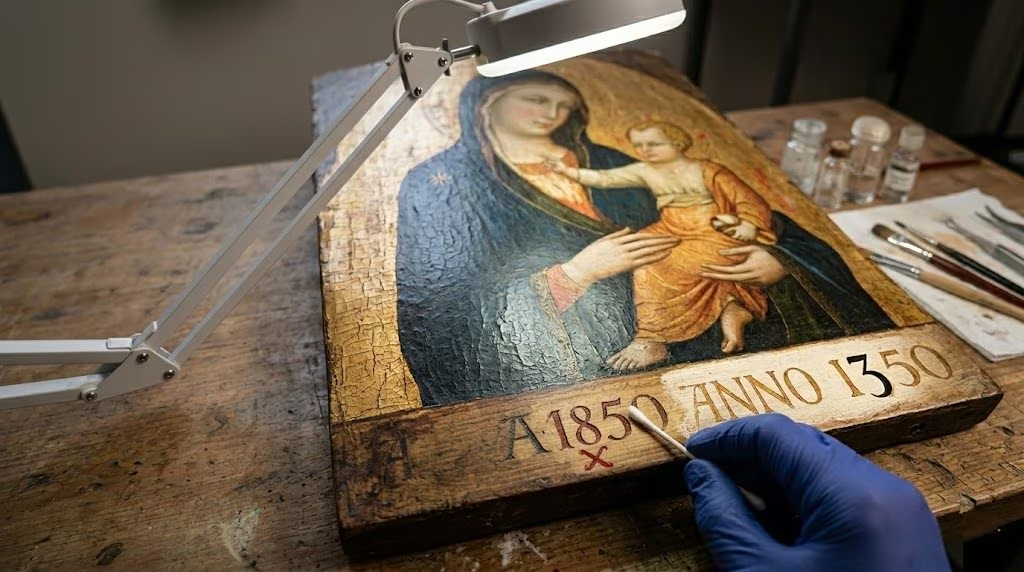
A sensational bureaucratic and evaluation error led Italy to lose a precious masterpiece from 1350, Madonna and Child, by the Master of the Baptistery of Parma. Mistaken for a minor work from 1850, apparently due to an oversight in reading the date, the painting was regularly exported to Switzerland in 2020 and now its value, initially estimated at 38 thousand euros, has turned out to be at least 400-500 thousand pounds (between 460 and 580 thousand euros), leaving the Italian state empty-handed after a long legal battle. The table is now located in a private company in Lugano.
But how is the attribution of a work achieved? As Emanuela Massa, restorer of paintings and art historian, co-founder together with engineer Anna Pelagotti of Art-Test Florence, which deals with diagnostic investigations for works of art, told us, the real problem is that in Italy, as well as at an international level, there are no official and shared protocols.
The attribution error of the Madonna and Child
The work at the center of the story is a Madonna and Child, a tempera on panel which was initially believed to be painted by the non-existent “Alfonso Martorelli Fiori”. Today scholars agree that it is a work by the “Master of the Baptistery of Parma” (also known as the “Master of 1302”), an anonymous Emilian painter of the highest level active in the first half of the fourteenth century. This artist is famous for having created the splendid frescoes inside the Parma Baptistery, including another Madonna and Child enthroned which depicts Bishop Gerardo Bianchi as a donor at the feet of the Virgin.
In 2020, a Swiss company purchased a Madonna and Child at auction for just 38,000 euros – a figure which, for a mid-19th century painting, would have been high. When requesting its export, the Ministry of Culture issued the Certificate of Free Circulation as per procedure, defining the painting as a “modest work” dating back to the nineteenth century. However, during a restoration that took place in October 2022, a surprising truth emerged: the work was not from 1850 as had been thought, but from 1350. The date was simply revealed during the cleaning and restoration operations, in which the presumed “8” turned out to be a “3”. Following this discovery, Christie’s auction house estimated the value of the painting at between 400,000 and 500,000 pounds.
The Ministry of Culture attempted to cancel the expatriation authorization in March 2023, accusing the company of “false indications”, but both the Lazio Regional Administrative Court in 2025 and, subsequently, the Council of State, agreed with the Swiss buyers. The revocation in self-defense, in fact, came too late compared to the maximum limit of 12 months established by the Constitutional Court.
How was it possible to exchange the “3” for the “8” on the date of the painting
The incredible error, as mentioned, arose from a distraction: on the back of the work there was an inscription with a badly worn and worn “3”, which the officials at the Export Office hastily read as an “8”. This meant that the original inscription “year 1350” was mistaken for “year 1850”, supporting the hypothesis that it was a modern tempera on panel which simply reflected the Byzantine style.
The error was unfortunately aggravated by the fact that the Ministry’s experts relied on the documentation provided by private individuals without carrying out adequate technical checks on the work. This is not an isolated case: in January there was a very similar episode concerning a painting by Giorgio Vasari not recognized by the Ministry, for which the State lost the rights again due to a self-defense request invoked late.
As Emanuela Massa explained to us, in the case of the Madonna and Child the problem arose from an incorrect consideration of the good. “From what we can learn, the officials, non-technical art historians, trusted the documentation presented and the mere viewing of the item at the Export Office.”
How to export works of art
When a private individual wants to export – or import – a work even temporarily, he must present valid documentation accompanying the work to the office of territorial jurisdiction: this includes information on the purchase, provenance, any invoice or private intermediation contract, the notarial deed and so on. Subsequently, the private individual, the antique dealer or the gallery who wishes to export a work are required to present all these documents within the SUE online platform, Export Office System, accompanying the documents with high definition photos.
At that point, an appointment is made to do an in-person evaluation. «In our experience, it is not possible – explains Massa – to carry out remote assessments». There is usually a commission of experts who evaluate the work, which decides within the terms of the law to issue or deny the certificate of free circulation, i.e. a recognition of the Italian State which decrees that the work is or is not of interest to the state heritage. If it is and the state is interested in the acquisition, a protective bond can be issued – and subsequent procedures can take years.
«Generally the evaluations are carried out by officials with excellent CVs, – explains Massa. – In this case, to understand what really happened, we should have the relevant documents available.” The main problem is that, to date, there is no shared national or international protocol. There are good practices for recognizing a work, but only at the discretion of the technicians who implement them.
The dating of works of art: historical analysis and the visual method
In general, to discover the age of a painting, three macro-methods are mainly used: visual examination, the study of the technique and materials constituting the work, initially with non-invasive investigations and, only subsequently, with possible microdestructive analyses.
First of all we proceed with the historical-artistic and technical analysis, whereby they study the details of the painting, such as the characters’ clothes, the hairstyles, the type of perspective and even the pigments typical of a certain art school, offering a very precise temporal perimeter. «Science helps us understand whether the technique and the material may not be incompatible with the era hypothesized by the stylistic analysis: in short, it tells us whether the canvas, or the panel as in this case, and the colors existed in that period or not», explains Massa. The final attribution of the hand of a specific master then falls to the art historian. The fundamental rule is that none of these analyses, alone, is sufficiently effective to authenticate a work.
The first step is to obtain a good knowledge of the work through observation and the drafting of a scientific Condition Report, accompanied by imaging diagnostic, with images in diffused light, grazing light, ultraviolet and infrared light, to be able to visualize with the naked eye and with lenses and viewers any retouching or inhomogeneities due to remakes or repaintings and evaluate whether they could constitute a distinction for the authentication of the work. If necessary, any x-rays are also taken and the documentation provided is adhered to. «If the 3 was changed to an 8 and the change was only detected during the restoration phase, I presume there was a retouching or rewriting, which usually becomes visible with analysis and which could have raised some doubts regarding the documents of legitimate ownership and provenance». In these cases, further analysis should be carried out: “as we always say, quoting Leonardo, a small certainty is better than a big lie!”.
The visual ones are non-invasive scientific methods, with techniques that allow the works to be analyzed without affecting them, exploiting different wavelengths of light. After the visual examination, we also proceed to study the canvas or board support, with even more invasive techniques such as color or support sampling. The latter can be analyzed with specific analyzes and can be dated, within the limits of the technique, with Carbon-14 «even if what we are really interested in is what is on the support, because the latter may have been recovered by the forgers, as they also report in their writings».
In fact, forgers buy paintings from all eras at flea markets, even those of no artistic value, scratch off the original color layer until they reach the bare support and paint the “artist’s forgery” on top. To the Carbon-14 test, so the canvas will be authentic from the time. Similarly for paintings on wood, forgers dismember cabinet doors, doors or beams from ancient houses from the same period and geographical area as the artist they want to forge, so dendrochronology will confirm the age of the wood.
In any case, «What we are interested in analyzing is therefore not primarily the support, but what is on top, therefore the pigments and binders. For example, if in a painting I find a synthetic binder discovered, produced and patented in the twentieth century in an area not affected by restoration, this painting cannot be ancient. For example, in some cases vinyl glue, recently invented, or a blue pigment, Phthalocyanine blue, widespread after 1934, is used as a binder. Therefore, even if the documents report it, a painting that contains them will probably not be from the nineteenth century”.
Destructive methods for reconstructing the history of works
For the most difficult cases, “destructive” methods are used, which involve micro-samples of fragments of material (usually a couple of square millimeters in the case of paint film) to carry out more in-depth laboratory analyses.
For wooden boards, as mentioned, the dendroconologywhich measures the thickness of the growth rings of the wooden panel, to establish the year in which the tree was felled. Carbon-14 dating is applied to organic materials such as linen, hemp or wood substrate. Despite having a margin of error, in the most favorable cases of a few decades, it is essential to unmask modern fakes or confirm the antiquity of the support. Even the paper support is interesting: there are in fact watermarks and watermarks that can give data on the production period.
Finally, the stratigraphy involves the micro-fragment being incorporated into the resin and cut on the bias to be studied under the microscope: this allows the exact succession of the layers (primer, colour, varnish) to be visualized, revealing the original executive technique and distinguishing it from subsequent repaintings.
Even in these cases, there is no absolute guarantee: «If a correct protocol is not used and an analysis of microsamples of retouching areas is obtained, an “incorrect” analysis may result».
In each case, it is necessary to understand which is the most effective and respectful analysis of the work, finding a fair compromise. «There is no imaging test in which you can see everything: they are synergistic methods and we need to be aware and aware of what each individual analysis shows us, so that the data is read in a synergistic way, so as to create a map of original, retouched and reworked areas». But, in fact, unfortunately today “each laboratory uses a different protocol and has its own guidelines and the biggest problem is that at an international level there is no protocol: we have been fighting on this type of issue for years, but there has still been no progress in this sense”.